Orange Trees Per Acre Calculator
Estimate orange trees per acre, total trees to plant, row count, tree order allowance, canopy clearance, drip emitters, water flow, and mature fruit yield from orchard spacing.
Choose a planting style, then adjust area, spacing pattern, rootstock vigor, spray lanes, reset allowance, mature canopy diameter, irrigation emitters, and expected boxes per tree.
Orange Tree Spacing Results
Spacing results will appear after calculation.
Calculation Breakdown
| Orange spacing | Trees per acre | Trees per hectare | Best fit |
|---|---|---|---|
| 24 x 24 ft | 76 | 187 | Large standard trees, wide equipment middles, low pruning intensity |
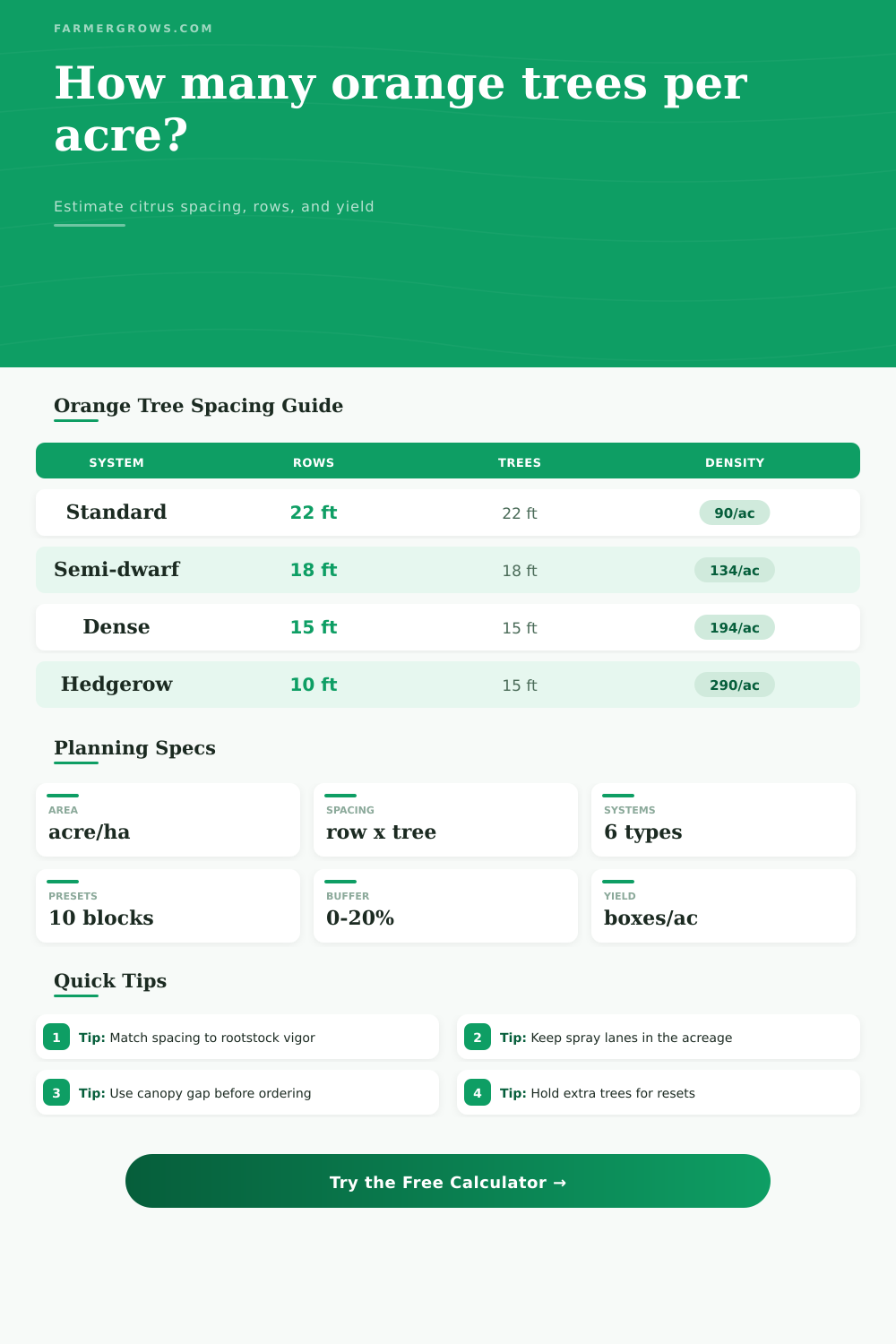
| 22 x 22 ft | 90 | 223 | Traditional orange grove spacing with mature canopy room |
| 20 x 20 ft | 109 | 269 | Balanced sweet orange block on moderate-vigor rootstock |
| 18 x 18 ft | 134 | 332 | Semi-dwarf citrus planting with regular topping and hedging |
| 15 x 15 ft | 194 | 479 | Dense orange spacing where canopy control drives long-term success |
| 10 x 15 ft | 290 | 717 | High-density hedgerow layout with narrow tree spacing |
| Planning item | Typical input | What it changes | Field note |
|---|---|---|---|
| Headlands and perimeter roads | 6% to 12% | Removes acres before tree count | Include turn rows, drains, canals, and loading space in this deduction |
| Service lane every 10 rows | 10 to 14 ft | Reduces net trees per acre | Useful where sprayers, bins, or harvest crews need cross access |
| Reset allowance | 3% to 10% | Adds extra nursery trees to order | Higher allowances fit blocks with replant disease or weak drainage |
| First-year survival | 92% to 98% | Shows likely established stand | Keep survival separate from trees ordered so losses are visible |
| Canopy diameter | 12 to 24 ft | Tests row and in-row clearance | Negative gap means hedging, topping, or wider spacing is needed |
| Spacing style | Emitters per tree | Flow range | Mature yield planning |
|---|---|---|---|
| Wide standard citrus | 2 to 4 | 1.0 to 2.0 gal/hr | Fewer trees per acre, higher boxes per tree when canopy is mature |
| Semi-dwarf block | 2 to 4 | 0.75 to 1.5 gal/hr | Moderate density with easier pruning and balanced crop load |
| Dense hedgerow | 2 to 3 | 0.5 to 1.0 gal/hr | More trees per acre, lower boxes per tree, stronger need for light |
| Backyard grove | 1 to 2 | 0.5 to 1.0 gal/hr | Low total flow but spacing should still respect mature spread |
| Block example | Area | Spacing | Approximate result |
|---|---|---|---|
| Small U-pick grove | 1 acre | 20 x 20 ft | About 109 spots before lanes and reset allowance |
| Commercial navel block | 10 acres | 18 x 18 ft | About 1,340 gross spots before field deductions |
| Juice orange replant | 25 acres | 15 x 20 ft | About 3,630 gross spots before roads and resets |
| High-density hedgerow | 5 acres | 10 x 15 ft | About 1,450 gross spots before service lanes |
Spacing: Orange trees per acre equals 43,560 divided by the effective square feet assigned to each tree. Triangular layouts use 0.866 times row spacing times tree spacing.
Canopy: Compare mature canopy diameter with both row spacing and in-row spacing. Crowded canopies need planned hedging, skirting, and topping.
Ordering: Keep reset allowance separate from net planting spots so nursery orders, replacement staging, and final stand counts stay clear.
Yield: Mature production is estimated from bearing trees and boxes per tree. Young orchards usually produce far less during establishment years.
An orange grove is a geometric puzzle in which you plant living things. How many canopies can I cram into this space? And how will they be spaced so that machines (tractors, sprayers) has enough room to operate?
This choice you make today will determine the cost of your irrigation over the coming decades, the amount of time spent pruning, and even how you harvest. Once those roots grab onto ground, it’s difficult to change course.
How to Space Your Orange Trees
Everyone begins with what feels comfortabley, twenty-two feet by twenty-two feet. The tree has plenty of space to create a full, natural canopy, with no need for excessive hedging. Wide rows accommodates vigorous rootstocks that want to spread out and get big. The downside is having fewer trees per acre, so producing your desired amount require a higher yield from each plant.
With semi-dwarf rootstock, you may narrow the grid to eighteen feet by eighteen. That will raise tree numbers to roughly one hundred thirty-four per acre. This could boost overall volume output but it will require closer canopy attention to allow light to reach middle of rows.
These calculations are simple enough, though it’s possible to get them wrong if you include the reality of working in the field. For example, you’re not going to plant on every single acre. There are service lanes, drainage ditches, and headlands where equipment turn around or crosses the block. All of these reduce the actual area planted. Eight to ten percent is typical for these types of reductions.
And if you skip this part of the equation, well then you’ll go ahead and over-order, crowd the outside and create an unruly and unwieldy edge. Once you enter dimensions of your block, as well as lane preferences, the calculator takes care of the rest, saving you the headache of doing any mental math while you try to envision the grove.
The other number many beginners mess up with is the reset allowance. Trees will die. Frost will kill them. Disease will take its toll. The soil won’t drain well enough for some to really get going.
Be smart: Order an extra five to ten percent just in case, because these trees are insurance against holes in your canopy that will lead to lower yields and less light catching. A uniform stand of tree is what you want, not a patchwork of established ones and open spots where nothing grows.
Density scales watering as well. Use smaller emitters spaced closer together or bigger emitters with greater spacing to moisten the shallow root zones of dwarf trees in thick plantings, perhaps more often but at low flows. You can provide deeper-rooting conditions for a broad soil profile by watering less frequent with bigger emitters in wider spacing. (The table of emitter flow rates, by spacing style, on the page will help you get the math right, so you can properly size laterals and pumps before the first shovel flies.) Better to plan for eventual water needs now than to try to retrofit the pipes.
The main question is how to maximize both accessibility and density. The answer lie in how many hours are spent pruning to maintain a manageable width. Higher-performing wide systems cost less over the long term in terms of canopy management but require greater per-tree performance. Hedgerows high in tree density yields higher immediate rewards, but they demand that you apply discipline to maintain smaller trees.
Consider the width limitations of your machinery and amount of available labor prior to settling on a number. Knowing these limits helps the math fall into place and allows you to proceed with confidence.