Lemon Trees Per Acre Calculator
Estimate lemon trees per acre, total tree order, rows, in-row count, canopy clearance, replacement allowance, drip emitters, lateral length, and mature fruit potential from orchard spacing.
Choose a citrus spacing pattern, then tune the area, rootstock vigor, headlands, replants, mature canopy diameter, emitter count, and target fruit load.
Lemon Tree Spacing Results
Spacing results will update as you edit the block.
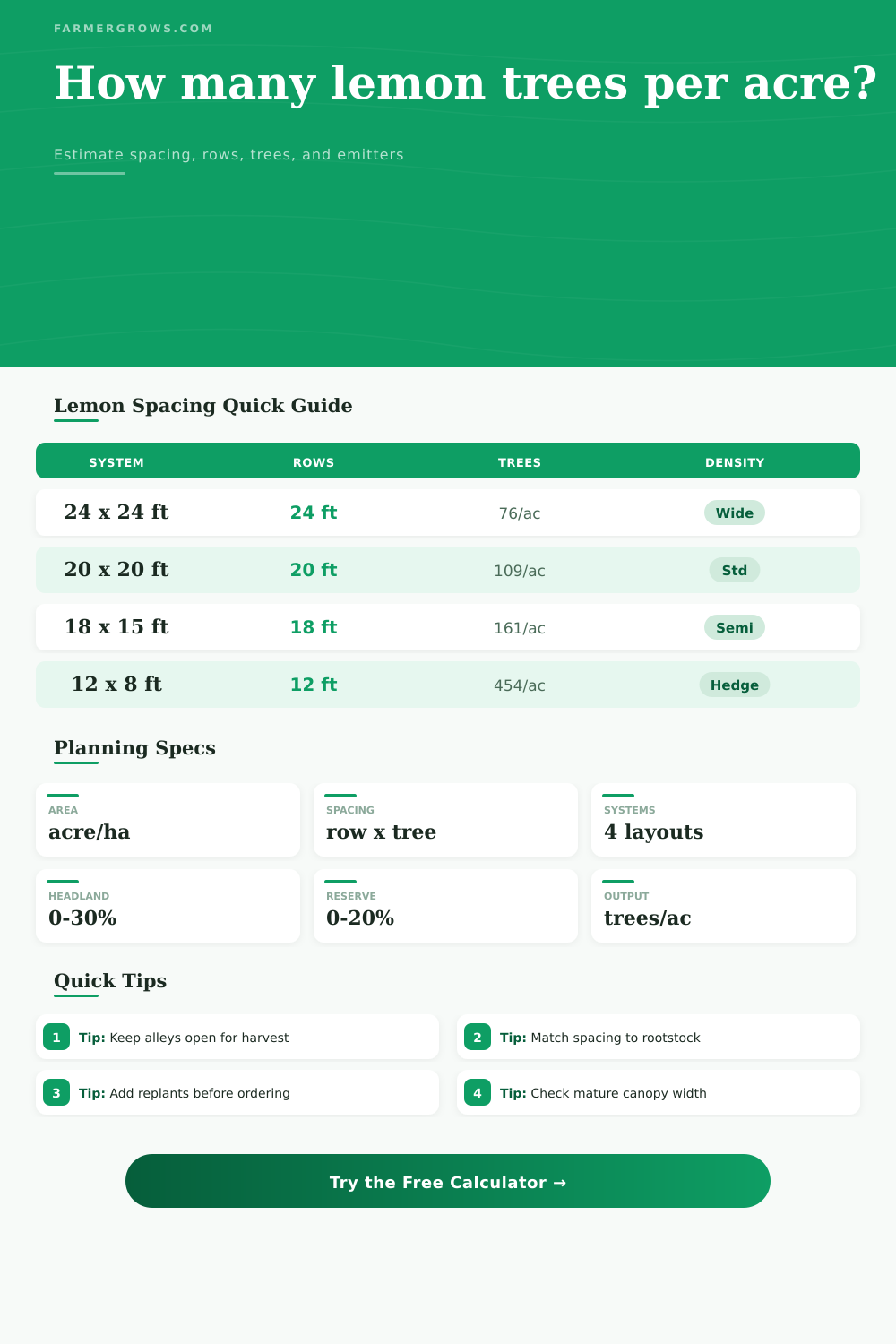
| Spacing | Trees per acre | Trees per hectare | Typical use |
|---|---|---|---|
| 24 ft x 24 ft | 76 | 187 | Large standard lemons, wide sprayers, long-lived canopy. |
| 22 ft x 18 ft | 110 | 272 | Moderate commercial blocks with still-open alleys. |
| 18 ft x 15 ft | 161 | 399 | Semi-dwarf blocks with planned pruning passes. |
| 16 ft x 12 ft | 227 | 561 | Smaller rootstocks or aggressive canopy management. |
| 14 ft x 10 ft | 311 | 769 | Tight row systems where hand harvest access is managed. |
| 12 ft x 8 ft | 454 | 1122 | High-density hedgerow trials and intensive lemon blocks. |
| Pattern | Formula used | What changes | Planning note |
|---|---|---|---|
| Rectangle grid | 43,560 / row / tree | Base spacing only | Most common starting point for lemon blocks. |
| Staggered grid | Footprint x 0.866 | About 15.5% denser | Can improve fill but makes row operations more complex. |
| Double row | Tree x average row | Uses pair and alley | Separates narrow tree rows from wider equipment alleys. |
| Custom area | 43,560 / sq ft each | User supplied | Useful for maps, terraces, or spacing from a consultant. |
| Tree age or system | Emitter count | Common flow | Layout note |
|---|---|---|---|
| Young tree | 1 to 2 | 0.5 to 1 gph | Keep wetting pattern near the young root zone. |
| Semi-dwarf lemon | 3 to 4 | 1 gph | Expand emitters as canopy and feeder roots spread. |
| Standard tree | 4 to 6 | 1 to 2 gph | Use soil type and irrigation set length to size zones. |
| Hedgerow | 2 to 4 | 0.5 to 1 gph | Often uses continuous laterals along each tree row. |
Canopy check: If the mature canopy diameter is larger than row or in-row spacing, treat the result as a hedged orchard count, not a free-standing tree count.
Ordering check: Keep the reserve percentage separate from skipped spots so the tree order reflects both mapped holes and young-tree losses.
Spatial calculations is left to calculator (above) to do the hard work of computing square feet. Then you can focus on growing things, instead of calculating how to plant them. The calculator turns wishes of having an orchard into a precise row count, replacement number and even irrigation line details. That’s what separates a plan from a Excel mistake.
Sure, you may grow the best rootstock and have the richest soil… But plant your lemon trees too far apart and you’ll be battling your own tree canopy or machinery for the better part of a decade. Your second choice: how dense do you want to plant? If you’re in it for the long haul, your instinct may tells you to squeeze as many trees as you can onto an acre, which makes sense: cramming them all in at once means you’ll get your money’s worth faster. But then you find yourself with a jungle of trees that neither harvester nor sprayer can access.
How to Plan Your Orchard Layout
You can set the density manually using the drop-down menu, such as “wide” layout with trees twenty-four feet apart both ways. Or, you can just drag slider to see what works best for you. Keep in mind that tight hedgerows require lots more trees initially and mean doing some serious cutting back later. Planting wide lets you use big equipment and won’t stretch your hedging dollars so far. Planting closely requires fewer tree per row but a heckuva lot more rows. Will you run a factory or a forest? The app calculates the tradeoff in real time.
That’s followed by the harsh reality of the land itself. In the real world, there is no perfect rectangles. You probably have some access roads cutting across your property, or drainage ditches, or irregular borders that gobble up some of the available planting space. Until the day the truck pulls up with less trees than expected, most growers don’t factor in that wasted space. By using skipped spots and headlands as data you can subtract the unproductive acreage before placing your final order. It sounds like nothing, a small percentage, but it keeps you from purchasing more tree than you’ll ever be able to plant.
It is equally important to add a reserve for replants. Young citrus trees is fragile things. A few saplings won’t make it past their first year, thanks to wind, disease, or simple transplant shock. Buying extras now is far less expensive then running around trying to find trees at the end of the season when none are to be had.
Guesses are expensive. Take water. Moddern citrus is drip irrigated, obvious, but what’s not obvious? How far do the lateral lines has to run? How many emitters do I really need? What kind of system should I size? The calculator tells you both lateral length and total number of emitters required (it factors in your row configuration). Now you can budget pipe and filters before breaking ground.
And then there’s the issue of mature canopy size. Planting trees closer together than they’ll grow wide means cutting back fruit-bearing wood as they gets bigger to avoid contact. You lose money by cutting your own tree to save space. The tool warns if you are planting with a tight canopy clearance. You should of liked hedge rows, because it does not want to be free standing.
Bottom line: Planning a lemon orchard involves understanding what fits; how dense can you get while keeping it all accessible? How do you achieve profitability from the land without losing track of the crop? A few reference charts on the page give an instant glimpse into typical industry spacing. From wide commercial layouts to more dense hedgerows (and everything in between). But remember, these aren’t laws; they’re starting points. They’ll be informed based off your particular circumstances: climate, labor availability, soil type, etc.
After crunching your own numbers using the tool, you’ll have not only a sense of how much you should order, but also a definitive layout plan. You’ll know precisely how many trees you need to purchase, how many emitters to install and whether or not you’ll be able to fit your tractor into the rows. That’s when a blank piece of land becomes a manageable business, and instead of regretting your first harvest, you’ll be celebrating its growth.