Oak Trees Per Acre Calculator
Estimate oak trees per acre, total seedlings, practical order quantity, surviving stand, final crop pressure, row count, and average row length from oak spacing and plantable acreage.
Choose a practical oak spacing plan, then tune the area, layout pattern, headlands, survival, replacement reserve, and final crop target for your site.
Tighter spacing raises early crown competition and leaves more stems for later thinning.
Moderate spacing balances acorn production, sunlight, and room for mixed understory planting.
Wide oak spacing keeps grass or forage light available while preserving long-term crown spread.
The calculator separates clean planting density from reserve seedlings and expected survival.
Oak Planting Results
Your oak spacing estimate will appear here.
| Oak spacing | Square trees/ac | Triangular trees/ac | Planning fit |
|---|---|---|---|
| 6 x 6 ft | 1,210 | 1,397 | Nursery liner blocks, biomass trials, or very dense selection plantings. |
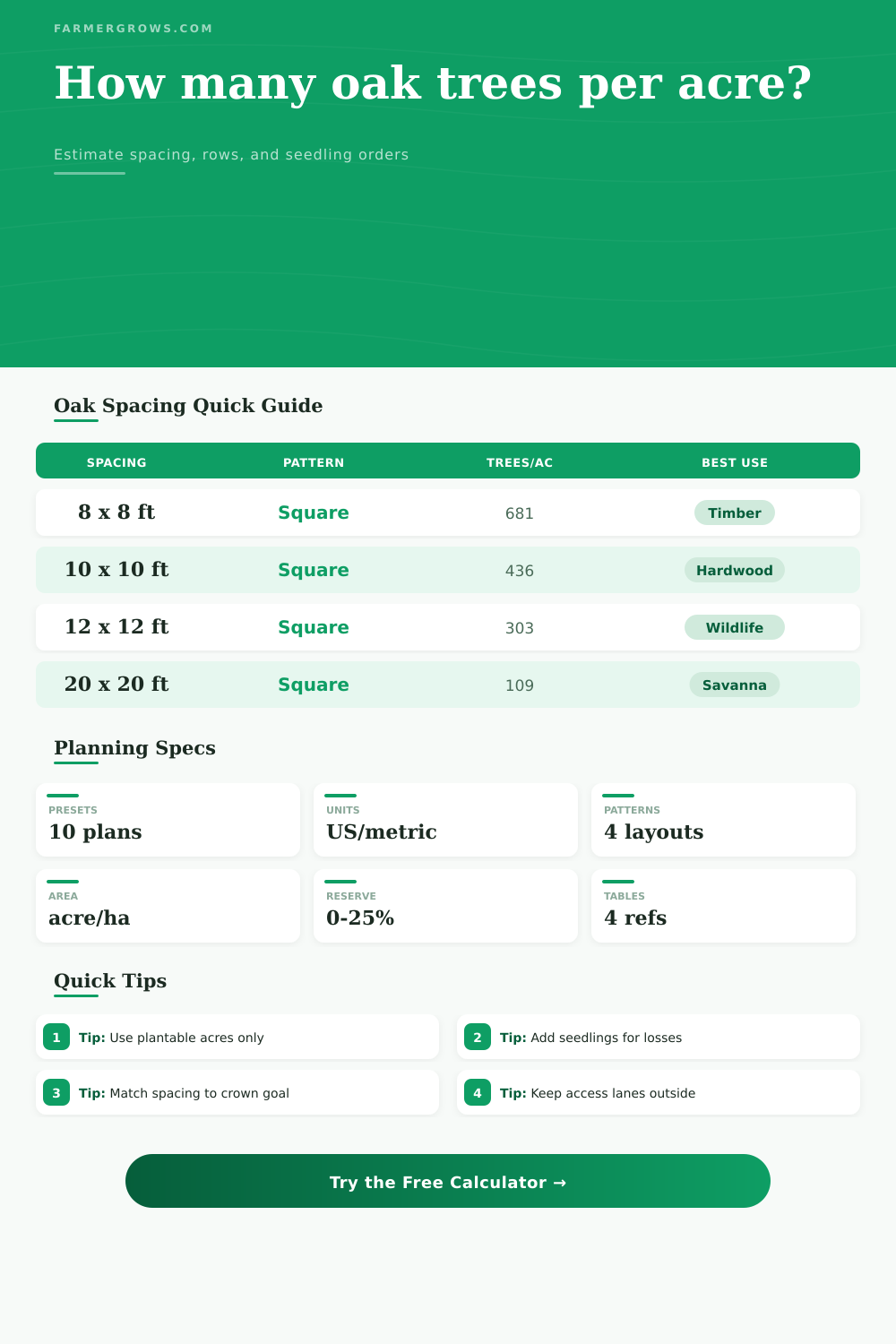
| 8 x 8 ft | 681 | 786 | Dense timber establishment, riparian buffers, and sites with expected mortality. |
| 10 x 10 ft | 436 | 503 | Balanced oak timber density with room for later thinning decisions. |
| 12 x 12 ft | 303 | 349 | Mixed hardwood restoration and wildlife plantings with easier maintenance access. |
| 16 x 16 ft | 170 | 197 | Mast orchard, shelterbelts, or lower competition plantings. |
| 20 x 20 ft | 109 | 126 | Savanna, silvopasture, and wide-crown oak plantings. |
| Planting goal | Common initial spacing | Typical survival assumption | Final crop note |
|---|---|---|---|
| Oak timber or veneer | 8 x 8 to 12 x 12 ft | 75% to 90% | Often managed toward 40 to 80 high-quality crop trees per acre. |
| Mixed hardwood restoration | 10 x 10 to 14 x 14 ft | 65% to 85% | Species mix matters as much as exact oak density. |
| Wildlife mast orchard | 15 x 15 to 25 x 25 ft | 80% to 95% | Wider crowns improve acorn access and understory light. |
| Oak savanna or silvopasture | 25 x 25 to 40 x 40 ft | 85% to 95% | Final spacing is usually designed around crown spread and grazing lanes. |
| Riparian buffer | 8 x 10 to 12 x 12 ft | 60% to 85% | Flood, browsing, and weed pressure often justify reserve seedlings. |
| Area example | Plantable acres | 10 x 10 ft square | 12 x 12 ft square |
|---|---|---|---|
| Half-acre oak pocket | 0.50 ac | 218 trees | 151 trees |
| One-acre homestead block | 1.00 ac | 436 trees | 303 trees |
| Five-acre timber start | 5.00 ac | 2,178 trees | 1,513 trees |
| Ten-acre restoration field | 10.00 ac | 4,356 trees | 3,025 trees |
| Twenty-acre hardwood stand | 20.00 ac | 8,712 trees | 6,050 trees |
| Conversion | Value | Use in calculator | Field note |
|---|---|---|---|
| 1 acre | 43,560 sq ft | Base area for trees per acre | Density equals area divided by spacing footprint. |
| 1 hectare | 2.471 acres | Metric area entry | Results show trees per hectare as a cross-check. |
| 1 meter | 3.28084 ft | Metric spacing entry | The script converts spacing to feet internally. |
| Triangular pattern | 0.866 footprint | Raises density about 15% | Useful only when rows are truly staggered. |
Separate planting density from final density. Oak timber plantings often start with many more stems than the eventual crop-tree target so natural selection and thinning have room to work.
Keep unplantable area out of the order count. Lanes, turnarounds, ponds, creeks, powerline offsets, and rocky patches can change seedling orders more than a one-foot spacing tweak.
To most eyes, a forest consist of nothing more than just trees. But when it comes to growing oaks, planting them with purpose requires careful planning. Mother nature doesn’t work according to your schedule or dollar amount. One of the first decisions you make before planting can mean the difference between growing timber or weeds. And that decision is spacing.
Spacing impact wood quality, resource competition and light level. Spacing affects whether you are growing firewood, or furniture grade wood. This means doing the math. And that’s where the calculator comes in on this page. But the numbers don’t tell whole story.
Choosing the Right Spacing for Your Trees
Selecting a planting method is selecting a management system. By planting close like eight feet by eight feet, you force trees into early competition. That forces straight, upright growing trunks. It encourages clean grain in the wood and it keeps down lower branches. The mills reward that quality wood with higher prices. Why do you plant tight? Because they’ll take most all your trees out later so the ones left can stretch out and be large trees. It is about quantity versus quality.
But then there’s wide spacing. For a savanna landscape or if you wish to feed wildlife, space them at least twenty by twenty feet, or even farther apart. Remember: You don’t need tight grain; you want a big crown for shade and acorn production. I will point out again that the number of seedlings decreases as gaps widen. People tend to purchase their seedlings by the thousand so they might not factor this in.
Wider spacing means fewer trees, but more land to maintain, such as clearing away grass that chokes off saplings in open areas.) No piece of actual land is perfect. No acre will be perfectly rectangular and completely plantable. There are wet spots, fence lines, rocks, and ditches that can kills your oak seedlings. With the tool you can subtract out a percentage for such areas. Many people forget to do this.
A lot of beginners will order trees based off their gross acreage. This results in too many trees for usable space and not enough for the edges. It’s also important to add a reserve for losses from poor planting technique, drought, deer and other things. In the first three years you lose trees to drought, deer, and poor planting techniques. And on some sites an assumption of 85% survival are optimistic. If you order just what you think you need, there will be gaps. What happens with gaps? Weed growth. What happens when weeds grow? They dominate area.
Set expectations with reference tables. Say, how many trees per acre? How about 400 or so in an area of ten by ten feet? That’s a typical starting point for timber operations. Increase density by switching to a triangular pattern. Better yet, the trees is staggered, increasing the efficiency of root space. This little change saves money on seedlings and maintains canopy closure.
Don’t worry. No math formulas to remember. Just move the sliders and the interface will update row counts and density.
Planting oaks involves both short-term and long-term thinking. You pay the expense now, but you get the reward over decades. Make sure you gets the plan correct from the start so as not to pay for wrong turns twice. Whatever your reason for planting, a timber block or a field restoration project, the arithmetic is straightforward. The execution looks ahead.
Run the numbers through scenarios using inputs provided. How does spacing affect the total number of trees at maturity and subsequent seedling purchase order? What’s the impact on your finished forest? It won’t be long until you know the trade-offs. The figures will guide your decisions like a roadmap.
Where do I plant my trees? How many should I buy? What forest am I building?