Teak Trees Per Acre Calculator
Estimate teak trees per acre, seedling order count, planted rows, reserve plants, thinning removals, final crop stems, canopy room, and hectare equivalents from spacing and stand goals.
Pick a starting teak layout, then tune the field shape, spacing pattern, road deduction, survival, seedling reserve, thinning intensity, and target final crop stems.
Teak Stand Estimate
Spacing and thinning results will appear here.
Calculation Breakdown
| Teak spacing | Trees per acre | Trees per hectare | Best fit |
|---|---|---|---|
| 14 x 14 ft | 222 | 549 | Veneer log goal, wider crowns, fewer early thinnings. |
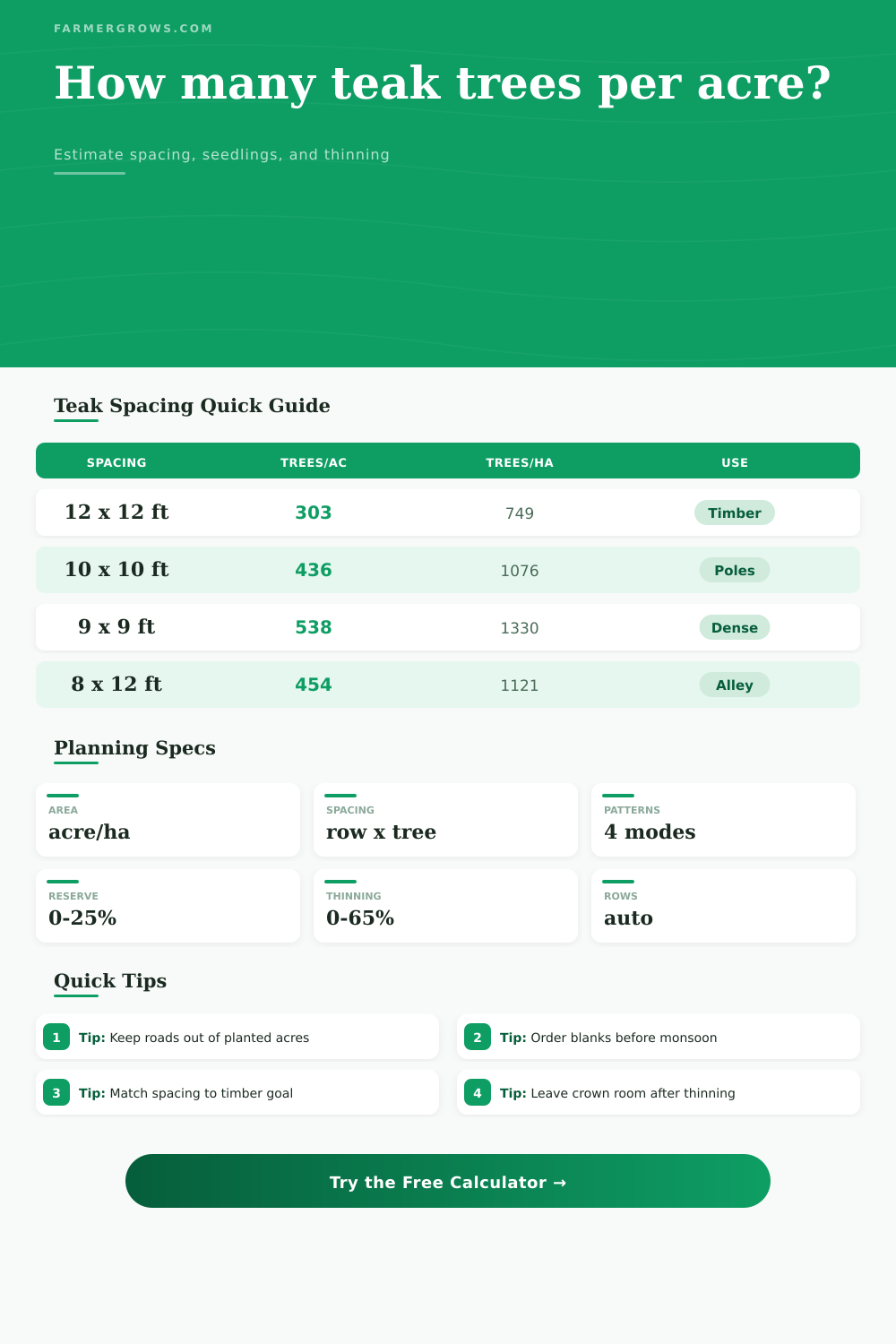
| 12 x 12 ft | 303 | 749 | Balanced saw timber planting for many small plantations. |
| 10 x 10 ft | 436 | 1,076 | Higher selection pressure with planned thinning removals. |
| 9 x 9 ft | 538 | 1,330 | Fast canopy closure where early pole thinning is expected. |
| 3 x 3 m | 449 | 1,111 | Metric teak spacing often used for plantation planning. |
| Thinning plan | First removal | Second removal | Final stand intent |
|---|---|---|---|
| No scheduled thinning | 0% | 0% | Use only for very wide spacing or short rotations. |
| Light thinning | 20% | 15% | Keeps more stems while removing weak and forked trees. |
| Standard timber | 30% | 25% | Moves a 10 to 12 ft stand toward larger final stems. |
| Heavy quality selection | 40% | 35% | Best for dense plantings where final log quality matters. |
| Example block | Area | 12 x 12 ft trees | 10 x 10 ft trees |
|---|---|---|---|
| Smallholder trial plot | 0.25 acre | 76 spots | 109 spots |
| One acre timber block | 1 acre | 303 spots | 436 spots |
| Five acre plantation | 5 acres | 1,513 spots | 2,178 spots |
| Two hectare block | 4.94 acres | 1,495 spots | 2,151 spots |
Separate land loss from spacing. Roads, firebreaks, drains, and loading strips should be deducted before comparing teak trees per acre between designs.
Use thinning as a design input. Dense teak spacing can work when weak, crooked, or suppressed stems are removed before crowns close too hard.
When most people begin thinking about teaks, they stare at a field and guess how many seedlings they needs to plant. Plug in your spacing and survival rate, and the calculator does the math for you. You will have no more guesswork with conversions and coefficients, and no more vague plans but a concrete planting schedule.
But the tool is only as good as the strategy behind it, and that’s where the real profit (or loss) lies. You don’t grow teak and go. Teak is a timber asset you manage every single year. You do this from year one through to harvesting in order to get the most out of your trees.
How to Plan Your Teak Plantation
Your success or failure as a plantation owner can hinge on how densely you planted it. Planting too sparsely means wasted land covered in grass that slows growth of your trees. Plant too densely and you’ll have trees competing for light, leading to crooked stems that is worthless for high-grade lumber.
The calculator adjusts for expected survival rates and accounts for roadways, firebreaks, and more. This helps you find that sweet spot. It is the middle ground where there isn’t any wasted space and you are actualy calculating live stems instead of just theoretical planting holes.
So, how do we space? One standard is a dozen by a dozen feet (a twelve by twelve foot grid). That’s just enough distance between trees to allow for mechanical equipment to pass throughout the stand as time goes on, but still provides some support from neighboring tree in the meantime.
For veneer logs, consider going wider. For earlier harvesting (poles) or immediate cash flow you may wish to go tighter. These options are pre-set in the calculator, but you’ll have to know what each option will cost you in terms of money and time. Going dense means more plants, which equals more labor for weeding and also more competition. You gotta be ready to cull.
The aspect of growing teak that is underestimated by new growers is the need for thinning. Teak takes a long time to mature. Planting too densely doesn’t work; you can’t plant three hundred an acre and think they’re going to grow into quality logs.
How do I know? There’s a plan for thinning included with the tool, and it tells you what number stem count will result from each round of thinning. Why does this matter? Thinning isn’t just about clearing up space. It’s also income. You sell the thinnings (which may be good-quality poles), and that money pays the bills to keep the rest of your trees standing.
If you skip thinning, you end up with a tangle of weak trees. These are easy targets for disease and wind throw. In that case, no one is happy.
The tool will show you total number of stems left at the end of calculation. But out there in the field, it’s your eye that says who stays and who goes.
The other factor that brings this calculation back down to earth is survival rates. Nobody gets all their seedlings. Some will die despite your best efforts at planting. So the calculator requests both a reserve count and what percentage survival rate you expect. That reserve amount is your insurance policy, the additional seedlings you purchase (or propagate) as backups from another supplier or nursery to plug those inevitable holes. Don’t order just the exact number of spots the calculator figures. Because then you’re going to be disappointed. Always allow for that buffer. A little price to pay for big-time peace of mind.
Plantation geometry. A rectangular grid is simple to measure and all that, but it’s not as space efficient. Staggering the rows, or even planting in triangles gives you a little more wiggle room without adding much competition. This is taken into account with the calculator. Depending on which pattern you choose, the overall tree count will be adjusted to match. On paper, it may seem like a small difference, but when you’re dealing with hundreds of acres, it translates into a significant number of additional trees.
So in summary: Match the density to the market that you’re selling into. If you are raising timber for high value veneer then you want clean stems and wide crowns. But maybe you have poles for fencing, so volume is what’s important than perfect stems. Your business plan determines the strategy. The calculator provides the numbers.
Run some scenarios. How would increasing or decreasing the row spacing impact my seedling order? What does aggressive thinning do for my yield? Once you know the trade-offs, the numbers aren’t abstract anymore; they begin to speak the language of your future stand.
It is about having clear goals, acting at the right time, and controlling growth. Make space for the unexpected. Plan for the thinning, start with the spacing. And then let the trees tell you if you got it right.