Walnut Trees Per Acre Calculator
Estimate walnut trees per acre, total plantable spots, row count, pollinizer trees, replacement order, mature canopy clearance, drip emitters, and irrigation lateral length from orchard spacing.
Choose a walnut spacing scenario, then adjust block shape, tree vigor, equipment lanes, pollinizer share, reserves, canopy diameter, and drip hardware for the orchard you are planning.
Walnut Orchard Spacing Results
Results update as you change area, spacing, and orchard adjustments.
| Walnut spacing | Square grid trees/ac | Triangular trees/ac | Typical use |
|---|---|---|---|
| 40 x 40 ft | 27 | 31 | Black walnut, timber, very wide canopy, or low-input grove spacing. |
| 35 x 35 ft | 36 | 41 | Large-vigor site where shade and equipment clearance matter most. |
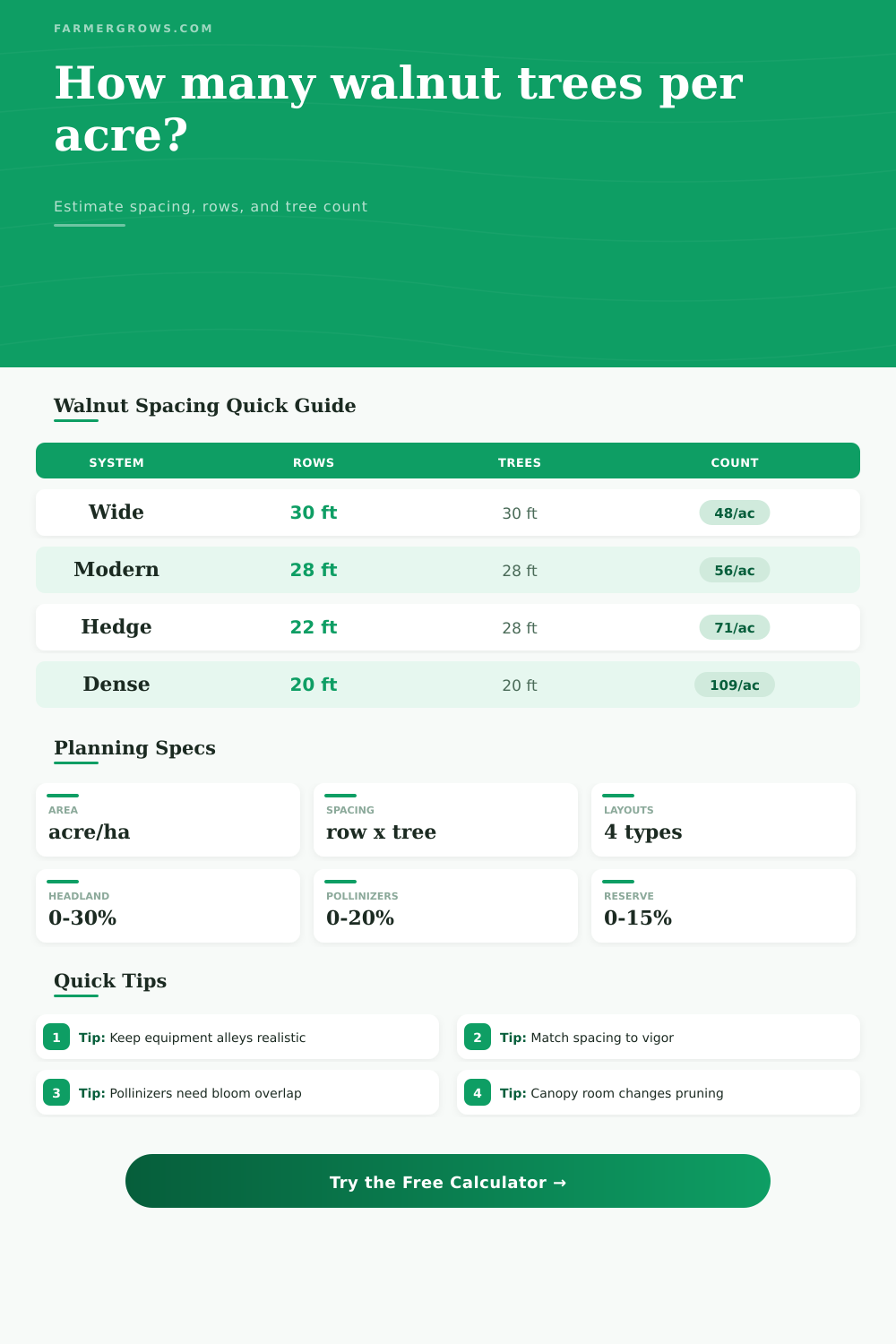
| 30 x 30 ft | 48 | 56 | Traditional English walnut spacing with generous mature canopy room. |
| 28 x 28 ft | 56 | 64 | Moderate-density commercial planting for balanced light and access. |
| 26 x 26 ft | 64 | 74 | Compact modern layout where pruning and row traffic are planned. |
| 24 x 24 ft | 76 | 87 | Higher density orchard with earlier canopy fill and tighter rows. |
| 22 x 28 ft | 71 | 82 | Hedgerow row spacing with more room for machinery than square dense blocks. |
| 20 x 20 ft | 109 | 126 | Very dense planting where vigor, pruning, and light interception must be managed. |
| Block size | Gross acres | 28 x 28 ft trees | 30 x 30 ft trees |
|---|---|---|---|
| Backyard test block | 0.25 ac | 14 trees before roads | 12 trees before roads |
| Small orchard block | 2 ac | 111 trees before roads | 97 trees before roads |
| Quarter field | 10 ac | 556 trees before roads | 484 trees before roads |
| Commercial block | 40 ac | 2,222 trees before roads | 1,936 trees before roads |
| Planning item | Low value | Common value | High value |
|---|---|---|---|
| Headland and roads | 4% | 8% to 12% | 20%+ |
| Pollinizer trees | 3% | 8% to 12% | 15% to 20% |
| Replacement reserve | 2% | 5% | 10%+ |
| Establishment survival | 90% | 95% to 98% | 99%+ |
| Canopy signal | Clearance result | Orchard meaning | Planning note |
|---|---|---|---|
| Gap over 8 ft | Open | Slow canopy fill and easy equipment access. | Often wider than needed for compact cultivars. |
| Gap 3 to 8 ft | Balanced | Reasonable mature light lanes with planned pruning. | Good planning zone for many walnut orchards. |
| Gap 0 to 3 ft | Tight | Canopy touch is likely as trees mature. | Use hedging, topping, or wider row spacing. |
| Negative gap | Crowded | Canopy diameter exceeds spacing. | Recheck vigor, cultivar, and removal strategy. |
Pollinizer planning: Walnut pollinizer trees should be distributed across the orchard, not parked in one corner, because wind direction and bloom overlap can change the effective pollen supply.
Order quantity: Use the calculated plantable trees for layout maps and the reserve quantity for nursery ordering, so replants do not distort the target tree density.
Canopy clearance: A dense walnut block may look efficient on paper but can lose value if mature canopies shade nut wood or close equipment lanes too early.
Drip length: The lateral estimate assumes average row length from plantable area; final irrigation design should follow surveyed row lengths, slope, pressure, and zone size.
Spacing out a walnut orchard isn’t as easy as drawing a dot-to-dot. Every tree you plant is a bet for its own future size, where it’ll find sunlight, where it’ll stretch for more soil to sip water from, where it’ll grab a little nutrient while it’s at it. Sure, many farmers begin with an approximation about how far apart their trees should be planted, but then they stumble over all those overhead expenses that can’t be seen. With this calculator, you input your preferred spacing and block size, and it does the rest of the equation for you: no need to convert or cull through coefficients; just plug and chug and transform acres of abstraction into actual rows and trees and irrigation requirements.
“The most common mistake by a new grower is they look at gross acres and don’t consider their unusable edges. The road, fence line, you can’t go all the way out there with your equipment; there’s got to be room for it to turn. Then there have to be service lanes for spray rigs and harvesters to run down the row, not crush the edge of trees. That tool automatically takes into account the road deductions and headlands, and it removes the non-productive land so you’re seeing what you actualy plant. It’s a little change on the input side, but it greatly impacts the number of trees that come out in the end. People who think every square foot is plantable ends up with overcrowding in the middle or coming up short.
Why Walnut Tree Spacing Matters
The trade-off: More trees means higher yield (you’ll have a lot sooner), but wider means less need for aggressive pruning (easier) and more room for each individual tree to fill out on its own (less work). Higher density mean faster closure and quicker full production. Wider spacing means fewer trees, which leads to slower closure and later production. You can run through both of those scenarios side-by-side on the calculator, and see just how much more tightly-packed you’re going to have to get. What impact does that have on when you place your first order of stock?
Another variable (and the one I typically forget about till my planting crew arrives) is the need for pollinators. Walnuts do not reliably self-pollinate: A mixture of varieties with varying bloom periods are required. With the tool you can specify what percent are pollinizers and where they go on the plot. They should not be clustered in far corner, but spread throughout the plot so that pollen travels well from one end of the block to the other via the wind.
And then there’s the question of those who don’t make it; no matter how carefully planted, not every tree thrive in its first year of establishment. Adding an extra few percent as a reserve to the amount ordered protects you down the road against holes in the future. It’s inexpensive insurance.
The rest is tied together by irrigation design… Your rows and trees dictates exactly how long each lateral line needs to be and how many drip emitters it will have. A tightly spaced orchard need far more drip line than a widely spaced one; the calculator’s estimate takes into account your desired pattern so that you can budget for hardware before ever breaking ground. How much drip line do you really need? One thousand feet or three thousand? That impacts zone pressure and pumping capacity.
Bottom line: Adjust the spacing to fit your level of pruning tolerance and your soil vigor. Compact varieties can live in tighter quarters; vigorous ones need a bigger space; deep soils demand more room. There is no single perfect answer, and the right answer is whatever fits your land… And yourself.
To see for yourself, consult the grid-table on the page. It explains how different spacings affect the density. Then, use your own instincts with the numbers. An orchard is a balance of sunlight, air flow, and equipment access. Do the spacing correctly from the beginning and the trees will reward you for decades to come.