Pounds of Potatoes Per Acre Calculator
Estimate potato pounds per acre from planted area, row spacing, harvested stand, tubers per plant, average tuber weight, harvest recovery, cull loss, storage shrink, and field size.
Load a realistic crop setup, then replace the values with your own stand counts, size samples, grade-out, and storage assumptions.
Potato Pounds Per Acre Results
Your potato yield estimate will appear here.
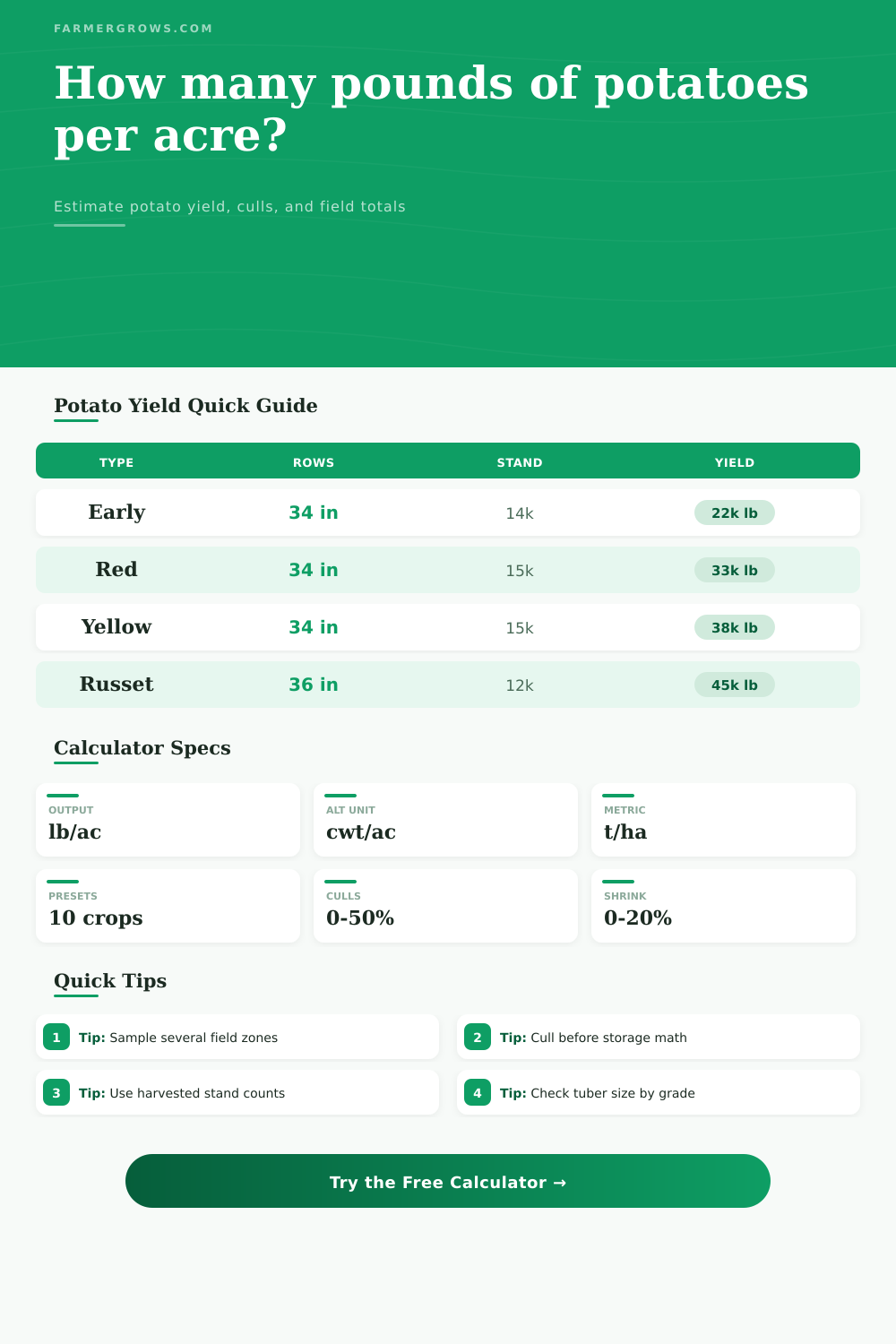
| Crop or condition | Typical lb/ac range | Cwt/ac range | Planning note |
|---|---|---|---|
| Early or new potatoes | 18,000 to 30,000 | 180 to 300 | Shorter season, smaller tubers, fast fresh-market turn |
| Red or yellow fresh market | 28,000 to 42,000 | 280 to 420 | Grade-out and skin finish can shift marketable pounds |
| Russet storage potatoes | 35,000 to 55,000 | 350 to 550 | Strong bulking with storage shrink after harvest |
| Processing potatoes | 42,000 to 62,000 | 420 to 620 | High tonnage, but solids and defects still matter |
| Row x in-row spacing | Seed pieces per acre | At 90% stand | Use case |
|---|---|---|---|
| 32 in x 9 in | 21,780 | 19,602 plants | Specialty or fingerling production |
| 34 in x 10 in | 18,449 | 16,604 plants | Dense red or seed lots |
| 34 in x 12 in | 15,374 | 13,837 plants | Common fresh-market layout |
| 36 in x 15 in | 11,616 | 10,454 plants | Large russet sizing pattern |
| Marketable yield | Pounds per acre | Tons per acre | 50,000 lb loads |
|---|---|---|---|
| 250 cwt/ac | 25,000 lb/ac | 12.5 tons/ac | 0.50 load/ac |
| 350 cwt/ac | 35,000 lb/ac | 17.5 tons/ac | 0.70 load/ac |
| 450 cwt/ac | 45,000 lb/ac | 22.5 tons/ac | 0.90 load/ac |
| 550 cwt/ac | 55,000 lb/ac | 27.5 tons/ac | 1.10 load/ac |
| Sample check | Good practice | Calculator field | Why it matters |
|---|---|---|---|
| Stand count | Count living hills in several row lengths | Harvested stand survival | Missed hills reduce pounds before tuber size is considered |
| Tuber count | Dig representative plants by zone | Marketable tubers per plant | Sets the number of saleable potatoes produced by each plant |
| Size sample | Weigh graded potatoes and divide by count | Average tuber weight | Large changes in size move pounds per acre quickly |
| Grade-out | Separate culls, oversize, undersize, and defects | Cull and grade-out loss | Gross field weight is not the same as marketable yield |
Run zones separately: Estimate hilltops, low areas, irrigated spans, and headlands as separate entries before averaging the whole field.
Use marketable weights: If your sample includes culls, set cull loss carefully so pounds per acre match saleable or storable potatoes.
Check sizing date: A sample taken before vine kill can understate final pounds if the crop is still actively bulking.
Separate storage shrink: Keep field yield, grade-out, and storage shrink as separate steps so harvest planning stays clear.
Estimating yield isn’t guessing; it’s math. To calculate yield per acre, you must convert the number of hills, size of tubers and loss rate to pounds per acre. Every variable diminishing your yield matter. And the calculator (above) do the math for you.
Most growers begin with stand survival and row spacing. With a starting population of about 15,000 seed pieces per acre (assuming that you planted in 12-inch hills within 34-inch rows), there’s often less stand survival than what was planted. For instance, if only 92 percent survive, there’ll be almost 1,200 empty hill with nothing but air to show for it, resulting in zero marketable potatoes. Count the number of surviving hills rather than those you planted. It’s an easy way to avoid overconfidence! The tool tell you precisely how many plants are alive to do the job.
How to Estimate Your Potato Yield
But you’ll also want to know about the tubers themselves. How many do they produce? How much do they weigh (on average)? How does that all stack up? Digging a sample will tell you average weights and number of marketable tuber per plant. So if you find, for instance, that your tuber sample averages 5.8 ounces and there were six tubers, then things starts taking shape in the math.
But don’t forget: You’re not getting everything back at harvest time. Not all potatoes gets picked up by the harvester. Some shatter; some roll into the windrow; some stay buried in the ground. Ninety-two percent might be generous given tough growing conditions or heavy soil. If it’s lower, your eventual weight estimate will also be lower, which keeps your expectations grounded.
The grade of your harvest will affect your total count as well. What will the buyer actualy pay for? Green potatoes are out, so are scabs, bruises, and those that didn’t make size grade. All these culled tuber add up; they never hit grocery shelf. To come up with an estimate based off weight that the buyer will take, set a realistic cull rate. For example, with fresh market product it might be 12 to 15 percent. Adjust to match.
Also, if planning to store any of the crop, factor in a shrink reserve. Tubers sheds water during storage. Six percent is a common shrink reserve for normal storage conditions. Larger percentages may be needed for longer storage periods. Failure to allow for shrinkage could of cause contract problems or inventory mistakes.
It works out the math, too. It translates saleable pounds per acre to hundreds of weight and tons, that’s what you pay truckers. It also figures the total number of truck loads if your tractor can holds 21 or 22 bushels in the bin (or whatever size trailer you have). If you grow seed, it figures the number of seed pieces per acre, with a cushion above that for the culls you’ll have at planting time. It works for both planting and harvest planning.
It’s a subtractive process: Measure the stand; weigh the sample; account for machines’ limitations; subtract for flaws. Begin with hypothetical and arrive at the possible. You can use these numbers for perspective: reference tables shows normal runs for early crops compared to those for storage russet potatoes. Those numbers only apply generally to your specific conditions. Your weather, soil, and variety all determine what will happen on your ground.
The tool lets you play with various what-if’s. How does an 85-percent stand survival affects your total? What happens if the culls run higher then average, how would that impact the tonnage? You can’t plan storage and negotiations as well without this information. It becomes a managed dig instead of chaotic.
You know how much you’re moving in pounds per acre before digging. That clarity make all the difference and is worth doing the number crunching for. The ground doesn’t lie, but it won’t tell you unless you do the math.