Ears of Corn Per Acre Calculator
Estimate harvestable ears per acre, total field ears, plant population, bushels per acre, grain weight, and loss from row spacing, in-row spacing, stand counts, ears per plant, kernel count, moisture, and field conditions.
Pick a field pattern, then tune stand, ear set, kernel depth, moisture, and harvest loss for your own scouting pass.
Corn stand summary
Harvestable ears and grain estimates update from your field dimensions, stand, ear set, kernels, and loss settings.
| Row spacing | Plant spacing | Plants per acre | Use note |
|---|---|---|---|
| 30 in | 8.0 in | 26,136 | Moderate dryland or wide plant spacing |
| 30 in | 7.0 in | 29,888 | Common grain corn final stand |
| 30 in | 6.5 in | 32,168 | Higher population grain corn |
| 30 in | 6.0 in | 34,848 | Dense stand with strong fertility |
| 20 in | 7.5 in | 41,818 | Narrow row or special high density setup |
| Ear check | Rows around | Kernels per row | Estimated kernels per ear |
|---|---|---|---|
| Light stressed ear | 14 | 28 | 392 kernels |
| Average grain ear | 16 | 32 | 512 kernels |
| Strong grain ear | 18 | 34 | 612 kernels |
| Large irrigated ear | 18 | 38 | 684 kernels |
| Sweet corn ear | 16 | 36 | 576 kernels |
| Harvestable ears per acre | Kernels per ear | Kernels per bushel | Estimated bu per acre |
|---|---|---|---|
| 24,000 | 450 | 90,000 | 120 bu/ac |
| 28,000 | 500 | 90,000 | 156 bu/ac |
| 32,000 | 520 | 90,000 | 185 bu/ac |
| 34,000 | 560 | 90,000 | 212 bu/ac |
| 36,000 | 600 | 85,000 | 254 bu/ac |
| Grain estimate | Bushel basis | Pounds per acre | Metric equivalent |
|---|---|---|---|
| 120 bu/ac corn | 56 lb at 15.5% | 6,720 lb/ac | 7.53 t/ha |
| 160 bu/ac corn | 56 lb at 15.5% | 8,960 lb/ac | 10.04 t/ha |
| 200 bu/ac corn | 56 lb at 15.5% | 11,200 lb/ac | 12.55 t/ha |
| 240 bu/ac corn | 56 lb at 15.5% | 13,440 lb/ac | 15.06 t/ha |
Count in more than one place: Ear counts change across headlands, low spots, dry knolls, compaction strips, and hybrid zones. Average several representative sections before trusting a whole-field number.
Separate ears from bushels: A high ear count does not guarantee high grain yield if kernel depth, pollination, tip fill, or kernel weight is weak.
You do not need degree in agronomy to know if your field is going to pay off this year. However, you can’t afford to guess anymore, you’ve got to start counting. With shrinking margins caused by high input prices well before planting time, the disappointment of eyeballing your crop and hoping for the best only adds salt to the wound.
What makes the difference? These factors is stand count, ear size, and amount of loss during harvest. If you can get the scoop of what’s happening in each field, along with its size, the calculator figure out the rest, so you don’t have to worry about doing any arithmetic while trudging through tough conditions.
How to Count Your Crop for Better Profit
The harvested population is not the same as the planted population. For example, if your plan was for 32,000 plants/acre but insects, moisture stress and weeds cuts down on them early, then you should of input the stand survival and harvested area share. That way the yield estimate is realistic rather than optimistic. Drowning and damage are excluded, so you can’t include those areas.
A lot of farmers overlook losses like this until it’s too late. Many times, the gap between your theoretical yield and real revenue comes down to the stands, or even just acres, that you decide to ignore.
Of course not all the plants bear an ear. In fact some won’t produce anything, and some will lose their smaller ears, contributing nothing to weight. This is why you can tell it how many plant are barren and how many ears was lost. That’s what makes the calculator accurate. Having lots of plants doesn’t help if half aren’t bearing grain.
Check out the ear set ratio. If there are more barren plants then normal, your yield is going to be hurt, no matter how many kernels is left on the other ears. Everybody focuses in on density but nobody thinks about being efficient. The actual yield potential lies in kernel count. Forty kernels on each one will give you a modest number (twenty-five thousand ears an acre). But half as many ears with really deep, well-filled-out kernels may yields as much or more tonnage.
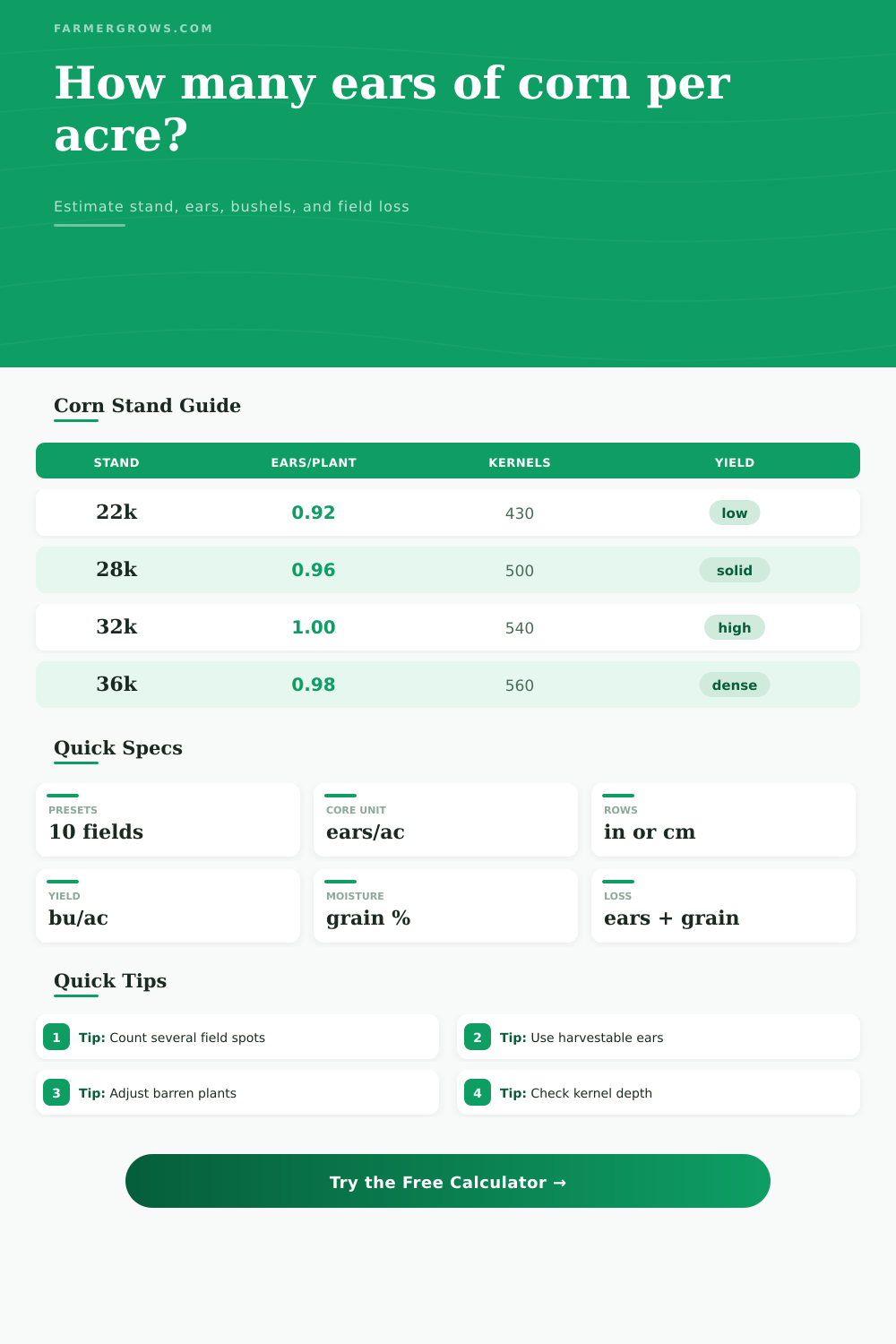
Kernels per row and rows around the ear compound rapidly, as the reference table shows. A typical ear could have thirty-two kernels and maybe sixteen rows, for five-hundredish kernels or so. That small amount make a big difference. Don’t choose the biggest ears nearest the road, but count several representative ones throughout the field to establish a true average.
The last adjustment is for moisture. At the elevator, corn normally has to be within a certain range of moisture levels (typically 15½ percent). If your corn has an 18 percent moisture content in the bin, you are hauling both grain and water. Using the calculator, you set the moisture to the actual level and it adjust the pounds to the “market” or basis weight. So when you unload, you won’t get a surprise check that’s less than expected. This very simple calculation makes a difference in the outcome.
When it’s time for harvest, you need to know exactly what you’re dealing with. That means walking the field and counting how many plants there is. You also need to check the size of the ears and note the plants that aren’t bearing fruit. Then enter those figures into the tool; it will tell you where you stand. It transforms the unknown into something you can manage.
Knowing the number of ears and how deep kernels go gives you a better idea of how to sell, store and dry them. No more reacting to hearsay, now you have information to base your plans based off. The objective is less of an abstract number on a computer screen and more a clear view of what’s headed back home.