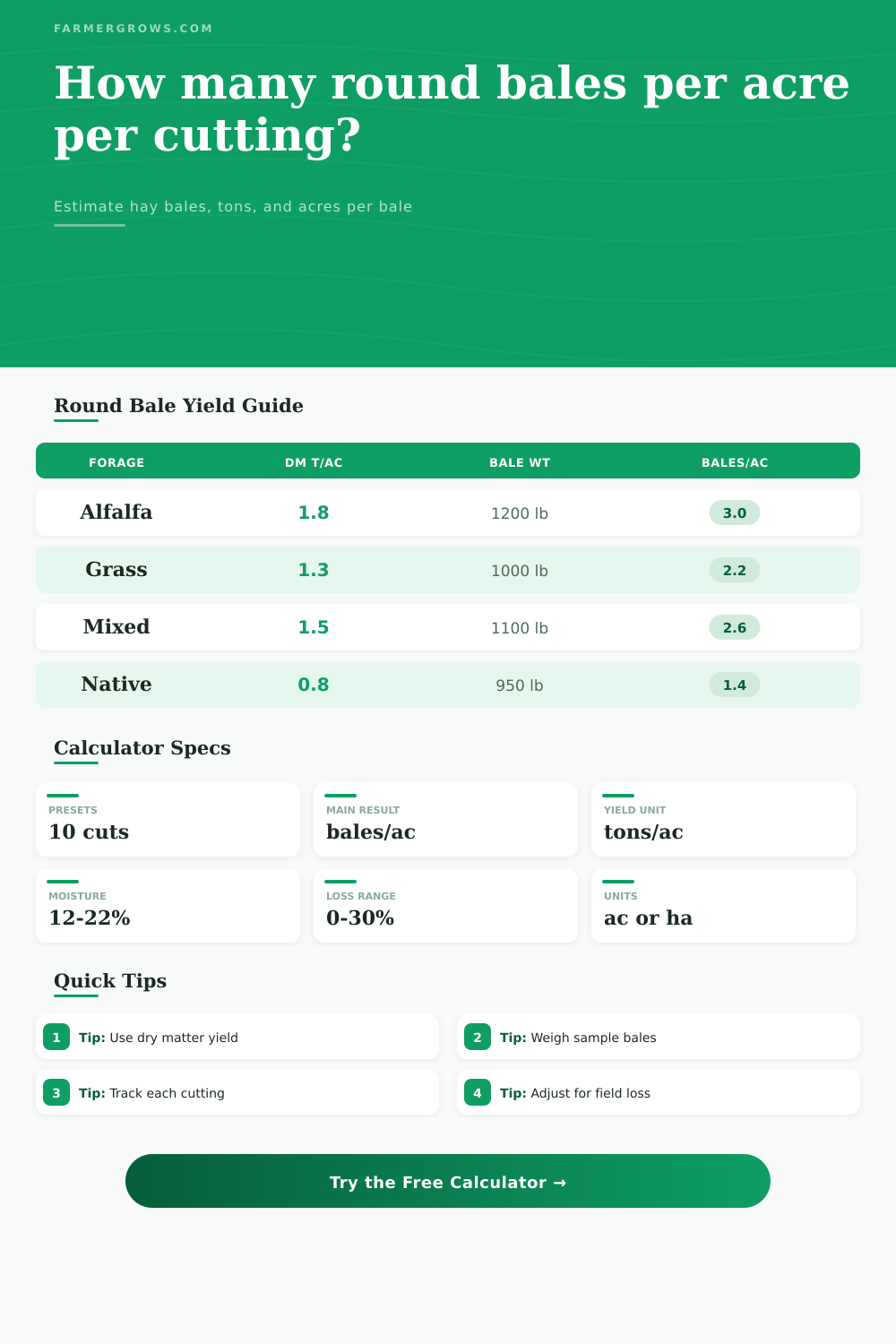
Round Bales Per Acre Per Cutting Calculator
Estimate round bales per acre, total bales, hay tons, acres per bale, and harvest loss for a single cutting using forage yield, hay moisture, bale size, and field conditions.
Choose a realistic hay cutting profile, then fine-tune acres, yield, moisture, bale size, and loss values to match your field record.
Per-Cutting Bale Estimate
Alfalfa hay for one cutting.
Often used where smaller equipment or easier handling matters more than field speed.
A common middle size for mixed farms, custom work, and moderate storage space.
Useful for many beef operations when bale handling capacity is adequate.
Large bales reduce count per acre, but need stronger handling and transport planning.
| Dry matter yield | As-baled tons at 15% moisture | 1000 lb bales per acre | 1200 lb bales per acre | 1500 lb bales per acre |
|---|---|---|---|---|
| 0.75 ton DM/ac | 0.88 ton/ac | 1.8 | 1.5 | 1.2 |
| 1.00 ton DM/ac | 1.18 ton/ac | 2.4 | 2.0 | 1.6 |
| 1.50 ton DM/ac | 1.76 ton/ac | 3.5 | 2.9 | 2.4 |
| 2.00 ton DM/ac | 2.35 ton/ac | 4.7 | 3.9 | 3.1 |
| 2.50 ton DM/ac | 2.94 ton/ac | 5.9 | 4.9 | 3.9 |
| Field example | Acres cut | Bales per acre | Total bales | Loads at 18 bales |
|---|---|---|---|---|
| Small hay patch | 8 acres | 2.0 | 16 bales | 1 load |
| Mixed grass field | 25 acres | 2.4 | 60 bales | 4 loads |
| Alfalfa block | 40 acres | 3.5 | 140 bales | 8 loads |
| Large meadow | 80 acres | 1.5 | 120 bales | 7 loads |
| Condition | Typical value | Calculator effect | Field note |
|---|---|---|---|
| Dry hay moisture | 12% to 18% | Converts DM to as-baled weight | Higher moisture increases bale weight. |
| Field loss | 3% to 15% | Reduces harvestable DM | Rain, raking, and leaf shatter raise loss. |
| Baler pickup loss | 2% to 7% | Reduces baled DM | Dry leafy forage loses more material. |
| Planning reserve | 5% to 15% | Shows feed bales after margin | Useful for livestock feed planning. |
Dry matter keeps comparisons honest. A 1,200 lb bale at 15% moisture contains about 1,020 lb of dry matter, so bale count changes when hay moisture changes.
Per-cutting records matter. First, second, and later cuttings can produce very different bale counts per acre even on the same field, so save each cutting separately.
It’s the day to go get the baler going; a big day. It starts with the sound of the baler. The first round bale rolls out and looks cylindrical and dense. Dense and cylindrical, it looks like a good year. But you don’t yet know how many bales there is from the forty acres. You want a number. Not an eye-balling guess, but a number. A specific number of something that’s about to turn to hay in the weather or on arrival of those trucks.
That’s where budgeting usually goes wrong, in the gap between what field looks like and what the barn contains. Making hay mean competing with nature’s rot while balancing moisture with weight. Each time you bale the crop, it lose some amount of dry matter when you lift, rake and stack it.
How to Plan Your Hay Yield
Enter your yield and field size into the calculator and it does the math for you. It eliminates the guessing games about conversions and coefficients. Encourages you to think about yield in terms of dry matter rather then as-baled weight. Good planning begins there, rather than with hopeful guesses.
Put in a yield of two tons dry matter per acre for first-cutting alfalfa. The tool takes into account your moisture level and adjusts to match. It tells you precisely how many real-world bales you’ll get.
One of the variables most frequently miscalculated are moisture. Twelve-hundred pound bales at 15% moisture have far less forage than a bale of hay at 10% moisture that weighs exactly the same. That’s what people do wrong. They think each bale is a consistent unit, like a brick. But it isn’t. It’s nothing but fiber and moisture squeezed into a shape.
As-baled weight will change according to moisture content (see chart/table above). When you’re baling at high moisture, you end up with more bales (by weight) but run the risk of losing nutrients and potential for mold. When you’re baling at low moisture, you run the risk of leaving behind all that leaf shatter in field. You’ll also end up with fewer, lighter bales. Balancing this out is where true yield happens.
How does it work? Geometry of fields matters (more than you’d suspect). Most are irregular; they have wet corners or pivot circles or just general wonkiness. Often parts of the field aren’t reachable by the baler. With this tool, you can enter precise measurements, then subtract what isn’t being cut. That brings things down to earth.
Take out another few percent of what you’ll harvest, because there will always be some headlands and missed spots that don’t get counted. Always err on the side of underestimating how much hay you’ll make. Plan on making forty-eight bales per acre so you aren’t shocked by how many bales you actualy get. Underestimate, and you’ll run short when the bunk in the feedlot empties.
How bale size affects things. The smaller 4- by 5-bales is a cinch for the tractor. But they also increase number of loads to haul. The larger 5- by 6-bales will decrease your overall load count per acre. You will have fewer loads and less handling, but they does take a lot more muscle power to move.
You can switch between estimated bale sizes and known weight in the calculator so that you can find the impact to your bottom line based off equipment selection. It allows you to calculate the dry matter yield per bale and compare prices accordingly when purchasing hay. And this is true no matter what density the round was packed at.
You will lose some of it; like it or lump it. You can’t cure hay in the rain and still expect to be dry. Your balers are less than perfect and may result in leaf shatter if you bale too dry, leaving leaves on the ground where they were supposed to be baled into hay. Then there’s the fact that pickup isn’t always perfect. There’s a place for field loss percentage as well as baler loss percentage on the tool.
Farming simply doesn’t work perfectly. Expect about ten to fifteen percent loss and plan for it. Ten to fifteen percent isn’t being negative; it’s managing realistically. It will keep your feed inventory calculations balanced when reality smacks you upside the head.
You want to be able to go into that field and have a pretty clear picture of what’s going on before the first truck ever leaves. You move from fuzzy “hope” to hard numbers. You stop guessing, and once you know exactly how many bales will come out of the field, you begin to manage. It may take you a couple extra minutes to run some numbers but it’s more valuable than having that confidence. Next time you hear that baler, you’ll know what it’s putting up.