Alfalfa Hay Bales Per Acre Calculator
Estimate bales per acre, total bales, hay tons, cutting distribution, dry matter, and storage space from field area, alfalfa stand condition, harvest losses, bale weight, and bale moisture.
Choose a field pattern, then adjust yield, cutting count, stand density, bale type, moisture, and loss settings for the hay you expect to store.
Alfalfa Hay Yield Estimate
Results update from the current field, cutting, bale, and storage settings.
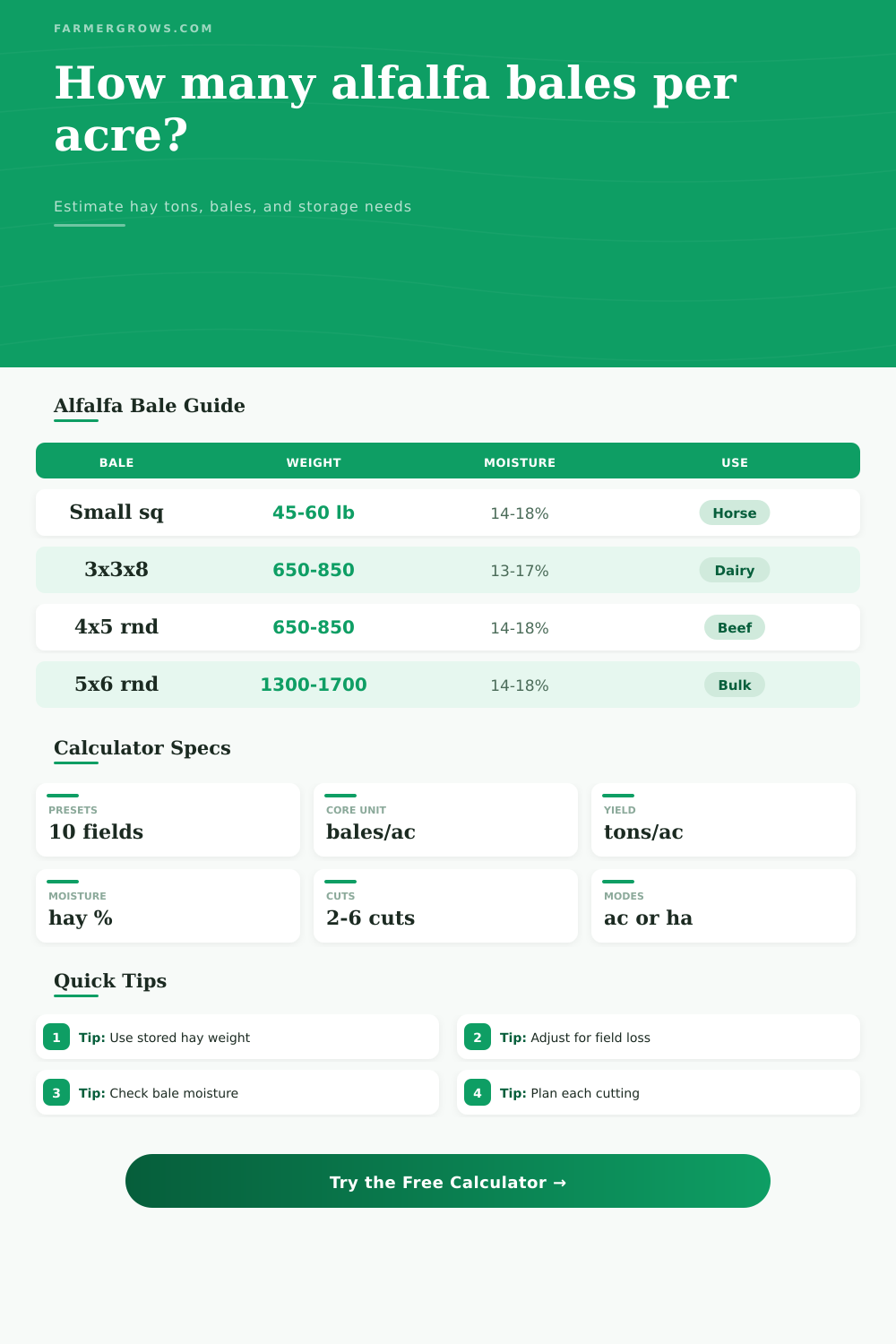
| Bale type | Typical weight | Dry hay moisture | Planning note |
|---|---|---|---|
| Small square light bale | 40 to 50 lb | 14% to 18% | Use for horse hay, hand stacking, and small deliveries |
| Small square dense bale | 50 to 65 lb | 14% to 18% | Bales per acre can drop sharply when flakes are tight |
| 3x3x8 large square | 650 to 850 lb | 13% to 17% | Common for dairy hay and commercial hauling |
| 3x4x8 large square | 950 to 1250 lb | 13% to 17% | Good for bulk movement when equipment can handle weight |
| 4x5 round bale | 600 to 850 lb | 14% to 18% | Density, diameter, and storage loss change usable feed |
| 5x6 round bale | 1300 to 1700 lb | 14% to 18% | Fewer bales per acre but much higher handling weight |
| Cutting program | Common annual split | Best use | Calculator behavior |
|---|---|---|---|
| 2 cuttings | 58% / 42% | Short season or dryland fields | Concentrates bales in first cut and second cut |
| 3 cuttings | 45% / 32% / 23% | Moderate dryland or mixed hay plans | Uses a strong first cut with tapering regrowth |
| 4 cuttings | 36% / 26% / 21% / 17% | Good established alfalfa stands | Balances yield and quality across summer harvests |
| 5 cuttings | 30% / 23% / 19% / 15% / 13% | Irrigated or dairy-quality harvest | Raises annual yield factor but spreads bales thinner per cut |
| 6 cuttings | 26% / 21% / 17% / 14% / 12% / 10% | Long season intensive systems | Uses the highest cut-count factor with shorter regrowth windows |
| Planning item | Low loss range | High risk range | Why it matters |
|---|---|---|---|
| Leaf and rake loss | 5% to 8% | 12% to 18% | Alfalfa leaves carry much of the feed value and shatter when too dry |
| Baler pickup efficiency | 94% to 97% | 85% to 90% | Light windrows, rough fields, or weathered hay leave more feed behind |
| Indoor storage loss | 2% to 5% | 10% or more | Dry floors and cover protect the bales counted by the calculator |
| Outdoor round bale loss | 10% to 18% | 28% or more | Weathered outer layers reduce usable hay even when bale count is unchanged |
Use actual bale weights when you have them. A field that makes 120 light small squares per acre may make 95 dense bales per acre from the same hay tonnage.
Separate field yield from stored yield. The calculator removes leaf, pickup, and storage loss so the final bale count reflects hay that should still be usable after storage.
Don’t base your alfalfa yield estimates on memory. You can remember how much yield you got last year, but don’t expect that number to apply to this year.
Stand density shift from one growing season to the next. An existing crop yield more tonnage then a new seeding. A thin stand infested with weed will do even worse. For accurate planning, the calculator wants to know how dense the stand is. It forces you to take stock of the number of stems per square foot; don’t just estimate by crop height. More than forty stems per square foot are typicaly considered dense and retain their yield potential. If your stand are thinner, it needs a reality check before counting bale.
How to Plan Your Alfalfa Harvest
Summer is about rhythms: Your cutting schedule dictates that rhythm. If you’re following a three-cut system, those are big-harvest days. After the initial harvest, there’s diminishing returns on the next two cuts. An irrigated five-cut field mean smaller windows spread over a larger number of harvests. This knowledge will affect how you manage the baler and where you stack the bales. You’ll have a problem if you expect to stuff five cuts into a storage area meant for three.
The calculator breaks out the cut-by-cut yield so you can plan individually for each harvest. So you won’t make assumptions about even distribution of hay during the season.
You can learn a lot about handling the hay by knowing its moisture content and Bale size. A fifteen hundred pound round bale contains the same amount of dry matter as a forty five pound small square bale. In your barn they are worlds apart, you should of known that. Small squares stack nice and tight with a high profile that reduces their footprint but increases work. Rounds require lots of space between each other. Left uncovered they gets tons of exposure to wind and rain.
Moisture content at the time of baling have an effect on how much you’re trying to move around, as illustrated in the reference table. Baling earlier at eighteen percent moisture saves time but adds water weight. Water is heavy. It occupies space. And it can catch fire. It is not a great deal.
You lose some of your crop’s usable feed when you store it. If you store round bales outdoors, you’ll lose between 20 to 30 percent of your crop if it’s left uncovered by tarps. That’s because weather and mold damage it. With indoor storage, you lose less than five percent. The calculator accounts for these losses. What’s shown at the end is what you have to feed. It is not what you baled on some particular day. That’s important for feed budgeting. You can’t feed what you lost to rot on the edge of the stack.
“An alfalfa harvest is management of expectations versus reality. You can’t manage the heat or the rain. What you can manage is how many tons of hay you have room for.”
Instead of guessing, you start calculating by adjusting based off your storage method, cutting frequency and stand quality. And you come up with a number which is the amount of usable feed you’ll have. That’s not just cut grass, but food you can eat when the snow comes. And that’s what this is all about (filling the barn). But you aren’t just filling it; you are filling it with hay that lasts.