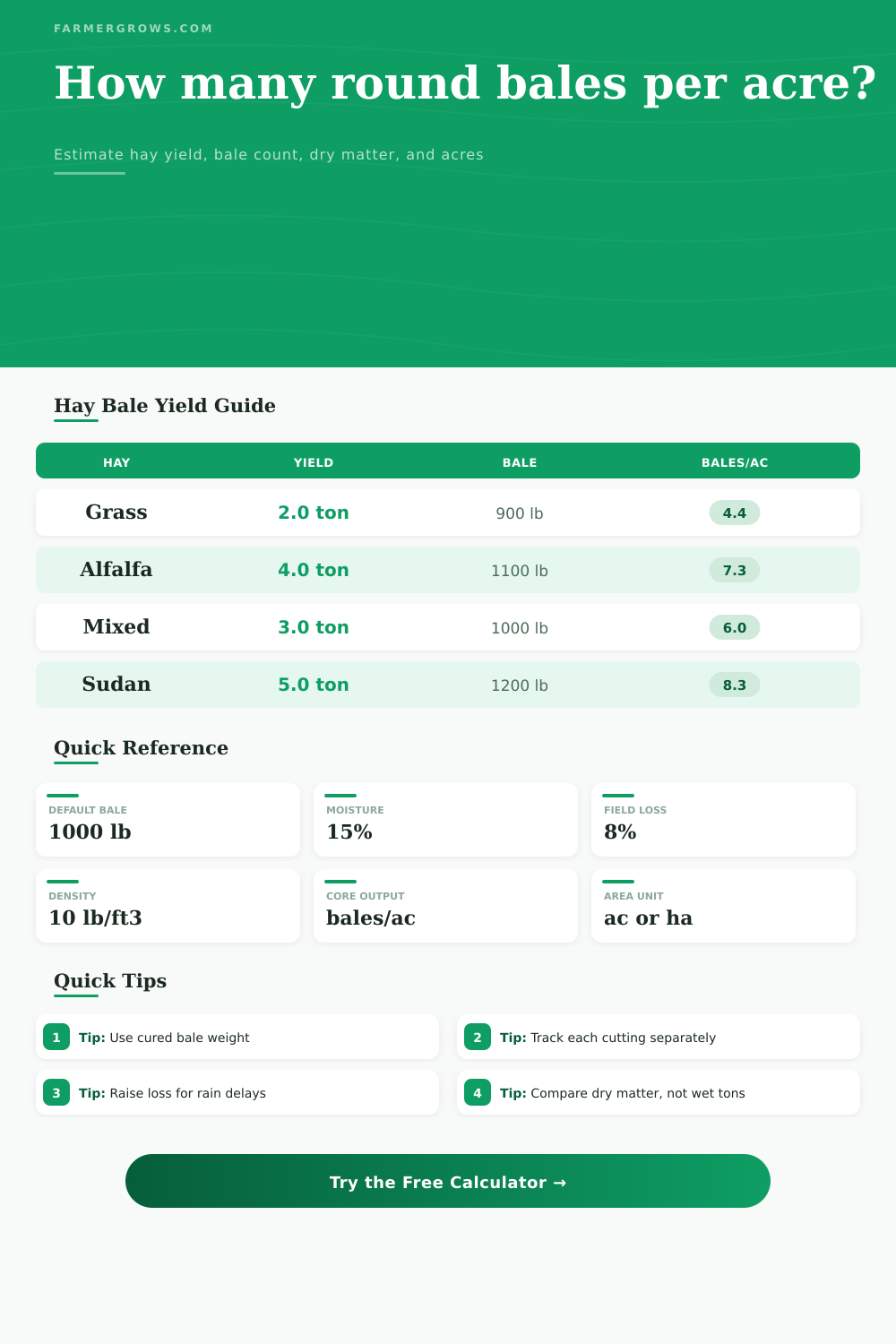
Round Bales of Hay Per Acre Calculator
Estimate round bale yield per acre from field area, hay dry matter yield, cutting count, harvest loss, bale size, bale moisture, and storage shrink.
Select a common hay field setup, then tune the area, yield, cuttings, loss, and bale package to match your baler and local forage conditions.
Round Bale Yield Results
Estimated from field area, hay yield, bale weight, moisture, and loss settings.
| Bale size | Common weight | Typical use | Notes for bales per acre |
|---|---|---|---|
| 4 ft x 4 ft round | 450 to 650 lb | Small tractors and horse hay | More bales per acre because each bale holds less hay. |
| 4 ft x 5 ft round | 650 to 900 lb | Mixed livestock feeding | Common size for moderate equipment and smaller fields. |
| 5 ft x 5 ft round | 900 to 1200 lb | General cattle hay | Good default when actual scale weight is unknown. |
| 5 ft x 6 ft round | 1200 to 1600 lb | High-capacity hay systems | Fewer bales per acre, but more weight per handling move. |
| As-fed hay yield | 800 lb bale | 1000 lb bale | 1200 lb bale |
|---|---|---|---|
| 1.5 tons per acre | 3.75 bales/ac | 3.00 bales/ac | 2.50 bales/ac |
| 2.0 tons per acre | 5.00 bales/ac | 4.00 bales/ac | 3.33 bales/ac |
| 3.0 tons per acre | 7.50 bales/ac | 6.00 bales/ac | 5.00 bales/ac |
| 4.0 tons per acre | 10.00 bales/ac | 8.00 bales/ac | 6.67 bales/ac |
| 5.0 tons per acre | 12.50 bales/ac | 10.00 bales/ac | 8.33 bales/ac |
| Condition | Moisture or loss | Calculator setting | Planning effect |
|---|---|---|---|
| Dry hay baled safely | 12% to 18% moisture | Bale moisture | Higher moisture increases as-fed bale weight but not dry matter. |
| Normal dry harvest | 5% to 10% field loss | Harvest field loss | Accounts for leaf shatter, rake loss, and missed hay. |
| Rain delayed hay | 12% to 25% field loss | Harvest field loss | Use a higher loss setting when weather reduced recoverable hay. |
| Outdoor storage | 8% to 18% shrink | Storage shrink | Reduces the marketable or feedable bales after storage. |
| Field example | Yield basis | Bale weight | Approximate output |
|---|---|---|---|
| 10 acre grass field | 2.0 tons/ac | 900 lb | 44 bales before loss |
| 25 acre mixed hay | 3.0 tons/ac | 1000 lb | 150 bales before loss |
| 40 acre alfalfa stand | 4.0 tons/ac | 1100 lb | 291 bales before loss |
| 60 acre light native hay | 1.4 tons/ac | 1000 lb | 168 bales before loss |
Use weighed bales when possible. Bale diameter, density, crop type, and moisture can shift round bale weight enough to change bales per acre by a wide margin.
Separate yield from storage shrink. Field yield tells what the acre produced; storage loss tells what remains usable after stacking, wrapping, or outdoor exposure.
You might wonder how many winter months lie ahead in that pile of round bales. Such worry raise all kinds of aggie angst, for there’s the bale…and then there’s the tonnage that isn’t visible. That’s where farm budgets go wrong, failing based off what looks like plenty and weighs like pennies on the pound.
Before heading out with the baler: How many round bales is an acre worth? It makes you consider storage, yield, and loss all at once. Everyone guesses. Most people start with a guess. “Oh, my grass hay yields three tons an acre,” they say, assuming they’ve read it somewhere. But yield are based on more than just growth; it’s also about how well something recovers after being cut.
How to Plan Your Hay Budget
Once you enter the size of your field, and the amount you think you’ll get per acre, calculator does the math for you. You don’t have to guess if harvesting at 5% instead of 15% will reduce your total.
Lost leaves = lost nutritional value. When you mow hay, you don’t collect all the leaf. Some are lost to the wind, some to dirt pickup, and some to raking. That’s why tool includes an adjustment for weather conditions; if it rains on the drying hay, you lose money from both wet bales and shattering. Leaves will fall out. Nutritional value goes down the drain. The calculator subtracts this loss before it even begins to count bales. Why? A bale of dried leaves isn’t worth the same than a bale of good nutritious forage.
Hay also loses weight in storage. When left uncovered, outdoor-stored hay rot at the ends and grows mold at the bottom, causing it to shrink. You can put the percent of shrinkage from storage into the tool. That’s acknowledging that you won’t eat all the pounds of hay that go into your barn. If you stack hay directly on the ground, prepare to lose a lot. A proper barn or pad means you retain some.
You don’t pay for hay by the pound; you are buying it for the energy in it, not weight of the straw on the pallet. These tie in to moisture levels. If you have a bale of hay at 20% moisture weighing 1,200 pounds, this has less actual dry matter than one with 12% moisture but weighs 1,100 pounds. Animals is fed on dry matter. Everything else is water weight that does nothing for nutrition and can be unhealthy depending on the level. The calculator will break out the dry matter into what you get so you can then compare various types of hay apples to apples. Wet alfalfa might weigh more but be less effective at delivering usable energy compared to drier, lighter grass bale.
The tool makes it easier to plan: Rather than react in the field, it’s better to plan out in advance. For example, enter your desired number of bales, then it will tell you how many acres you’ll have to cut for that. That way, you won’t have to panic buy at the end of November when things are in short supply and prices is high. Or use it to determine if you should of increase acreage or find ways to make the space you have more efficient. Sometimes it’s more economical to buy tarps than rent additional land.
If you’re not sure where to begin, use this reference table on the page, which displays average yields of various crop. Now you have a baseline. Alfalfa, grass hay, and mixed meadows does not respond similarly when put under pressure.
But keep in mind: your inputs are only as good as the number you put in. If you underestimate losses or overestimate yield, your result will be an optimistic lie. Be honest with yourself about your field conditions. If possible, use actual scale tickets from your bales’ weight. It’ll turn that vague worry into a manageable plan.
Making hay is a subtraction game. It is potential yield minus harvest loss. Storage shrink minus what’s stored. Subtract moisture weight to find what your animals actualy eat. How much do they really get?
It isn’t about making as much hay as possible. It’s about keeping the most hay possible. If you know what gets lost where, then the bottom line begins to make sense. You don’t guess anymore; you manage. That’s how a field of grass becomes a winter survival strategy.