Hay Bales Per Acre Calculator
Estimate bales per acre from hay yield, cutting count, bale type, moisture, field loss, storage loss, target bales, and harvest load planning.
Choose a field pattern, then adjust acres, forage stand, cutting schedule, hay moisture, bale size, and losses to match the crop actually going into storage.
Hay Yield Results
Adjust the field and bale settings to calculate hay bales per acre.
| Bale type | Common as-fed weight | DM at 15% moisture | Approx bales per as-fed ton |
|---|---|---|---|
| Small square bale | 40 to 70 lb | 34 to 60 lb DM | 29 to 50 bales |
| Three-string square bale | 90 to 120 lb | 77 to 102 lb DM | 17 to 22 bales |
| Large square bale | 700 to 1200 lb | 595 to 1020 lb DM | 1.7 to 2.9 bales |
| 4x5 round bale | 700 to 950 lb | 595 to 808 lb DM | 2.1 to 2.9 bales |
| 5x5 round bale | 900 to 1200 lb | 765 to 1020 lb DM | 1.7 to 2.2 bales |
| 5x6 round bale | 1200 to 1700 lb | 1020 to 1445 lb DM | 1.2 to 1.7 bales |
| Hay moisture | Dry matter share | As-fed tons from 1 DM ton | Use note |
|---|---|---|---|
| 10% | 90% | 1.11 tons | Very dry hay; leaves may shatter more in handling |
| 15% | 85% | 1.18 tons | Common target for many dry hay storage systems |
| 18% | 82% | 1.22 tons | Watch storage heat, bale density, and airflow |
| 22% | 78% | 1.28 tons | Often too wet for dry hay unless treated or managed |
| 30% | 70% | 1.43 tons | More like baleage planning than dry hay storage |
| Scenario | Yield basis | Small square bales per acre | Round bales per acre |
|---|---|---|---|
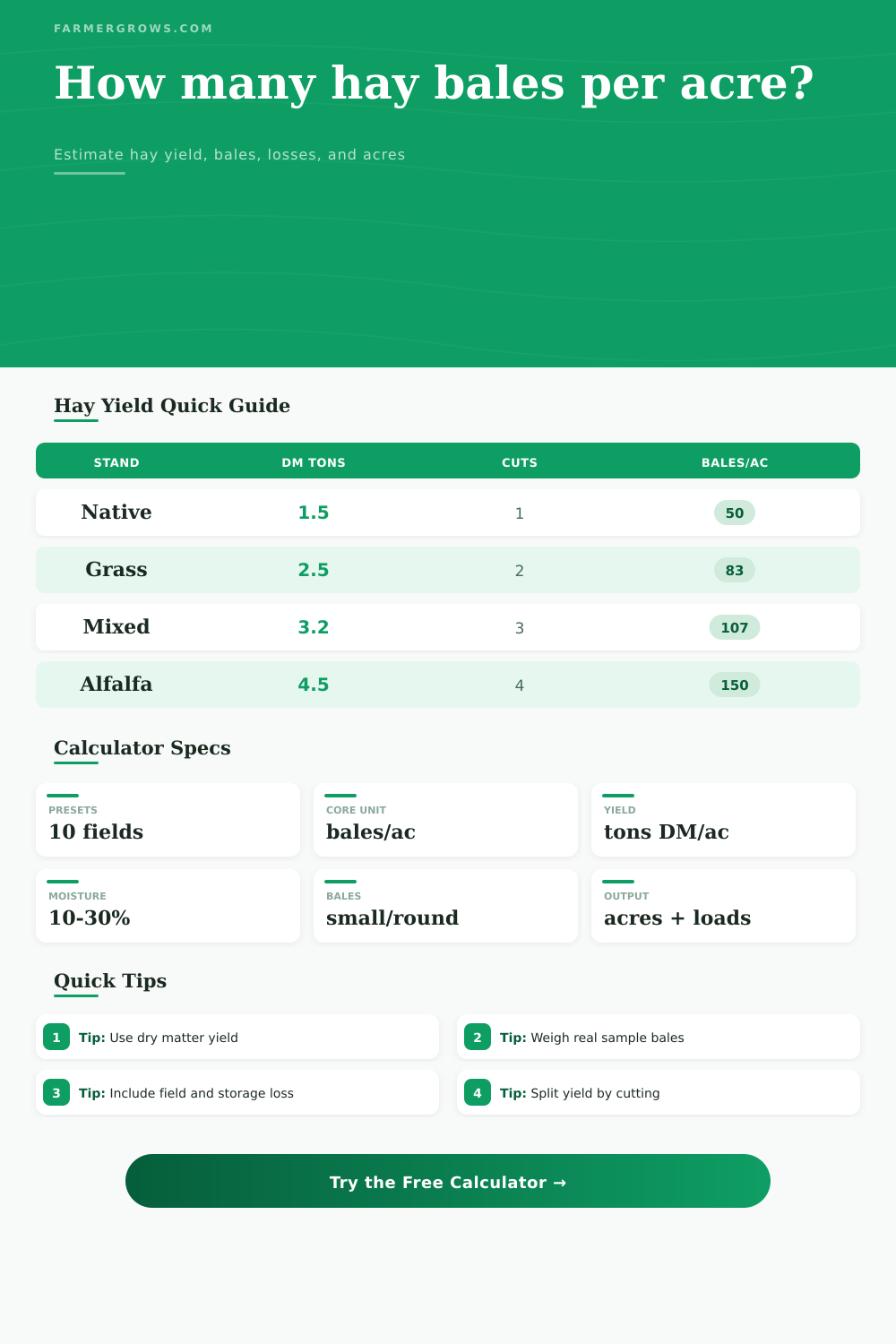
| Thin native hay | 1.2 DM tons/ac, 80% recovery | 34 to 40 bales | 1.6 to 2.0 bales |
| Average grass hay | 2.5 DM tons/ac, 85% recovery | 75 to 88 bales | 3.5 to 4.4 bales |
| Mixed grass legume | 3.2 DM tons/ac, 85% recovery | 96 to 112 bales | 4.6 to 5.6 bales |
| Strong alfalfa stand | 4.5 DM tons/ac, 88% recovery | 140 to 165 bales | 6.8 to 8.2 bales |
| Cutting plan | Typical stand | Yield split | Planning note |
|---|---|---|---|
| One cutting | Native meadow or late grass | 100% | Often stemmier hay with larger weather window risk |
| Two cuttings | Cool season grass hay | 60% / 40% | Balances first-cut volume with regrowth quality |
| Three cuttings | Mixed grass legume | 45% / 30% / 25% | Useful where rainfall supports summer regrowth |
| Four cuttings | Alfalfa or lucerne | 35% / 25% / 22% / 18% | Needs fertility, traffic control, and stand rest |
Convert yield to dry matter first. Hay bales per acre swing sharply when moisture changes, so dry matter tons per acre gives a steadier comparison across cuttings and fields.
Use real bale weights. Bale count can look high or low simply because density changed. Weigh several bales from the same baler setup before planning storage space.
They say you get what you measure, and here’s how that applies to hay: You’re in the field, and it looks like a lot of feed, but then you do the numbers, and they don’t add up. That’s the typical tradeoff for being a hay farmer. The weather was good. The stalks grew to six inches. You ran the baler all day long, but there still doesn’t seem to be enough of it in the barn.
Most of that discrepancy between expectation and experience arise from three factors: moisture conversion, harvest efficiency, and storage shrink. Many people like to estimate yields by looking at them, but that approach is far too generous. Enter your field size and bale type into calculator, and let it crunch the numbers. No more guesswork with conversions and coefficients.
How to Count Your Hay Correctly
Know this: It’s all about dry matter. If you put a ton of hay in the bed of your truck and jump on scale, you’ll see a number, but what if it has 20 percent moisture? Then instead of feed, you’ve got a ton of water that weighs you down and doesn’t contribute anything nutritious to the mix. The more water, the less nutrition, and that skews your per acre calculations right away. The tool will ask for baling moisture, then take wet weight and turn it into an actual plant matter number by converting it back to dry matter. Knowing the difference between them mean the difference between a profitable season and a storage fire hazard.
Dry matter yield is the baseline, since it eliminates the day-of-harvest rain variable. But from there it gets thin fast. Some of the crop will remain even under perfect conditions. Bales are bounced; hay is missed by mowers; leaves is scattered by rakes. And your tool will want to know how much of growing crop you harvested. It’ll have a default of typically, say, 85 percent.
The remaining fifteen percent, guess what: That’s not a mistake, just part of the game. Cut it in inclement weather, or if your fields are lumpy, and that harvested share drop even lower. The single biggest planning oversight is to ignore field loss. Believe you’ve got all of it? The windrows tell another story.
One big reason for loss is storage. A baled load that comes off the tractor doesn’t weigh what’s on that harvest tag forever once it sits in a barn. It’ll get smaller (the bale), dry out more (the bale), lose dust (not good) and if it gets real wet (like from melting snow, or rain) then it will heat (yikes) and compost. There’s room in the calculator to add a storage shrink factor. Twenty-five percent isn’t unreasonable for bales standing in the rain, and ten percent for covered hay. That means your first tally is fine, until winter sets in. Then you find the shortage just when the cows need food. Not fun.
But remember: it’s not just the quantity (tonnage) in the pile; it’s also its size (which can affect how you feel about it). Round bales are consistent but heavy. Small squares is lighter, but their weight varies from bale to bale. This makes them easier to carry around but more difficult to count precisely. The tool lets you switch between small squares, large squares, and various round sizes to see how many actual unit you will have to move. So you can toggle between them all to estimate how many actual units you’re looking at having to transport.
And that does matter when planning out labor. It takes a different amount of time and crew size to transport fifty large bales compared to five hundred smaller ones. The bale weight per bale input is supposed to be an average of your own real-world bales, not some hypothetical guess. Get that number by weighing several examples of what comes off your baler.
The exercise is based on thinking about what the target is. A hundred bales for the winter? The tool will calculate backwards and tell you how many acres of hay you’ll have to grow to reach your goal. It also factors in losses along the way, which prevents you from underplanting. Reverse engineering prevents last-minute panicked purchases of overpriced commercial hay in January when you didn’t think through the yield in July.
On the page they’ve laid out how much to expect from various kinds of grasses, so you can adjust your expectations by looking at the reference tables. Native meadow hay doesn’t behave like alfalfa; first cut’s heavy but stemmy; later ones is lighter but more nutritious. Knowing that helps you balance quantity and quality.
“Farming hay is subtractive. You take your whole field in, then little bits away each time until all that’s left is the last pile. Then you hope that whatever went wrong didn’t go so wrong that you don’t match your plan. If you add up the losses fairly, they turn out to be reasonable. And if you shrink on the right side and respect the moisture content, then all of this adds up.”