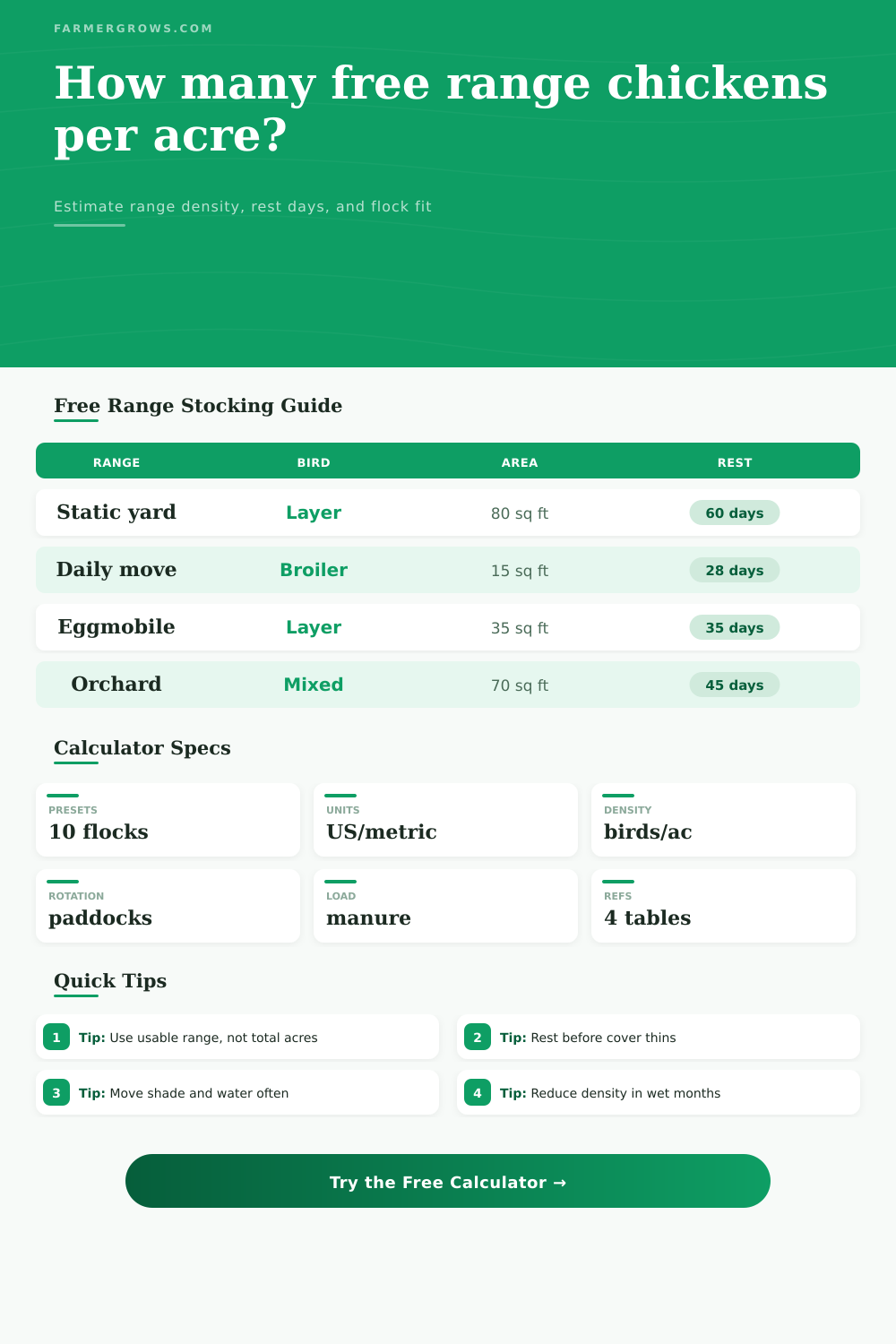
Free Range Chickens Per Acre Calculator
Estimate how many free range chickens fit per acre using usable pasture, bird class, outdoor access target, rotation rest, vegetation strength, manure load, shade, and housing support.
Pick a starting flock style, then adjust range acreage, outdoor allowance, rest days, usable land percentage, cover condition, and shelter support for your own layout.
Free Range Stocking Results
Your calculated range plan will appear here.
| Free range system | Typical outdoor target | Birds per acre before adjustment | Best use |
|---|---|---|---|
| Static backyard free range | 80 to 150 sq ft per bird | 290 to 544 birds/ac | Use lower density where birds return to the same yard daily. |
| Homestead laying flock | 50 to 100 sq ft per bird | 436 to 871 birds/ac | Fits small flocks with movable feed, water, and cover. |
| Mobile egg layers | 25 to 50 sq ft per bird | 871 to 1742 birds/ac | Use with frequent moves and enough rested paddocks. |
| Broilers on day range | 12 to 20 sq ft per bird | 2178 to 3630 birds/ac | High pressure works only with short occupancy and recovery time. |
| Orchard or tree range | 60 to 120 sq ft per bird | 363 to 726 birds/ac | Shade improves use, but trunks, lanes, and wet spots reduce usable area. |
| Move interval | Rest target | Sections needed | Range interpretation |
|---|---|---|---|
| 1 day | 21 to 30 days | 22 to 31 sections | Daily poultry net shifts spread manure and scratching evenly. |
| 2 days | 28 to 35 days | 15 to 19 sections | Useful for eggmobiles when labor allows frequent fence moves. |
| 5 days | 35 to 45 days | 8 to 10 sections | Moderate plan for small flocks with resilient vegetation. |
| 7 days | 42 to 56 days | 7 to 9 sections | Works at lower density or where range is not used hard. |
| 14 days | 60 or more days | 6 or more sections | Long occupancy should be paired with low bird pressure. |
| Support item | Planning target | Why it matters | Calculator effect |
|---|---|---|---|
| Indoor shelter for layers | 3 to 5 sq ft per bird | Enough floor area reduces crowding around exits. | Used to estimate total coop floor needed. |
| Field shelter for broilers | 1 to 2 sq ft per bird | Short growout and daily moves lower shelter space need. | Preset changes shelter and manure assumptions. |
| Shade or brush cover | About 1.5 sq ft per served bird | Birds graze farther when shade is distributed. | Shown as cover service area in results. |
| Feed and water placement | Move with each paddock shift | Static resources create bare, nutrient-heavy spots. | Distribution quality adjusts range capacity. |
| Flock example | Dry manure estimate | Daily range note | Management check |
|---|---|---|---|
| 25 laying hens | 4 to 5 lb/day | Small flocks still overload doorways if yards are static. | Rotate high-use zones or add litter at the coop apron. |
| 100 laying hens | 16 to 20 lb/day | Move feed and water to pull birds across the whole range. | Watch nitrogen hot spots after rain. |
| 300 broilers | 40 to 50 lb/day | Daily range shifts are usually needed at this pressure. | Do not return until the surface has recovered. |
| 150 mixed birds | 22 to 30 lb/day | Age and body weight can change manure output widely. | Use the custom manure input for local records. |
Count usable acres. Subtract buildings, ponds, driveways, steep banks, permanent wet areas, and places birds will not reach before trusting a free range chickens per acre result.
Let the surface decide. If cover thins, soil caps, odor builds, or manure concentrates near doors and waterers, reduce density or increase moves even when the calculator says the flock fits.
The plan starts as green grass. But by the time it gets close to the coop there’s just bare dirt. Why? Because an acre isn’t what you think it is in a small yard. An acre is a fixed size. But throw in a driveway and a pond, and the usable space decreases. Also, chickens will congregate beneath first tree that they see.
The calculator does the math for your particular property and lets you know whether your flock will thrive (no guessing required).
How to Use the Chicken Calculator
First thing is to know what you’re trying to measure. You aren’t doing bird counts; you’re managing pressure. The tool prompts you to input your total land area, and how much of that area are usable. Here is where most folks miscalculate. Forty percent of your acre might be buildings. How many animals can you graze in a fraction of the space? That’s what the capacity is adjusted for. So it doesn’t lead you to overstock a field that appears bigger than it is. Know the difference between what you own and what you can use.
Bird type also makes a difference: What works for a layer is different than what’s required by a broiler. Broilers are heavy foragers and clean up ground cover fast. Laying hens is lighter but will scratch until you move them as well. These types of variations have been included in the tool’s presets.
With a static set-up, the number of animals per area decreases due to lack of rest on land. Using a mobile system, however, allow you to increase density since you move the birds before damage occurs. As table shows, the safe stocking rate depends on how long the birds stay in one area.
“The system works through rotation. You can have 100 birds per acre. But if they’re all crammed in one place for a month, the ground will become hardened. Manure burns out the grass. Parasite levels will build up. Your move interval and rest days are what the calculator factors into how many paddocks you’ll need. It’s simply this: Let the land recover and move the birds before the grass dies. Those days translate into a certain number of sections, which takes the guessing out of fence-building.”
The secret ingredient is manure. Each animal poops. In small amounts it’s fertilizer; in large amounts, it’s pollution. Based off your flock size, the tool estimates how much manure you are making. Is the number high compared to the size of the land? That’s a signal to rotate faster, or make a smaller flock. That’s important for water quality and soil health.
The usable range is affected by shelter and shade distribution. If all your shade and water is in the corner, birds won’t use that whole acre. They’ll crowd around their resources and ignore the rest of the pasture. The calculator has a distribution quality factor to account for this. Spread the resources around and your usable area goes up. Cluster them together and the effective density spikes.
But numbers are just a start. What’s really true is what happens on the ground. When the birds aren’t in it, or the grass thins out, tweak the inputs. Use the calculator to set the structure, then adjust with your observations. Go with the math but believe your eyes.
That’s how you makes the birds stay healthy and the grass grow. Actualy, that’s how you should of managed it.