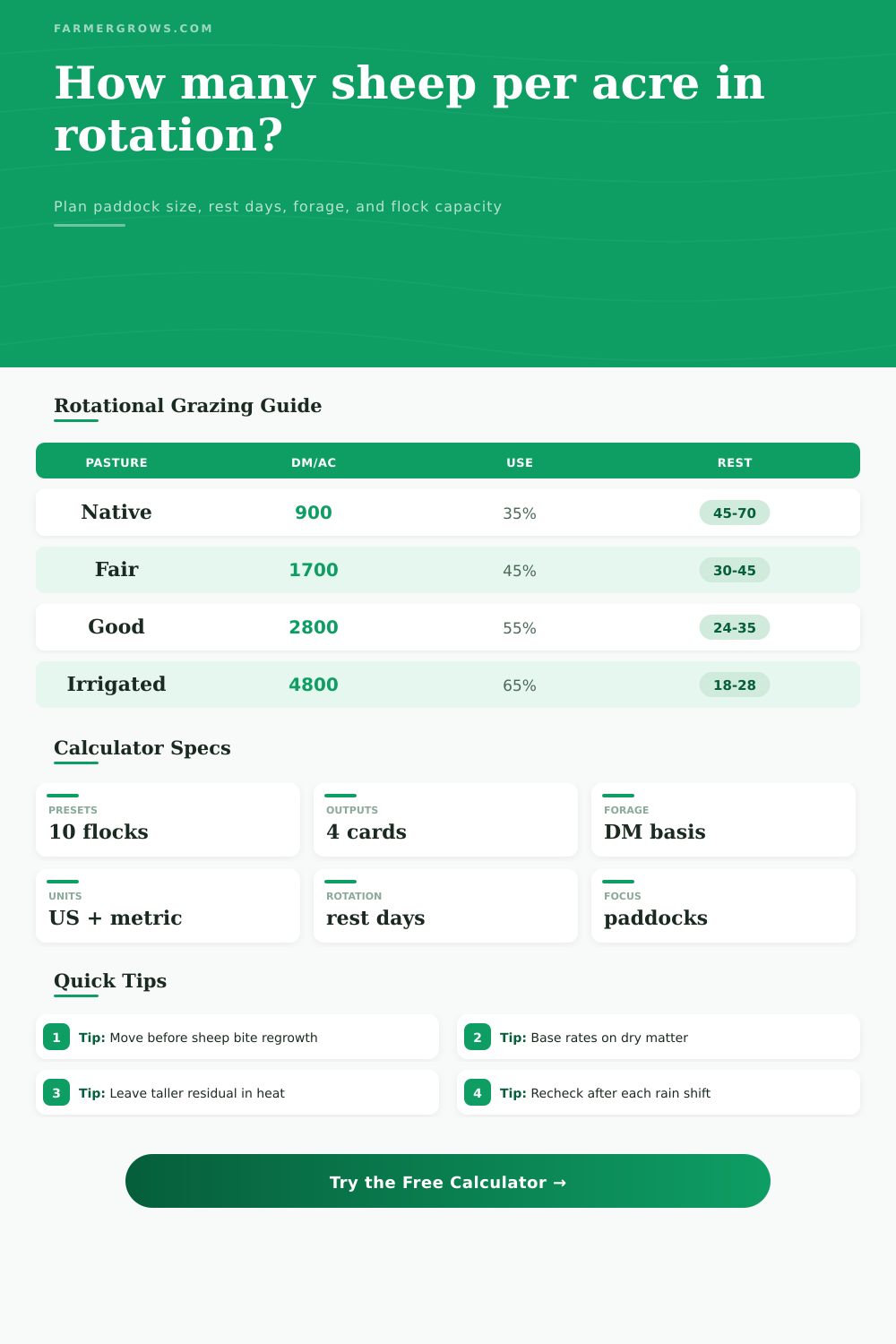
Sheep Per Acre Rotational Grazing Calculator
Estimate sheep per acre, flock capacity, paddock acreage, grazing days per move, rest interval, and forage pressure from dry matter supply and rotation goals.
Start with a pasture and flock pattern, then adjust sheep class, forage supply, move length, recovery target, paddock count, and drought buffer for your farm.
Rotational Grazing Results
Calculated grazing plan will appear here.
| Sheep class | Typical weight | Intake guide | Daily dry matter |
|---|---|---|---|
| Dry mature ewe | 130 to 170 lb | 2.3% to 2.8% BW | 3.0 to 4.8 lb/head |
| Late gestation ewe | 150 to 185 lb | 3.0% to 3.5% BW | 4.5 to 6.5 lb/head |
| Lactating ewe with twins | 155 to 190 lb | 4.0% to 4.8% BW | 6.2 to 9.1 lb/head |
| Growing lamb | 55 to 90 lb | 3.2% to 4.0% BW | 1.8 to 3.6 lb/head |
| Finishing lamb | 80 to 115 lb | 3.5% to 4.2% BW | 2.8 to 4.8 lb/head |
| Mature ram | 190 to 260 lb | 2.4% to 3.0% BW | 4.6 to 7.8 lb/head |
Lower labor, but sheep may rebite regrowth and graze selectively unless forage is moderate.
A practical compromise for many ewe flocks, with better utilization and cleaner rest periods.
Improves allocation and residual control when fencing, water, and flock checks are easy.
Works for stockpile or lush forage, but needs careful residual and bloat-risk management.
| Pasture situation | Typical rest target | Useful utilization | Rotation note |
|---|---|---|---|
| Fast spring cool-season growth | 18 to 25 days | 50% to 65% | Speed up moves before forage becomes stemmy. |
| Normal grass legume pasture | 25 to 35 days | 45% to 60% | Watch residual height and leaf stage. |
| Summer slump or heat stress | 35 to 55 days | 35% to 50% | Lower demand or add hay before plants stall. |
| Native range or thin pasture | 45 to 75 days | 25% to 40% | Conservative use protects crowns and cover. |
| Dormant stockpile | No regrowth credit | 45% to 65% | Treat as a finite forage bank. |
| Example flock | Forage basis | Move target | Planning range |
|---|---|---|---|
| 30 dry ewes on fair pasture | 1,700 lb/ac at 45% | 4 day moves | About 5 to 8 acres for 60 days |
| 50 ewes with lambs on good pasture | 2,800 lb/ac at 55% | 2 day moves | About 10 to 16 acres for 75 days |
| 80 finishing lambs on excellent clover | 3,600 lb/ac at 60% | 1 day moves | About 5 to 9 acres for 45 days |
| 40 hair sheep on brush mix | 2,200 lb/ac at 40% | 3 day moves | About 12 to 20 acres for 90 days |
Use residual as the brake. If the calculated paddock fits on paper but sheep are leaving less leaf than planned, reduce head count, move sooner, or enlarge the next break.
Recalculate when growth changes. A rotation that works in spring can become overstocked during summer slump. Update growth rate, rest days, and buffer after weather shifts.
The trick begins with a change in perspective. Instead of thinking about your pasture as a big open field, think of it as a succession of meals. Timing is critical to rotational grazing but not just with fences. It’s also key to developing a rhythm, a pulse that keep the grass growing while keeping the sheep fed.
Most folks guess at what their piece of earth will support. Land vary. Weather is fickle. The flock doesn’t have a set appetite. A static stocking rate rarely works if spring shoots up and heavens shut off. Model the variables first. Do this before anyone cuts first bale of hay or lambs are born. Planning is what understanding the numbers look like. That said, calculator does the number crunching for you.
How to Plan Your Grazing
The most important number to feed into the calculator is your pre-graze forage dry matter. Pre-graze. What’s that? It is not weight on the ground. It is the standing biomass there before sheep graze it down. The rapid expansion of irrigated land are fragile. Sparse native range vegetation need a lot of time to recover. Use rates adjusts for these extremes. On one end, using up to 35% will protect soil and be conservative. Driving up to 65% calls for more careful control and more moves out of an area. It is a tradeoff between yield and longevity.
The pasture? Also important. A lactating ewe with twins eating for two is different animal than that gentle winter grazer who’s dry. The calculator can identifies specific classes of sheep. By selecting them, it will adjust daily dry matter intake based off their biological needs. That’s critical, since over-estimating intake removes forage from the pasture, leaving it bare.
In addition, you must consider waste. Sheep are messy eaters. They pee and poop; they leave some patches ungrazed and trample other areas flat. These area are unsuitable for grazing for a time. The tool includes a provision for inefficiencies like this one, ensuring that the plan isn’t built around a theoretical world in which each blade of grass is eaten.
The centerpiece are rest periods. Without a chance to rest, plants can’t produce forage. According to the table of references above, they may require up to seventy days to recharge in their native range. Irrigated lush pasture? It might take just three weeks. Too few paddocks = shorter rests. Never replenish those root reserves. Eventually weeds moves in. Stands become thinner. The calculator will tell you if your setup allow enough rest to meet your goals. It’s probably correct if it tells you “you need more breaks.” Fencing does cost money, but it pays back in long run with healthy pasture.
This is the plan: the weather always changes things. And that’s why I said earlier that a drought buffer is insurance, not pessimism. Slow growth during periods of limited moisture reduce carrying capacity. The calculator allows you to adjust your estimated growth with a reliability factor. For example, if you’re accounting for a variable season, maybe you decreases expected growth by 10%. Such a little change could of been the difference between running out of hay early or having enough in the barn. Hungry sheep in the field is not good. Extra hay in the barn is best.
You need humility when planning to rotate grazing. The land gives the last word. It’s up to you to listen to what it says and then adapt your moves accordingely. Before the animals can do any damage, you get them moving. With your eye on the grass, you use the tool to set a baseline. Then, you adjust your pace based off the signs: Move more quickly as growth increases, slow down when it stalls. Aim for sustainability rather than perfection. You want a system that feeds your flock today without starving it of tomorrow. That balance makes the acreage number workable, turning it into a productive farm.