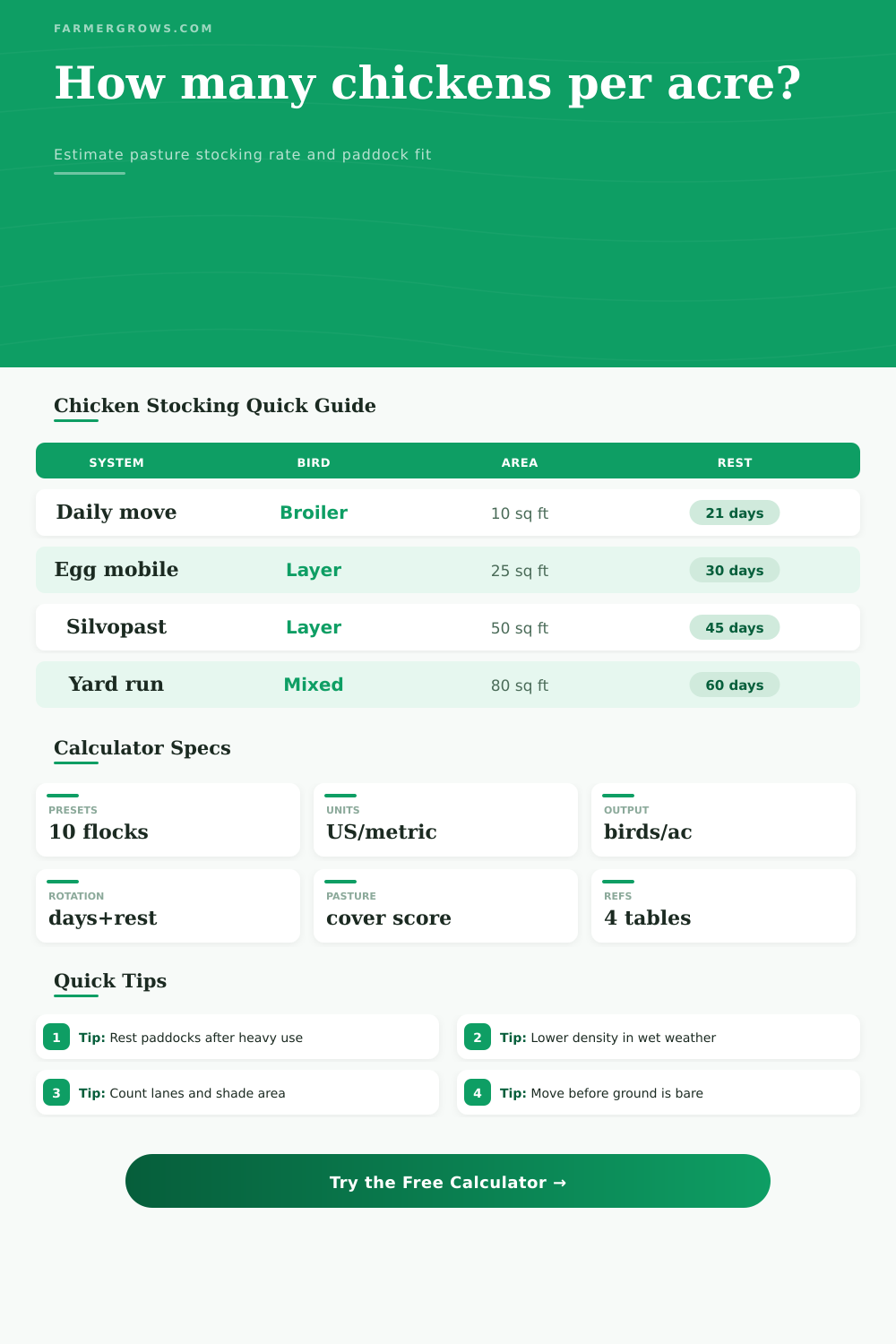
Chickens Per Acre Calculator
Estimate pasture stocking rate from flock size, bird class, outdoor area, rotation length, pasture cover, manure load, coop space, and rest days.
Choose a common flock pattern, then adjust bird type, land area, move interval, rest target, pasture score, and housing space for your own farm layout.
Stocking Rate Results
Pasture flock estimate from area, bird class, space target, and rotation timing.
| Chicken group | Common outdoor target | Birds per acre | Use note |
|---|---|---|---|
| Broilers in daily-move tractors | 8 to 12 sq ft per bird | 3630 to 5445 birds/ac | Works only when fresh ground is provided often and rest is planned. |
| Laying hens in mobile housing | 20 to 35 sq ft per bird | 1245 to 2178 birds/ac | Use more area when birds scratch hard around feeders and nest access. |
| Heritage or slower meat birds | 25 to 50 sq ft per bird | 871 to 1742 birds/ac | Longer growout can require more total rotation area. |
| Orchard or silvopasture layers | 50 to 100 sq ft per bird | 436 to 871 birds/ac | Shade helps distribution, but lanes and wet spots reduce usable space. |
| Mixed backyard flock run | 60 to 120 sq ft per bird | 363 to 726 birds/ac | Lower density preserves cover where birds return to the same run. |
| Move interval | Rest target | Paddocks needed | Field interpretation |
|---|---|---|---|
| 1 day | 21 days | 22 paddocks | High-management broiler or layer rotation with short occupancy. |
| 2 days | 28 days | 15 paddocks | Good for many eggmobiles where fencing moves every other day. |
| 3 days | 30 days | 11 paddocks | Common compromise for small laying flocks on growing pasture. |
| 7 days | 42 days | 7 paddocks | Works better at low density or with strong ground cover. |
| 14 days | 56 days | 5 paddocks | Use carefully because long occupancy concentrates scratching. |
| Bird group | Indoor floor target | Roost or shelter note | Outdoor effect |
|---|---|---|---|
| Standard laying hens | 3 to 4 sq ft per bird | Plan roost length separately where hens sleep indoors. | Doors and feeders can create high-pressure zones. |
| Large or dual-purpose hens | 4 to 5 sq ft per bird | Heavier birds need calmer traffic around exits. | More exits spread manure and scratching across the paddock. |
| Broilers in field shelters | 1 to 2 sq ft per bird | Move shelters often enough to avoid wet bedding and bare ground. | Outdoor area is mostly controlled by daily move size. |
| Pullets or growers | 2 to 3 sq ft per bird | Allow extra feeder space during growth spurts. | Lower pressure helps feathering and cover recovery. |
| Flock example | Manure dry matter | Typical N share | Management check |
|---|---|---|---|
| 50 laying hens | 8 to 10 lb/day | 3% to 4% | Move feeders and water to avoid repeated hot spots. |
| 250 broilers | 30 to 45 lb/day | 3% to 5% | Daily moves spread load and protect cover. |
| 100 pullets | 10 to 16 lb/day | 3% to 4% | Low body weight reduces load but runs still need rest. |
| 300 laying hens | 50 to 60 lb/day | 3% to 4% | Watch high-use zones near shade, nests, and gates. |
Use usable acreage. Subtract buildings, lanes, ponds, steep banks, permanent wet spots, and areas birds will not actually reach before using a chickens per acre number.
Recheck the surface. If grass disappears, soil caps, odor builds, or manure concentrates near waterers, reduce bird count or increase move frequency even when the math fits.
You must start with a vision. Typicaly this means 100 hens running loose on an acre of clover. That’s what most folks imagine: birds forage on a neatly mowed lawn. They hunt for bugs and scratch through the turf while laying eggs.
In real life, however, it is messier. It happens fast. Soon enough, you discover your chickens loves to landscape. They don’t graze like cattle; rather, they scratch, leaving bare spot at feeders and turning up dirt elsewhere. Too many animals? Not enough space? Then you end up with a dust bowl (not a pasture).
How to Use the Chicken Calculator
Achieving a good balance takes some change in how you look at things. Instead of viewing land as an endless feast, you begin to consider it as a limited resource that must be given time to recover.
After entering your move frequency and flock size into the calculator above, it’ll do the math for you. You input how often you’re going to move them. You also enter what kind of bird they are and how much usable acreage you have. Then the tool does the rest.
How many paddocks do you really need? How should you stock them? What’s your stocking rate? It’s not just birds divided by land. It’s also time. If a broiler is in a tractor being moved every day, he can be stocked at a pretty high density. He doesn’t stay long enough to strip out the ground. A layer in a static run must have far more space since it stays there for months, and the tool lays bare this tradeoff.
You can only manage high densities if you provide enough care to maintain them. The pasture cover score shows that a green lawn in spring doesn’t necessarily mean it can support three hundred hens by July. The calculator accounts for wet and dry conditions as well as thin cover (theory meets mud). For example, if your soil type is heavy clay, it drains slowly and no one likes wet feet; least of all chickens. They’ll simply hang out beneath the coop and trample a circle of bare ground, with the remainder of the paddock untouched. So you’d either want to move the coop faster (to spread them out), or give each chicken more space to roam.
Soil resilience (not just size of your fence line) alters the equation. There’s also a quieter factor: manure load. Each bird leaves waste behind and over time, that adds up to nitrogen in your soil. Too little nitrogen will starve your pasture; too much will burn it down and invite flies. The calculator helps you understand whether you’re fertilizing or polluting by estimating how much dry matter and nitrogen each chicken contributes. It reminds you that chickens aren’t just part of the egg- or meat-producing parts of the farm. They also contribute to its nutrient cycle, so you can’t ignore what they produce by only focusing on what they consume.
Your square footage gets eaten up by shade and shelter too. Maybe you think you’ve got fifty feet per bird, but then you realize forty percent of that space is either a mud bath or some shade structure all year long. Your actual available grazing area decreases! The tool provides an option to input a shade coverage percentage so it doesn’t count any unusable space as grazing land. It’s just one more little thing to prevent overcrowding in the hot months.
The final, and most critical, number in this entire equation are the rest days. Because you moved them every third day, then those birds must not come back to that paddock until they’re rested twenty-seven or even thirty days later. How many unique paddocks does that require? The calculator will tell you that, too. And if you’ve got just five acres, you may be splitting it into ten little paddocks. That is a lot of fence. I know. But without rotation, the pasture will die.
Move around little and often. Observe what the grass does and change the numbers to match. You don’t want to fill up every last square inch of earth; you simply want to maintain a level that remains workable as an earthmaker. Happy birds don’t tread dust; they walk on livig soil. You should of known better than to ignore it.