Goats Per Acre Calculator
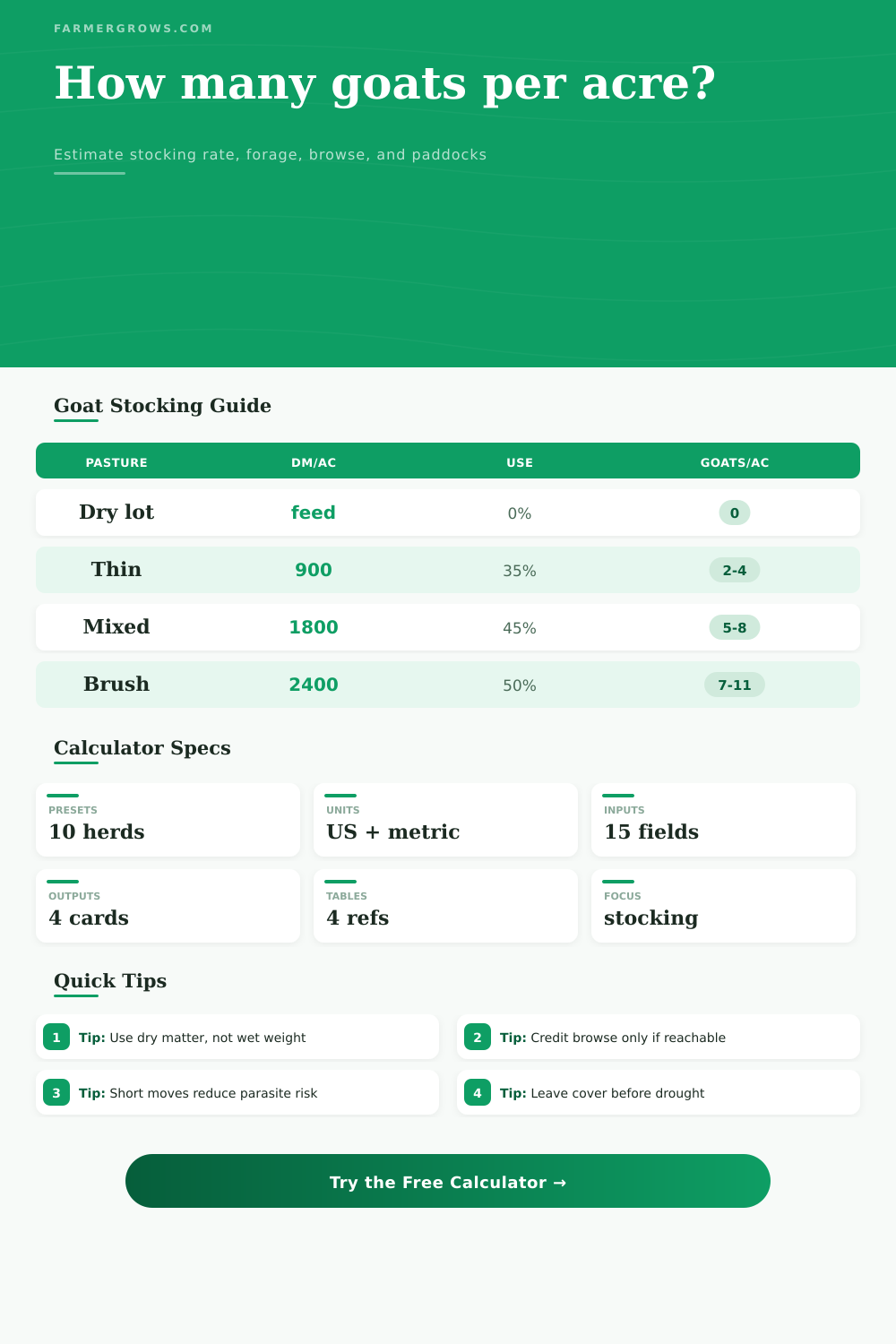
Estimate a practical goat stocking rate from grazeable acres, forage dry matter, browse access, herd demand, grazing days, residual cover, and paddock rotation targets.
Pick the farm situation closest to your plan, then tune forage, browse, utilization, goat class, intake, season length, and rotation details.
Goat Stocking Rate Results
Enter your pasture and herd details to estimate goat capacity, acres needed, and rotation size.
Often a moderate intake group, so forage supply usually drives capacity more than weight.
Milk production raises daily dry matter intake and can cut safe head capacity quickly.
Small bodies eat less total forage, but performance depends on digestible, leafy feed.
Woody and broadleaf growth can help if goats are moved before stems are stripped bare.
| Forage profile | Typical dry matter | Usable share | Planning note |
|---|---|---|---|
| Thin grass pasture | 700 to 1,100 lb/ac | 30% to 40% | Keep stocking conservative and protect residue. |
| Fair grass and weeds | 1,200 to 1,700 lb/ac | 35% to 45% | Works for short rotations with enough rest. |
| Mixed grass legume | 1,800 to 2,800 lb/ac | 45% to 55% | Good baseline for small farm goat plans. |
| Brush and briar paddock | 2,000 to 3,200 lb/ac | 45% to 55% | Browse access matters more than grass height. |
| Improved managed pasture | 2,600 to 4,200 lb/ac | 50% to 60% | High output requires quick moves and fertility. |
| Goat class | Common weight | Intake guide | Stocking effect |
|---|---|---|---|
| Dry mature doe | 100 to 150 lb | 2.5% to 3.2% BW | Good base class for acreage planning. |
| Lactating doe | 120 to 170 lb | 4.0% to 5.2% BW | Needs more acres or supplement. |
| Growing kid | 45 to 85 lb | 3.5% to 4.5% BW | Lower total demand but higher quality need. |
| Mature buck | 160 to 240 lb | 2.5% to 3.2% BW | Weight raises daily demand per head. |
| Mixed herd | 90 to 140 lb | 3.0% to 3.8% BW | Use weighed averages when possible. |
| Rotation pattern | Days in paddock | Rest target | Best use |
|---|---|---|---|
| Continuous grazing | 30+ days | Limited | Use low utilization and high reserve. |
| Weekly rotation | 5 to 7 days | 25 to 35 days | Simple fencing with moderate regrowth. |
| Short rotation | 2 to 4 days | 30 to 45 days | Better for parasites and plant recovery. |
| Strip grazing | 0.5 to 1 day | 35 to 60 days | High control, more labor and water moves. |
| Brush cleanup | 2 to 5 days | 45+ days | Prevents overstripping woody plants. |
| Example herd | Forage setting | Likely acres | Planning check |
|---|---|---|---|
| 12 dry does | Fair pasture | 2 to 4 ac | Works best with rotation and backup hay. |
| 25 meat does | Mixed pasture | 4 to 7 ac | Watch demand when kids are nursing. |
| 40 brush goats | Brush mix | 4 to 8 ac | Fence pressure and water access matter. |
| 18 dairy does | Improved pasture | 4 to 6 ac | Milk demand usually needs supplement. |
| 6 bucks | Thin pasture | 2 to 3 ac | Heavy animals need conservative stocking. |
Measure before relying on the number: Clip, dry, and weigh a sample if stocking pressure is high. Goat preference can leave grass while stripping browse, so visual fullness can be misleading.
Use the result as a starting rate: Parasites, kidding stage, fencing, water distance, poisonous plants, drought, and actual regrowth should decide the final turnout number.
They say you know what time it is when field appears brimming with green, yet nature’s got a more sober count than our eyeballs do. Everything’s going well: The herd look healthy enough to expand; the weather’s nice; the forage appear robust enough for several more doe. Perhaps you’ll find room for half-a-dozen, maybe eight? But here’s the thing about goats: unlike cows that graze on grass, goats browse. They prefer eating leaves, vines, and woody stems different than the grass beneath them. And that’s where the accounting gets real different. What a cow sees as a lush pasture may be nearly bare ground to a browsing goat, unless there are some shrubs nearby.
To get the stocking rate right, both animals and plants must survive the experiment. While the calculator do the math for you (above), it’s more important that you understand the variables going into equation than resulting number itself. First, you’ve got to separate wet weight from dry matter. What you’re estimating for standing forage include no water. Yes, green grass weighs a lot, but goats consume the dry matter which contains the energy. Guess too high without considering moisture? You’ll find yourself with an overstocked pasture.
How to Feed Goats the Right Amount
Next, the tool will ask you to set your use rate (which is typically about forty-five percent for moderate rotations). Where’d that come from? This leave enough residue for regrowth and root health, but still allows the herd to graze as much as desired. The season also matters because browsers change what they eat during the year. A nursing doe feeding twin kids will eat much more then a dry old girl. In fact she may up her daily consumption by almost 2 percentage points of bodyweight. Plug your wrong class into the planer and there you go, out of feed three weeks prior to kidding. That’s why the calculator require you to choose your goat class. Your milking dairy doe has different energy requirements from your finishing kid. Lumping the two is generally a recipe for either starving goats or wasting your pasture.
The second lever you have available is rotation speed: How fast do you rotate your herd? On paper, moving them every two to three days may sound excessive, but there’s more than just pasture-rotation efficiency at play here. This breaks up the lifecycle of parasites, as larvae must has time to crawl back onto new leaves and short grazing prevents them from eating that reinfected vegetation. It is also a small change in operations with huge impact on health.
The reference table on page explains it well, longer rest times between grazing give the grass time to bounce back and rebuild its roots. Keeping them in one place for too long will result in all of the furnitures being stripped right down to ground level, where they’re dead and won’t provide you with anything to rely upon.
Everything changes with drought. Wet years see spikes in growth rate, and it’s tempting to think you can fit one more dozen heads into herd. And it’s dangerous to have such confidence. The tool has a planning buffer for just this reason. Add ten or fifteen percent to your safety margin, and you can ensure a dry spell doesn’t turn a manageable shortage into an emergency. If the rain holds out, add some goats later. But when the pasture dissapears, removing goats is no easy task.
But then there’s this other mistake: relying on what the eyes see as “green.” That grass might be full of weeds that appear like food, but aren’t nutritionally valuable at all. Sure, goats will chew up those weeds, but without nutritional value they won’t thrive. For this reason, we take our own dry matter samples and compare them against information from local extension sources, which may not be as pretty, but are accurate.
In order to sustainableley manage your grazing, you don’t want to push each acre to its maximum output; rather, you want a balance so that the plants grow faster than they’re eaten up. Then you know you’ve got a sustainable system. Your days seem to go more slowly than if you were expanding rapidy, and that is good. You will have a happy herd while also keeping the land producing year after year. You want green pastures that can breathes, not just survive.