Cattle Per Acre Calculator
Estimate cattle stocking rate from acres, forage dry matter yield, usable grazing share, animal weight, intake, AUM demand, and planned grazing days.
Choose a herd and pasture pattern, then adjust the acreage, cattle class, forage supply, utilization, and season length to match the field you are planning.
Stocking Rate Results
Results update as soon as the grazing plan has usable pasture and herd numbers.
| Cattle class | Typical weight | AU factor | Daily dry matter |
|---|---|---|---|
| Stocker calf | 500 to 700 lb | 0.55 to 0.70 AU | 13 to 18 lb DM |
| Yearling heifer | 700 to 900 lb | 0.75 to 0.90 AU | 18 to 23 lb DM |
| Dry mature cow | 1000 to 1200 lb | 1.00 to 1.15 AU | 24 to 31 lb DM |
| Cow calf pair | 1200 to 1400 lb cow | 1.20 to 1.35 AU | 31 to 38 lb DM |
| Mature bull | 1600 to 2200 lb | 1.50 to 2.00 AU | 42 to 57 lb DM |
| Lactating dairy cow | 1300 to 1500 lb | 1.40 to 1.70 AU | 42 to 55 lb DM |
| Pasture condition | Season yield | Typical use | Estimated AUM per acre |
|---|---|---|---|
| Drought-stressed native range | 800 to 1400 lb DM/ac | 25% to 35% | 0.17 to 0.39 AUM/ac |
| Average native range | 1600 to 2200 lb DM/ac | 30% to 40% | 0.40 to 0.73 AUM/ac |
| Mixed cool-season pasture | 2500 to 3500 lb DM/ac | 40% to 50% | 0.83 to 1.46 AUM/ac |
| Improved grass pasture | 4000 to 5500 lb DM/ac | 45% to 55% | 1.50 to 2.52 AUM/ac |
| Irrigated or high-input forage | 6000 to 9000 lb DM/ac | 50% to 60% | 2.50 to 4.50 AUM/ac |
| Plan length | AUM per AU | When it fits | Management note |
|---|---|---|---|
| 7 days | 0.23 AUM | Quick paddock check | Useful for rotations and temporary fencing |
| 30 days | 1.00 AUM | Standard monthly planning | Compare directly to AUM supply per acre |
| 90 days | 3.00 AUM | Warm season or summer block | Needs regrowth monitoring and rainfall checks |
| 180 days | 6.00 AUM | Long grazing season | Usually requires rotations or forage reserve |
| Example | Forage basis | 90-day capacity | Acres per pair |
|---|---|---|---|
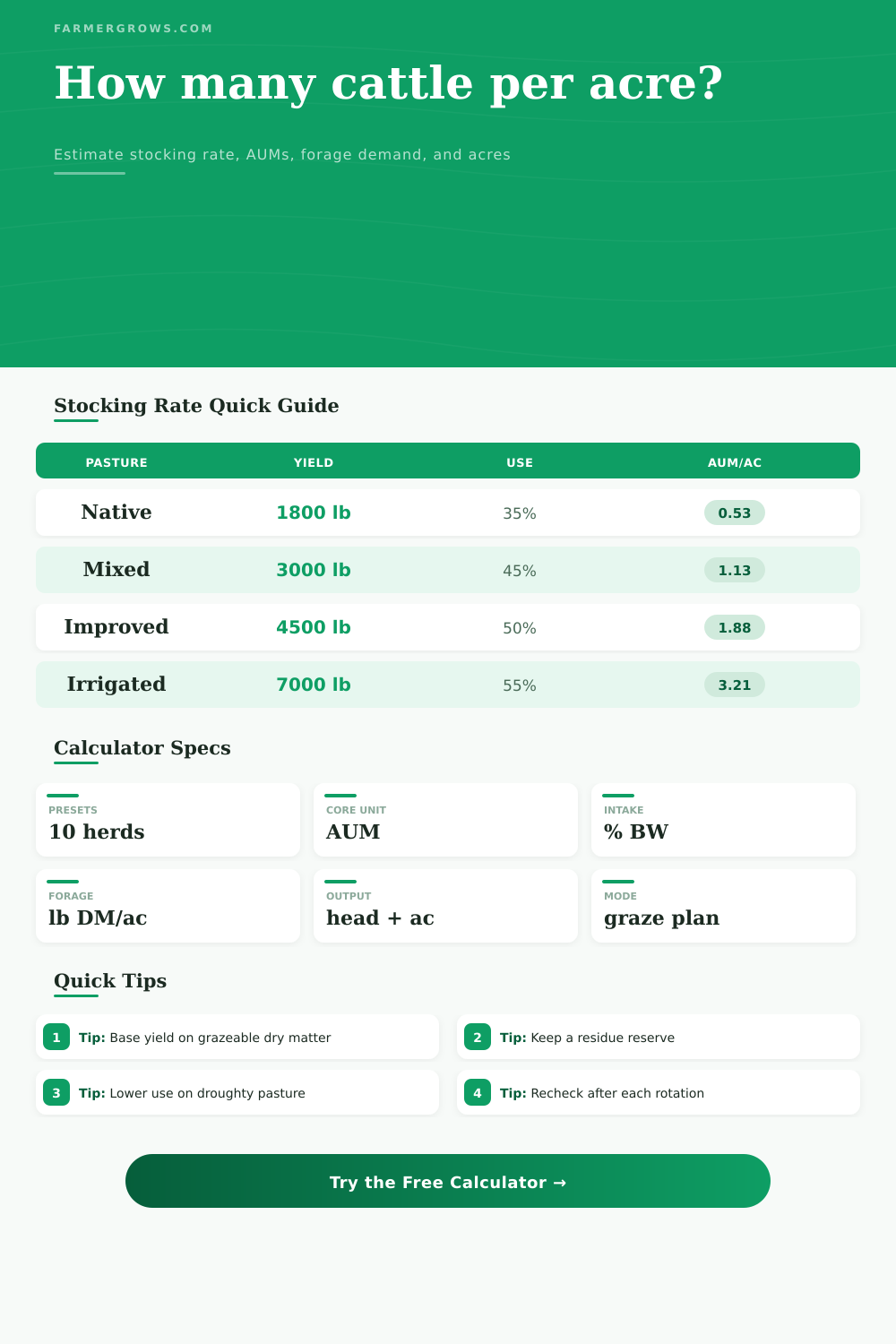
| 20 acre native range | 1800 lb/ac at 35% | 4 to 5 cow pairs | 4.3 to 5.0 acres |
| 40 acre mixed pasture | 3000 lb/ac at 45% | 18 to 21 cow pairs | 1.9 to 2.2 acres |
| 25 acre improved grass | 4500 lb/ac at 50% | 19 to 22 cow pairs | 1.1 to 1.3 acres |
| 12 acre irrigated pasture | 7000 lb/ac at 55% | 14 to 17 cow pairs | 0.7 to 0.9 acres |
Use dry matter yield. Clipped pasture, grazing-stick readings, or hay-equivalent estimates should be converted to dry matter before using the calculator for cattle per acre decisions.
Match the weakest month. A season average can hide summer slump, drought stress, or winter dormancy. Recalculate when growth rate, cattle weight, or pasture condition changes.
When your herd begins scraping the ground for weed seeds, that’s when math has gone against you; check your pastures at that time. It’s dangerous to guess your stocking rate. This leads to hidden problems. A pasture may look full of green and luscious. But then come August and the grass are nowhere to be found.
Understanding dry matter, not just standing height, is what often makes difference between a thriving herd versus a desperate herd. Cattle consumes dry matter. They don’t care about standing height. Season and species also has a lot to do with moisture content, which can vary wildly, meaning a thick-looking pasture full of water-rich forage could give you half the nutrients than the same acre in a denser, but drier, stand. That is where most folks go wrong.
How to Count Cows Correctly
You can enter your desired grazing days, and your actual forage yield (or your best guess), and let calculator do the math. It will translate those biologics into a hard limit on how many head you can feed. The key input here is the forage yield in pounds of dry matter per acre for each season. That means if you’re estimating from clipped samples or from hay production, you’ll want to adjust for moisture. Keep in mind that native range generally produces fewer total pounds of biomass than an improved pasture, but the portion that’s usable varies with your management style.
Some forage needs to be left in place to protect the soil; it also need to stay to fuel the next round of regrowth. So don’t just take the total standing crop and divide by number of cows.
But that’s the strategy: the use rate. You specify a utilization percentage, how much of the available forage are you willing to let the cows eat? Sounds like a no-brainer; maximize output, right? But over-do that and you kill the pasture’s capacity to recover. If you push that utilization number too high, it often destroys the pasture’s ability to recover. Keep things more conservative; say using only thirty-five percent of forage, and leave plenty of residue to protect the roots. That will be your nutrient reservoir, as well as some insulation from heat or cold. Stripping a field bare opens it up to weeds and erosion. These two problems is worse than just the loss of a grazing day.
Next, let’s look at animal unit factor. Not every cow eat the same, and a mature bull consumes significantly more dry matter then a yearling heifer or a dry cow. This is reflected in the animal weight and intake percentage fields in the calculator. What does that mean? If you run both stocker calves and cow-calf pairs, for example, your total demand change. Some animals will be bigger (heavy eaters) and some smaller (lighter eaters). Ignoring this variance lead to undergrazing some while others starve. It is a small detail but it is a big deal.
The AUM balance in the results displays the remaining forage after feeding the entire herd. How do you know if you have too many animals on the pasture? If there is a negative number, then you should of either reduce the number of days or increase the acreage.
The bottom line: The calculator makes it easy to figure out how many animal can fit into a paddock and how long they can stay before moving to another one. Yield is based off pasture type. Below is the baseline yield from native range (tough but low) vs. Improved pasture with irrigation can be three-plus AUMs/acre, but it requires thoughtful watering so nothing’s wasted. This chart explains it all in the “capacity” column of the table on the page, which takes into account both the yield and how that is used. It makes sense that you wouldn’t graze a stressed-out dry field the same way you would a well-irrigated one, right? Keep expectations dialed back in dry years to avoid overgrazing.
The bottom line is there’s no right answer to how many animals per acre; it is a judgment call given the soils, weather, and animal requirements of your herd. Changing them each season allow for an honest system. The best systems aren’t the ones pushing boundaries; they’re the ones honoring the biology of the grass. Let it root around; don’t graze it down to nothing; let it breathe; leave something up, and the numbers will work themselves out.