
GERMINATING A tomato seed seems simple: just put the little thing in the ground (or rather, a flat of dirt) and add water. And then…you wait.
Then something happens: the soil moves around. That’s the moment that makes all gardeners go “aha,” when their tomato seed has began to move from lifeless matter into a living thing.
How to Grow Tomato Seeds
Why didn’t I do this correctly? Novice gardener stumble at precisely this point. How we treat a seedling in its initial days or weeks can make all the difference between a sturdy plant and one that’s puny. Know the science behind that sprouting seed, and you’ll know better how to tend to it.
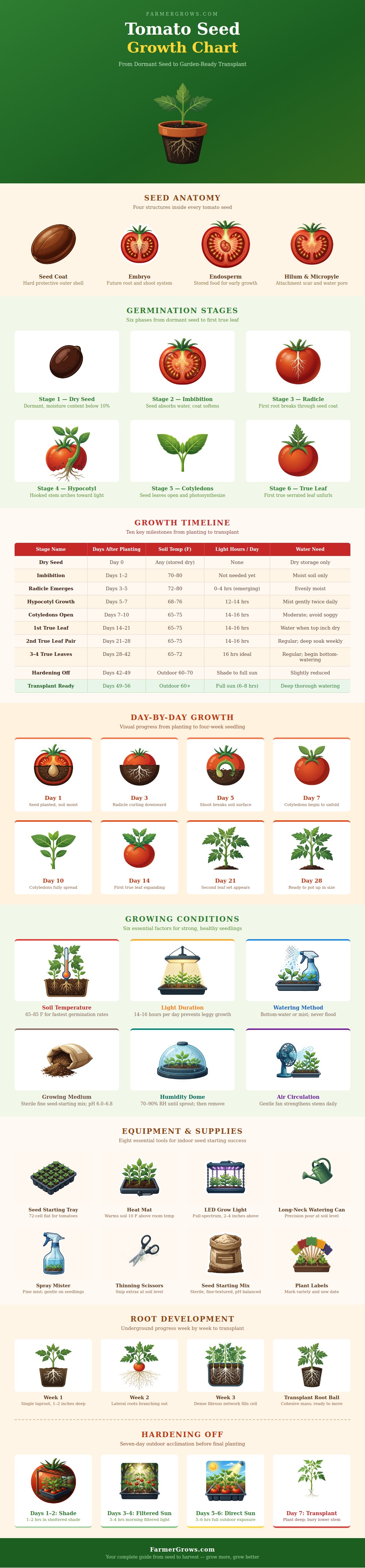
Each seed has its own full-on survival plan, wrapped up in a protective package that’s made to last, designed to survive even our neglect. That plan (which you’ll see broken down in the chart above) include the embryo; the soon-to-be-shoot-and-root-system, which is surrounded by some kind of food reserve to sustain it through its earliest moments of life, until the plant can get around to feeding on itself.
All that and more happens under what looks like a single shell (but no).
First comes the soaking wet part. The water softens the seed coat and soaks back into tissue within. This needs to happen when the soil temperature is in the mid-seventies. Otherwise, the seed’s enzyme-driven germination mechanism won’t kick in.
When it has softened enough, out pops first hint of a baby plant; its radical or primary root. That anchors the seed and goes right up looking for something to grab hold off. Soon after the shoot also pushes aboveground, forming a kind of hook with the stem to cushion the tender tip on its journey skyward. It is pure mechanics.
When the first seed leaves, called cotyledons, unfold light becomes the focus. Those early leaves are not what you think of as tomato leaves at all. They are oval-shaped, glossy, and smooth surfaces that absorbs light. This allows emerging true leaves to have more time.
And this is where so many gardeners falter: thinking the baby plants can’t take full light yet. They can’t. Stretching them to a softening window is one sure way to grow spindly-legged seedlings, among the most leggy things in nature. Give your babies continuous bright lights (fourteen to sixteen hours daily) to remain sturdy and compact.
You can add another element to encourage thickening and strengthening of stems by running a small oscillating fan (as if there’s a breeze).
The actual leaf shape clues you in: Once its true leaves emerge (above) with toothed or serrated edges, they tell you it’s real tomato time. It is also time to change the watering routine. No more splash zone (keeping things sodden on the surface); time to let top inch of soil dry between irrigations.
Now that it is doing some real growing instead of just livig off the seed supply, the plant wants its roots grow down deep. It needs to develop a strong, fibrous system to hold it up later than when it goes into the ground. You don’t see what’s happening underground, but this is where it all counts. A strong root ball make a tough plant.
Hardening off is the next step (and no skipping this one) before heading outdoors. Transporting your seedling from a comfortable indoor setting to the harsh conditions of outdoor weather will result in shock… And maybe death.
You should of started earlier. Give them a chance: Gradually get them used to it by first putting them in shade, then increasing their exposure to wind and sun over a week’s time. It’s a rite of passage; part of building up their toughness.
Burying a seedling deeply when you plant it helps its roots grow. This makes it a survivor that has earned the right to live in the garden and thrive. It goes from that little sleeping seed to a full-fledged garden plant, proving that big harvests realy can come from small beginnings and teaching a lesson in being patient and careful every step of the way.