Sunflower Microgreen Growth Time Calculator
Plan sunflower shoot timing from seed soak to harvest using tray size, seed density, weighted blackout, light days, temperature, humidity, hull shedding, airflow, media choice, and weekly production targets.
This calculator is tuned for edible sunflower microgreens grown indoors from black oil sunflower seed. It separates soak time, weighted blackout, light exposure, harvest height, and drying needs so you can estimate a realistic harvest date rather than using one fixed day count.
Your Sunflower Microgreen Schedule
Adjust the inputs above to calculate a sunflower shoot harvest window.
| Setup | Soak and drain | Blackout target | Light target | Expected harvest |
|---|---|---|---|---|
| Balanced 10 x 20 tray | 10 hr soak, 2 hr drain | 4 days, weighted 3 days | 5 days at moderate light | About day 9 to 11 |
| Cool room crop | 12 hr soak, 3 hr drain | 4.5 to 5 days | 6 to 7 days | About day 11 to 13 |
| Warm rack crop | 8 to 10 hr soak | 3 to 4 days | 4 to 5 days | About day 8 to 10 |
| Tall chef cut | 10 hr soak, 2 hr drain | 4 days | 6 to 7 days | About day 11 to 12 |
| Tray area | Seed range | Best use | Expected yield | Watch point |
|---|---|---|---|---|
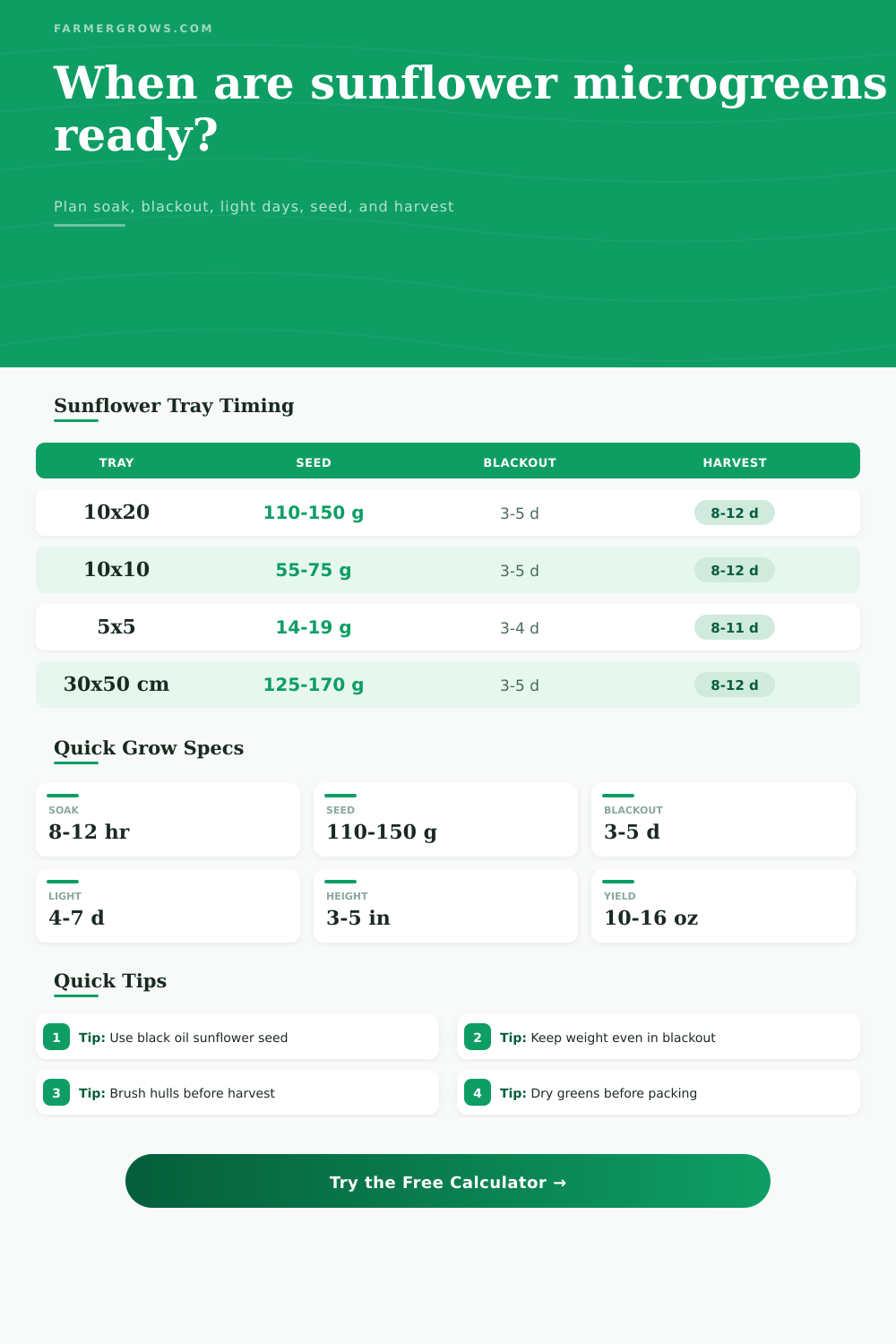
| 10 x 20 tray | 110 to 150 g | Main market crop | 10 to 16 oz | Too dense can trap hulls and moisture. |
| 10 x 10 half tray | 55 to 75 g | Small orders or tests | 5 to 8 oz | Edges dry faster on open shelves. |
| 5 x 5 sample tray | 14 to 19 g | Seed lot checks | 1.2 to 2 oz | Small trays heat and dry quickly. |
| 30 x 50 cm tray | 125 to 170 g | Metric rack crop | 11 to 18 oz | Scale seed by actual inner tray area. |
| Factor | Good range | Calculator effect | Grower note |
|---|---|---|---|
| Temperature | 68 to 74 F | Cool rooms add days; warm rooms can shorten lightly. | Very warm trays need more airflow and careful watering. |
| Humidity | 45 to 65 percent | High humidity adds risk time and dry-down time. | Sunflower stems hold moisture under dense canopy. |
| Light | 12 to 16 hr per day | Weak light adds time; strong light can speed finish. | Use enough light to green leaves without toughening stems. |
| Airflow | Gentle, steady | Low airflow raises hull and shelf-life risk. | Avoid blasting tender shoots directly. |
| Weekly target | Yield per tray | Trays to sow weekly | Pipeline at 10 days | Practical rhythm |
|---|---|---|---|---|
| 5 lb per week | 12 oz | 7 trays | 10 trays growing | Sow one tray per day. |
| 10 lb per week | 13 oz | 13 trays | 19 trays growing | Sow two small batches weekly. |
| 20 lb per week | 14 oz | 23 trays | 33 trays growing | Sow three to four batches weekly. |
| Restaurant sampler | 8 oz | 2 trays | 3 trays growing | Stagger by three or four days. |
Soak cleanly: Rinse sunflower seed before and after soaking. If soaked seed smells sour, shorten soak time, improve drainage, and check seed age before sowing a full tray.
Weight evenly: Sunflower trays respond well to a flat, even weight during early blackout. Uneven pressure creates patchy height and leaves more hulls attached at harvest.
Brush before cutting: A gentle hand pass or clean brush before harvest removes loose hulls while the crop is still upright, which saves sorting time after cutting.
Pack dry: If you rinse, spin or drain thoroughly and add dry-down time before packing. Wet sunflower greens lose shelf life quickly in closed containers.
Despite their simplicity, sunflowers are deceptive. There’s just this tray of soil and some black oil seeds; what could go wrong? But as any grower knows, it’s often all about the timing. The margin between a trayful of bright green, crisp stems and one that turns yellowed or moldy or otherwise leggy.
In most cases, it isn’t because someone had poor seed. They is failing because they have lumped the whole operation into one block of time, even though there are several very different biological events happening. The calculator above breaks them out so you can plan in real-time instead of guessing when things will happen.
Why Timing Is Key for Sunflower Microgreens
Of course, it all starts well in advance of anything looking green: Because sunflower seeds are hardy and large, they requires a large amount of time soaking to get things going. Go too fast; don’t go long enough; forget the whole thing, and these hard-shelled seeds won’t be able to punch their way past layer of medium or soil. Too long, though, and you may sour the seed, starting it down a path to rot before the crop is even up and running. That’s why the tool lets you enter exactly how long you soaked your seeds (and how long after soaking them you drained them off). Think of it as laying groundwork.
And then there’s the blackout. That’s when it really gets tricky for novices. To grow tall fast, sunflowers must be weighed down and kept dark for several days after being planted, when they stretch upwards with all their might to remove the hefty hulls from their hairdos. Otherwise, exposed to daylight prematurely, they expend energy making chlorophyll before freeing themselves of their own coats (stuck), short hull failure. The calculator accounts for blackout days and use of weights, which is a key variable if you’re aiming for a no-hulls harvest. This ensures they fall away on their own rather than being tugged away later with a knife blade.
So once the lights turn on, it’s time to get leaves growing (rather then more stems). Here’s where those other environmental factors, humidity and temperature, become important. A warm, moist environment speeds up growth. However, it also increases the chance of damping off if air flow isn’t good. A cool environment slows things down by a day or two.
This is where the tool comes into play: You input the environmental conditions, and it tweaks the projected harvest window accordingly. No more generic estimates, but an actual date. Which is important, since we want to know whether our food will be ready in time for a particular market stall or dinner party.
How many seeds? This determines yield, so it’s crucial. For example, with sunflower seeds, there’s typically an ideal range: about 110-150 grams of seeds per regular-sized (ten by twenty) tray. Too few, and you’re not getting a good return on your water and light. Too many and they will form such a tight canopy that moisture won’t penetrate. Air circulation will also be impaired. This is bad news for disease resistance and easy hull removal.
The “how many seeds fit into a what size tray” reference table on the page will help you learn how to adjust your operation based off how much seed you have and how large a tray you want to sow in. Whether for one meal or multiple meals at once, knowing the right amount of seed-to-space will keep you productive and avoid frustration from having too much or to little.
The last bit of the puzzle is production cadence. Microgreen growing is a pipeline, not a one off. Whether you’re using microgreens as an ingredient in a product or whether you want a pound of greens twice a week, you can’t simply go ahead and sow all your seed all at once if your cycle lasts 10 days.
What do you do? You set up a staggered system, starting new trays on a regular basis so that there’s always something coming along to meet demand. Use the calculator to figure out how many trays to sow each week to hit your target yield, turning hobby growing into a steady production schedule.
In short, growing sunflower microgreens is a series of transitions, and each requires something slightly different. If you plan ahead, that eliminates any stress from this process, and suddenly, you don’t fret over when it’s time. Suddenly, you trust the timing. And trusting the timing is what transforms a haphazard kitchen experiment into a reliable source of lively, fresh food.