Microgreen Shelf Life Calculator
Estimate sell-by timing, freshness score, shrink risk, and handling actions for harvested microgreens from crop type, wash status, cut age, cold-chain temperature, packaging, condensation, and delivery exposure.
Load a real harvest, market, or delivery scenario, then fine-tune the crop, pack style, washing, temperature, condensation, and handling time.
Microgreen Shelf Life Estimate
Adjust the harvest and storage details to estimate sell-by timing.
Cut cleanly, remove heat before closing packs, and keep greens near 34 to 40°F for most crops.
Useful for sandy crops, but the calculator shortens life if droplets or wet liners remain in the pack.
Uncut trays preserve roots and can extend customer value, but they need upright handling and light moisture.
Repeated openings, sun exposure, and soft ice packs can burn through sell-by time during one long market.
| Crop type | Cold dry baseline | Main risk | Best storage note |
|---|---|---|---|
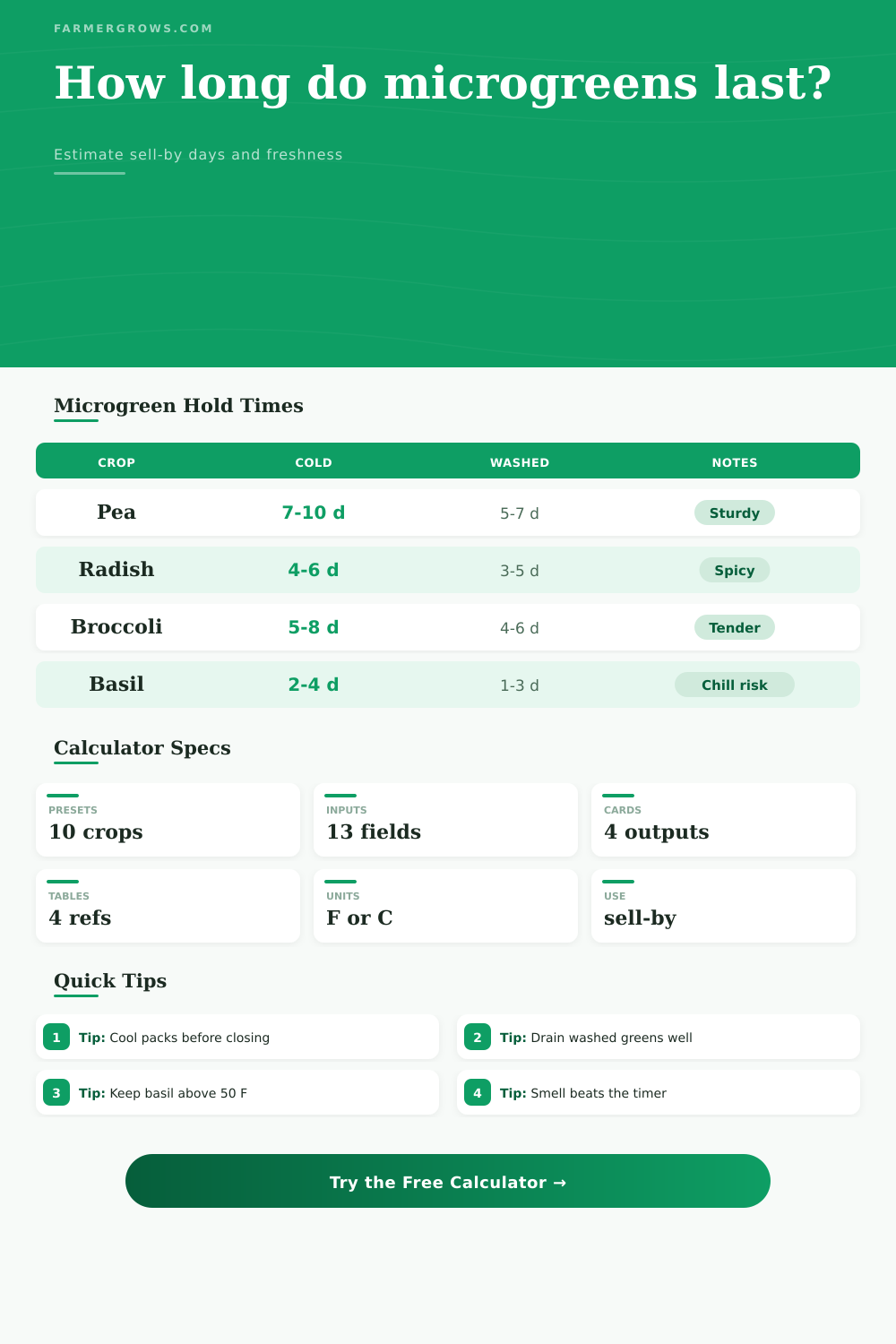
| Pea shoots | 7 to 10 days | Yellowing and stem bend | Chill promptly in vented packs |
| Radish microgreens | 4 to 6 days | Aroma, heat, and bruising | Sell fast after market harvest |
| Broccoli microgreens | 5 to 8 days | Damp mats and cotyledon wilt | Pack dry with light venting |
| Sunflower shoots | 5 to 8 days | Stem slime if overpacked | Use roomy containers |
| Basil microgreens | 2 to 4 days | Chilling injury and black spots | Hold warmer than leafy brassicas |
| Cilantro microgreens | 3 to 5 days | Aroma fade and wet leaves | Drain well before cups or jars |
| Storage temperature | Effect on shelf life | Use for | Watch for |
|---|---|---|---|
| 34 to 40°F | Best for most crops | Pea, broccoli, radish, sunflower | Freezing against ice packs |
| 41 to 45°F | Good but shorter | Markets and short delivery routes | Door opening swings |
| 46 to 55°F | Moderate loss | Basil and short holds | Condensation after cooling |
| 56 to 65°F | Fast quality decline | Brief display only | Wilting and aroma loss |
| Above 65°F | High risk | Emergency sorting only | Sour smell and wet packs |
| Package style | Air movement | Moisture behavior | Calculator adjustment |
|---|---|---|---|
| Vented clamshell | Good | Lets light moisture escape | Standard retail baseline |
| Tight clamshell | Low | Fogging and warm pockets | Shorter hold if not precooled |
| Foodservice bag | Moderate | Needs liner and loose fill | Good for dry sturdy shoots |
| Bulk tote | Variable | Compression risk near bottom | Best with absorbent liner |
| Live tray | Excellent before cutting | Roots still buffer stress | Longest customer window |
| Wash and drain status | Freshness effect | Shrink risk | Action before sale |
|---|---|---|---|
| Dry cut | Best if clean | Lowest | Brush seed hulls and chill |
| Mist only | Small reduction | Low to moderate | Vent packs before closing |
| Washed, fully drained | Good when cold | Moderate | Spin and rest on towels |
| Washed, visibly wet | Short hold | High | Re-drain or sell same day |
| Condensation present | Depends on crop | Rises quickly | Repack damp lots if needed |
Close packs only after the greens are cold and dry. Warm microgreens sealed in clamshells often fog the lid, and that condensation becomes the shelf-life problem even when the cooler is set correctly.
Let sensory checks override the estimate. If a pack smells sour, feels slimy, shows blackened leaves, or has wet corners, downgrade it or discard it no matter how many calculated days remain.
By dawn, with dew on their stems, you’re sure it’s ready to go: You take your knife and slice up the tray. Come noontime at the farmers market, that pile of goodness look limp and sad.
Usually it has nothing to do with the crop, and everything to do with the invisible timeline of decay that begin as soon as those roots get severed. Once out of the medium, microgreens is in a state of shock, their life-sustaining tissue suspended, and begin to breathe (and lose water) rapidy. That’s the decay curve to understand if you want a good harvest more then compost bin filler.
How to Keep Your Microgreens Fresh
Rather than guessing, our calculator, which does most of the work here, takes into account when you harvested them (the “cut age“), their general toughness (think: pea shoots versus basil), and other factors such as whether your cold chain is sound. After you choose your crop, the calculator establish a shelf life from there. While peas are relatively tough and will last longer in storage, basil are delicate and susceptible to chilling injury if kept cold, not all greens is created equal! Treating them similarly ensures you waste the fragile ones.
Temperature is the single biggest lever you can pull to slow down respiration. The tool include the decay rate when it senses what temperature you’re putting it into. If you put it at room temp in your house, it will assume that and start adjusting your decay rate. But greens stored around thirty-eight degrees Fahrenheit last longer then greens sitting in a warmer environment.
Not just ambient temperature, though: That’s where many growers gets tripped up, moisture management. Greens are washed (which looks cleaner), so now you’ve got some residual water on them, which is perfect for bacteria to grow. If they aren’t spun all the way dry before being packed, this is a moist environment where bacteria thrive. The calculator count a wet pack against you. Condensation inside of a closed clamshell is deadly. You’re creating a microenvironment that speed up rot. This can happen in as little as a day.
What about how the greens is packaged? That’s also a critical factor. A vented pack is best because it lets the greens “breathe” without building up ethylene gas, which accelerate aging. A sealed bag traps moisture and the same gassing process that makes the harvest go bad fast; a fresh crop becomes slimy in no time. To determine your true freshness score, the tool take into account what kind of package you’re using as well as whether there’s any condensation on the bag.
Your freshness score isn’t random. Rather, it’s based off the combined effects of how much time the greens spent at ambient temperatures (above forty-five degrees Fahrenheit), along with its humidity and heat levels. Time away from fridge while traveling on a lengthy delivery route counts against you, since every minute add up quickly.
On the financial side, it’s shrink risk. How much will your microgreens wilt, or go bad before it reach the customer? The estimate takes into account how much quality you have left and how long the customer intends to hold the produce. If you sell to a restaurant that holds the greens for three days, you would of want to have a higher quality score. This is different than selling directly to a customer who picks up at your farm stand right away. The tool factor in customer hold time. You won’t over-promise freshness, because you cannot deliver it.
It has reference tables on the page (below), which give you quick baselines for various crops. But it’s the synthesis that’s the gold. Perhaps your drain is great and your cooling is perfect, but your package hold heat. Or maybe your package is great, but your drainage are terrible. The calculator makes you consider the overall system. Hours spent carefully chilling something can be undone if you leave a pack open during an especially hectic shift.
All in all, there’s no replacing your nose for this. Smell an open bag and if it stinks, it’s done. However, by knowing what your base line is, you’ll be able to pick up on something being wrong before it turn into a loss. Now you know when you have a cool morning crop; now you know exactly how long you need to keep it like that. Simply put, the goal is to sell your greens when they’re still green, not barely hanging on.