Wood Chip Aging Time Calculator
Estimate how long fresh wood chips should age before mulch, paths, tree rings, vegetable beds, chicken runs, or soil mixing based on chip source, pile size, storage method, moisture, season, and intended use.
Pick a real storage scenario, then adjust the age, pile shape, chip source, moisture, and planned use. This aging calculator is for stored chips, not hot composting.
Wood Chip Aging Estimate
Your chip aging estimate will appear here.
Best for paths, established trees, and shrub beds when chips are not mixed into crop root zones.
Good for general mulch once heat, sharp wood odor, and leafy slime have settled down.
Better for vegetable bed surfaces, seedling areas, and places where chips may contact shallow roots.
Needs the longest wait and often extra nitrogen because soil microbes work directly in the root zone.
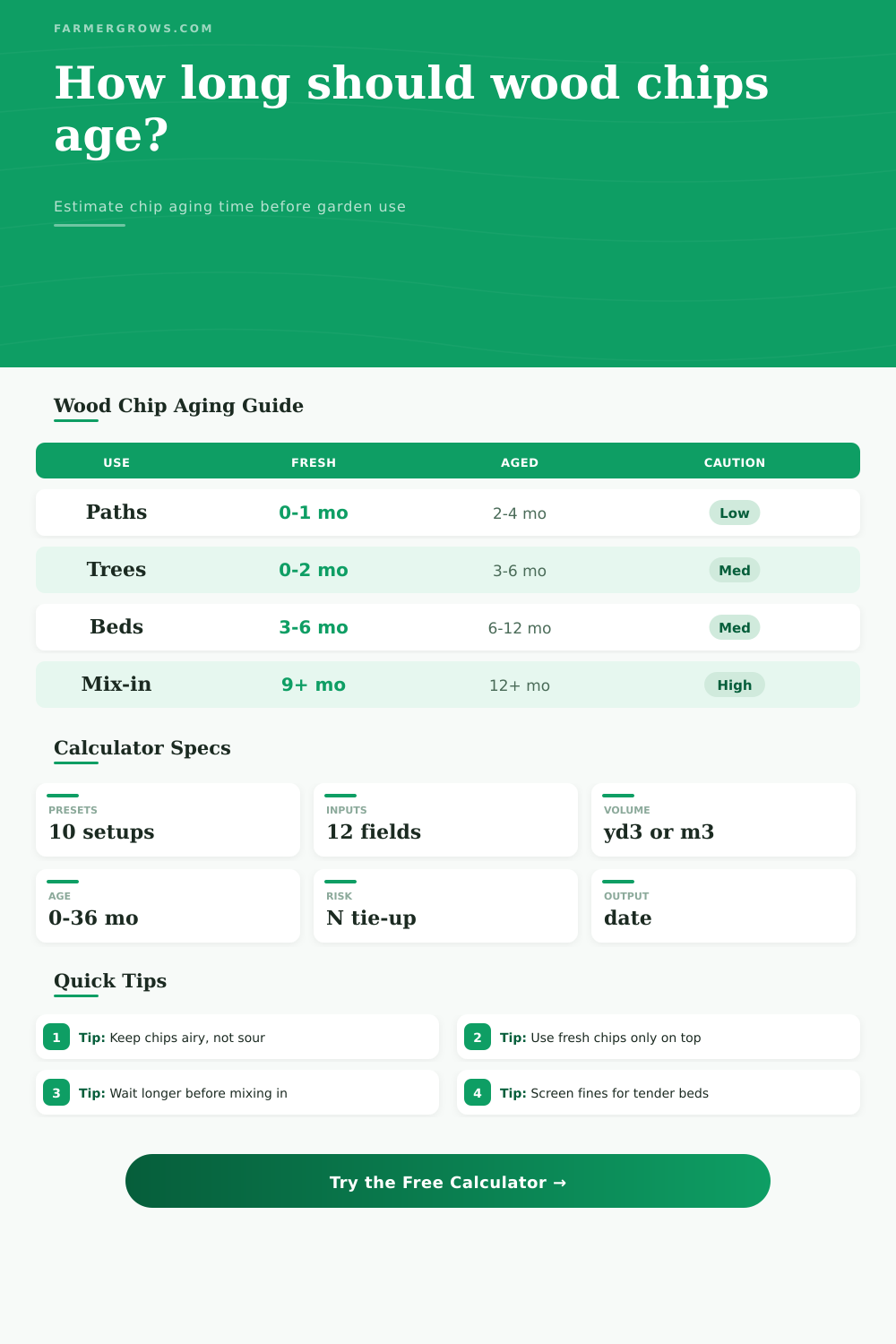
Use these tables to sanity-check the calculator output against common wood chip aging patterns.
| Planned use | Typical minimum | Safer target | Main reason |
|---|---|---|---|
| Garden paths | Fresh to 1 month | 2 to 4 months | Low root contact; surface use tolerates fresh chips. |
| Tree and shrub rings | Fresh to 2 months | 3 to 6 months | Keep chips off trunks and avoid mixing with soil. |
| Vegetable bed surface | 3 to 6 months | 6 to 12 months | Tender crops are more sensitive to sour or hot pockets. |
| Chicken run litter | 0 to 2 months | 1 to 4 months | Fresh chips work if they stay airy and dry underfoot. |
| Soil incorporation | 9 to 12 months | 12 to 18 months | Direct mixing raises nitrogen tie-up pressure. |
| Chip source | Aging speed | Common cue | Calculator adjustment |
|---|---|---|---|
| Leafy ramial branch chips | Faster | Leaves darken and stems soften | Shortens target because green twigs carry more nutrients. |
| Mixed arborist chips | Moderate | Earthy smell after storage | Baseline for most home garden aging estimates. |
| Hardwood chips | Moderate slow | Edges dull and fungi appear | Adds time for denser woody carbon. |
| Softwood or conifer chips | Slower | Resin smell fades | Adds time, especially for vegetable or seedling use. |
| Coarse bark chips | Slowest | Chunks stay springy | Adds the most time because bark resists breakdown. |
| Storage condition | Effect on aging | Check interval | What to correct |
|---|---|---|---|
| Loose static pile | Steady fungal aging | Monthly | Open matted zones and water dry edges. |
| Turned every 2 to 4 weeks | Faster and more even | 2 to 4 weeks | Rebuild if center is dry or sour. |
| Covered, sides open | Protects from saturation | Monthly | Keep air movement along the sides. |
| Bagged or compacted | Slow and risky | 2 weeks | Dump, fluff, and re-stack before use. |
| Wet anaerobic pockets | Time penalty | 1 to 2 weeks | Mix with dry chips until sour odor fades. |
| Aging stage | Approximate age | Visual or smell cue | Best use |
|---|---|---|---|
| Fresh | 0 to 2 months | Bright wood color, sap smell, possible heat | Paths and established tree surface mulch. |
| Settling | 2 to 6 months | Duller color, fungi, less heat | Ornamental beds and path topping. |
| Aged | 6 to 12 months | Earthier smell, softened fines | Vegetable surface mulch with shallow placement. |
| Well aged | 12+ months | Dark fines, crumbly edges, no sour odor | Careful blending, nursery paths, mature beds. |
Surface use: Fresh chips are usually safest when they sit on top of the soil, away from stems, trunks, and seed rows. The risk rises when fresh chips are dug into the root zone.
Air first: If chips smell sour, feel slimy, or have wet compressed pockets, aging time resets partly. Fluff the pile, mix in dry chips, and wait until the odor turns earthy.
If you pour a thick layer of fresh wood chips onto your vegetable garden, there’s something about that process that will disappoint you. You think: Here’s an earthy soil amendment to nourish my peppers and tomatoes. Instead, you may end up with pale leaves and stunted growth.
That’s because the chips is high-carbon and low in nitrogen; so the soil microbes pulls nitrogen from surrounding soil to break them down instead. It’s not malicious; it’s simply how biology works. This explains why and it prevents you from wasting free mulch, or creating real soil structure. Use the calculator above to map out the timeline so you’re not guessing when chips will be ready for whatever task you have in mind.
Why Fresh Wood Chips Harm Your Garden
So what’s happening with those fresh chips? Well, they’re nothing more than freshly cut wood that contains plenty of carbon. It looks nice and neat. It stays up off ground instead of touching any root systems. It can also go on a path or a driveway.
When you place them over top of a tomato plant or rose bush, that’s another matter entirely. To break down those hard-to-decompose cellulose and lignin, bacteria needs nitrogen. If there isn’t any in the pile, then those microbes steals nitrogen from area where the pile rests. And that means your plants turns yellow. While the chips chow down, your plants starve.
This tool takes into account what type of chips you have and how you stored them to give you an idea of how long it will take for biological debt to be repaid. Not all chips are created equal Softwood such as pine or cedar contains resinous compounds that tend to slow decomposition. Other species of wood, such as mixed tree arborist waste, also age more slowly than plain hardwood or softwood. Knowing what the source of the chips was make a difference, so the calculator has a question about it.
And here’s one little detail: Leaves also add nitrogen. When you have a load of leafy ramial branches, they break down rapidly because the leaves provides that nitrogen immediately. You’ll get away with not having to wait nearly as long then if your heap contains both leaves and a mix of brush. The page lists the breakdown in a chart so you can compare.
Other big variables is air and moisture. Turned piles gets more air into them than ones piled up and not moved. A matted, soggy one runs out of air and begins to smell sour (like an acid smell), which is bad for aging. The calculator takes this variable into account, adjusting its estimates depending on what type of shape your pile is in, covered? turned? just sitting there, a loose windrow? If yours is a wet, stinky pile, the tool will tell you to wait longer; it’s accounting for the time lost to the sour fermentation phase.
You don’t want it to rot. You want the smell to change from decay to an earthy scent. That change in smell is the best sign that aging process is happening.
One other practical detail that you may not think about is shrinkage. As a new pile of chips settles, it shrinks considerably, water evaporates, organic material decomposes, and fines (the fine bits) fills in the gaps. The estimate tells you how much mulch you’ll actualy be able to use, because what looks like a cubic yard of chips at the beginning could be a lot less by the end of the year. That’s a huge help in planning your storage area, and avoiding a sudden “Oh no, I’m out” moment when you’re halfway through the season. How many chips will fit into your space? You’d better bank on fewer.
Chips that is mixed into the soil pose another challenge. Even aged chips can tie up nitrogen if they are dug into the soil. The calculator takes this seriously because any microbes that want to be busy just got busier then ever in root zone. Better to leave chips right there on surface as a mulch layer. Eventually, they’ll work their way down and blend in, but don’t try to push them below the surface too early; that’s asking for trouble.
The calculator outputs how risky mixing in chips would be for you, depending on your intended use, and if it flags “high,” don’t mix them in. Leave them on top, and let Mother Nature gradually work them in. Don’t race it,” they say.
Match the age of the chips to what the plants need. Use fresh ones where required, like on paths. Use aged ones for beds, and really aged ones to mix into. And voila! A simple hierarchy that helps no one starve, and saves the plant.
When you understand how time, nitrogen, and carbon relate, you don’t think of those wood chips anymore as merely debris, but rather as a slow-release resource. Once you enter the details of your storage situation into the calculator above, it does the math for you (no more guessing at the conversions and coefficients!).
The true gift comes in understanding that waiting is not wasted time. It is actualy an active part of the gardener’s job. Your soil microbes will be grateful if you get timing right.