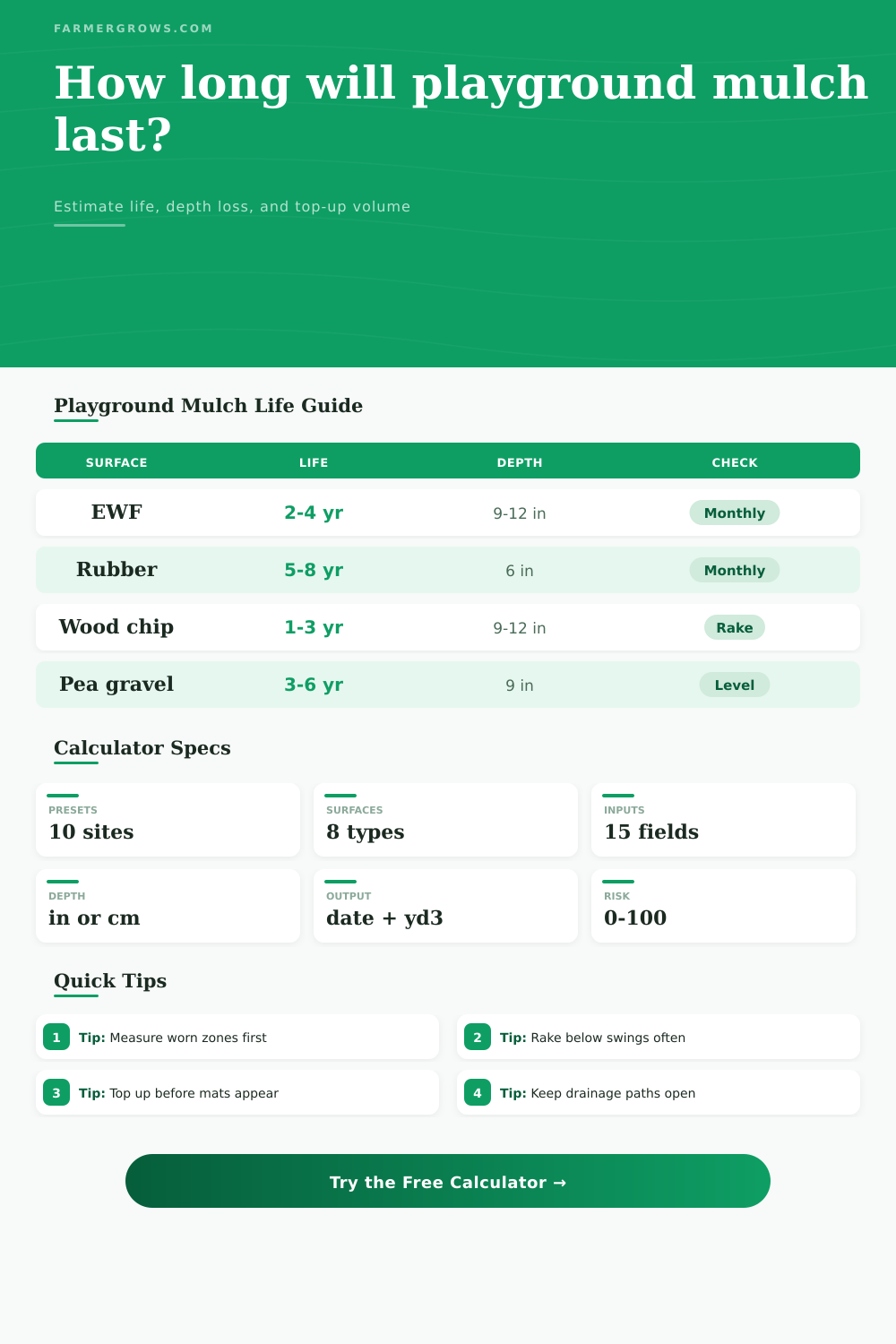
Playground Mulch Lifespan Calculator
Estimate how long loose-fill playground mulch should remain useful, when to top up, and how much material is needed after depth loss, compaction, traffic, drainage, and surface contamination.
Load a realistic play area, then adjust surface type, measured depth, fall-height target, traffic, drainage, and maintenance to match your site.
Playground Mulch Lifespan Estimate
Enter the play surface details to estimate remaining life and top-up material.
Loose-Fill Coverage by Depth
| Maintained depth | Sq ft per cubic yard | Sq m per cubic meter | Typical use note |
|---|---|---|---|
| 6 in | 54 sq ft | 2.0 m² | Low fall-height residential zones only after checking local guidance. |
| 9 in | 36 sq ft | 1.3 m² | Common maintained target for many loose-fill playground surfaces. |
| 12 in | 27 sq ft | 1.0 m² | Used where deeper cushioning or faster settling is expected. |
| 3 in top-up | 108 sq ft | 4.0 m² | Useful for restoring thin wear zones before the full area fails. |
Surface Factors Used by This Calculator
| Factor | Low stress | High stress | Calculator effect |
|---|---|---|---|
| Traffic | Backyard weekly use | Public daily use | Shortens expected life and raises inspection frequency. |
| Drainage | Free-draining base | Ponding or washout | Raises decomposition, fines, and depth-loss pressure. |
| Wear zones | Even use | Bare mats | Blends observed depth loss with surface-specific loss. |
| Maintenance | Weekly leveling | Rare raking | Changes scatter loss, compaction pressure, and review interval. |
Common Playground Top-Up Examples
| Project | Area | Top-up depth | Material volume |
|---|---|---|---|
| Swing bay repair | 80 sq ft | 3 in | 0.74 yd³ before buffer |
| Backyard play set | 240 sq ft | 4 in | 2.96 yd³ before buffer |
| Daycare toddler area | 450 sq ft | 2 in | 2.78 yd³ before buffer |
| School structure zone | 900 sq ft | 3 in | 8.33 yd³ before buffer |
Measure the thin spots: Playground surfacing is limited by the lowest useful depth in the use zone, not the average of fluffy corners.
Use this as a planning estimate: Check manufacturer guidance, local rules, and professional inspection requirements for critical fall-height compliance.
First, you spot the issue underneath swings. From across play space, mulch looks good. But when a kid steps onto it, ground feels hard. That compacted layer of mulch reduce the safety of playing space.
And it doesn’t happen overnight. Rain wash away finer particles called “fines.” Foot traffic kick it up. The seasons change surface. Or you can follow along with deterioration yourself. Or you can input your unique site conditions into calculator above to get your results.
Why Playground Mulch Wears Out
Rot: Most people think mulch life is about rot, but it’s actualy about depth. They think it’s all about rot. But wood fiber and bark chips does eventually break down…yet they scatter long before they go to mush. Kids on slides land hard, creating bare patch where their exit comes out. Swing sets act like fans blowing loose fill out of impact zone. They compress it into a hard layer, too.
Because fill doesn’t decompose instantly, the tool accounts for this by allowing you to define your wear zones. A big drop-off? You can expect these zones to last a shorter time then areas with heavy traffic lanes or bare mats beneath equipment. Why? You’re fighting physical displacement, not just biological decay.
The shape makes a difference, and more than most people realize. Real-life yards aren’t rectangles. They’re a mishmash of circles (as in the ring around that climber) and triangles (tucked behind a fence). There are also irregular corners where the mulch drains or puddle. Choosing the proper shape option in the calculator will help ensure you don’t over-order material. You can also rake existing mulch to help prevent a shortfall.
On the page, a table provides an overview of all this. This reference table show how square footage relates to volume depending on desired depth. So that’s the target depth, your safety net. A few inches may seem sufficient for a small backyard, but think about what’s beyond it: a swing set need some more cushion. For bigger drops, 12 inches is standard; but does that mean more material to upkeep? With the calculator, you can see just how much volume it takes to replenish that depth. It will tell you precisely how many bags, or cubic yards, to order to fill in thin spots and get them back up to code. You will no longer have to guess how much to order or make an extra run to landscape supply store in the pouring rain.
Water is another consideration. Mulch that drains well is loose and breathable. Mulch in poor-draining areas becomes compacted and rots prematurely, creating muddy conditions. If you have a playground where kids run around getting the mulch all over themselves and tracking it on your lawn, add six more years.
The tool takes into account sun exposure. Full sun makes wood mulch dry, dusty, and brittle. Shade means it will be moister and more likely to harbor fungus if not kept dry. And it figures in drainage conditions, adjusting the estimate of how long the mulch should of last.
All of that changes when we talk maintenance. No, no one rakes every week because it looks nice; it’s to redistribute any loose fill back where it was kicked out (into impact zones). It breaks up compaction mats that are becoming hazardous. To limit movement of materials so they do not stay displaced, which shortens how long they last in my garden. The calculator accounts for how often you do maintenance. If you simply level the surface a few times a year, it gives you a longer but more realistic estimate.
The results also include risk scores that can guide your priorities: Higher score? That’s a safety gap, and you’re near edge of it. Time to top up. Don’t let the mulch get entirely gone; don’t wait till mats is forming. Top up before then. Replacing an entire area cost more than just topping it with three inches of new material (on a 400-square-foot area). It’s about safety (and budget). Because planning your garden around these cycles will save money, and keep kids safe.
Don’t measure the fluffy edge; measure where they’ve worn through. Get an exact volume with the calculator, and allow for some extra settling room. Do the dates. Even if everything seems OK, if you installed engineered wood fiber more than two years ago, it’s likely time to freshen up. Surface life can vary, but the way it wears won’t.
The playground surface is a living thing. It settles. It shifts. It wears out. Treat it like a static floor, and you’ll have accidents. Treat it like soil, and you’ll do some maintenance. Just add as needed. The math can help, but what really counts are the bare patch beneath the swing.