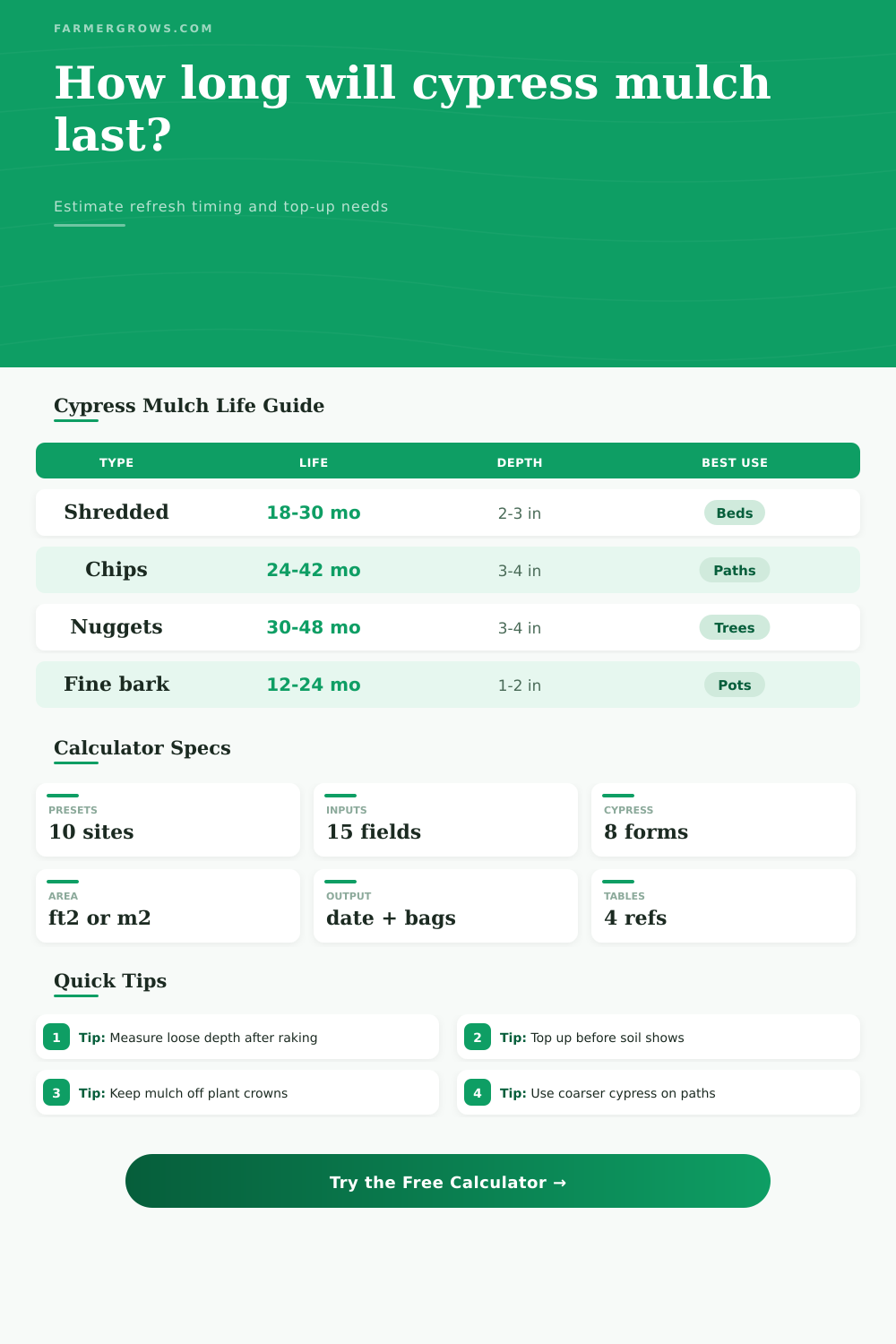
Cypress Mulch Lifespan Calculator
Estimate how long cypress mulch will keep useful coverage, when it should be refreshed, and how much top-up material your bed, path, tree ring, or container area needs.
Load a realistic cypress mulch situation, then fine-tune the area, depth, age, exposure, drainage, and maintenance for your site.
Cypress Mulch Lifespan Estimate
Results appear after calculation.
| Condition | Slower breakdown | Faster breakdown | Calculator effect |
|---|---|---|---|
| Cypress form | Nuggets or large chips | Fine shredded material | Changes baseline life and yearly depth loss |
| Moisture | Even moisture with good drainage | Frequent irrigation or wet runoff | Raises decay and compaction pressure |
| Sun exposure | Part shade or canopy shade | Full sun and reflected heat | Shortens color life and dries loose surface |
| Traffic | Undisturbed planting beds | Paths, pets, and play edges | Adds displacement and compaction loss |
| Ground contact | Fabric below the mulch | Cardboard or active soil contact | Adjusts biological contact rate |
| Maintenance | Rake, edge, and redistribute yearly | No raking since install | Changes remaining life and risk call |
| Depth | Sq ft per yd³ | Sq m per m³ | Common use |
|---|---|---|---|
| 1 inch | 324 sq ft | 12.0 m² | Cosmetic top-dress or containers |
| 2 inches | 162 sq ft | 6.0 m² | Light weed cover in maintained beds |
| 3 inches | 108 sq ft | 4.0 m² | Typical cypress bed refresh target |
| 4 inches | 81 sq ft | 3.0 m² | Coarse chips on paths or tree rings |
| 6 inches | 54 sq ft | 2.0 m² | Low-traffic play edge or deep chip zone |
| Package | Volume | Bags per yd³ | Coverage at 3 in |
|---|---|---|---|
| Small bag | 1.5 ft³ | 18 bags | 6 sq ft per bag |
| Standard bag | 2 ft³ | 13.5 bags | 8 sq ft per bag |
| Large bag | 3 ft³ | 9 bags | 12 sq ft per bag |
| Bulk cubic yard | 27 ft³ | 1 yd³ | 108 sq ft per yd³ |
| Project | Area | 3 in volume | 2 ft³ bags |
|---|---|---|---|
| Small foundation bed, 10 ft by 20 ft | 200 sq ft | 1.85 yd³ | 25 bags |
| Tree ring, 8 ft diameter | 50 sq ft | 0.47 yd³ | 7 bags |
| Garden path, 40 ft by 3 ft | 120 sq ft | 1.11 yd³ | 15 bags |
| Raised bed aisle, 24 ft by 4 ft | 96 sq ft | 0.89 yd³ | 12 bags |
| Backyard play edge, 15 ft by 15 ft | 225 sq ft | 2.08 yd³ | 29 bags |
Measure after loosening: Cypress mulch can crust or mat after rain. Rake it level before checking depth so the calculator reads the loose working layer, not just compacted high spots.
Refresh gradually: Restore the target depth without burying crowns, trunks, stems, or vegetable rows. Keep mulch pulled back where excess moisture against plant tissue would be a problem.
When people lay down a thick coat of cypress mulch, they assume that’s the final step, when in fact it isn’t. It looks rich, smells good, and you may think the bed is done forever. But once the mulch is exposed to moisture and air, it starts to decompose right away.
How fast does this happen? That depends on the mulch type and the location. Mulch settles fast: Shredded mulch are made of individual particles with spaces between them. Those spaces fill as the mulch settles, forming a compact mat that retains water well (but uses up much less space over time). That means if you put down three inches in the spring, you might have just two inches by fall. And that leads to a patchy-looking bed after just one rainy season.
Why Mulch Disappears and How to Fix It
Materials such as big wood chips or bark nuggets don’t settle nearly as much; they allow air pockets, so the surface stays fluffier and more distinct for longer. Once you know how deep things are now, the calculator above will tell you how long until the layer is too thin to do its job of covering.
It is like all garden chores: when should you do them? The obvious answer is “when it shows,” as in when you see the soil, but then it’s too late. Weeds has had time to grow in any holes, and what mulch remains is baked hard into a crusty state. Top up mulch when it feels skimpy beneath your feet, not when it looks shabby.
The tool will tell you how much longer the mulch might last (assuming it was installed in the first place), based off its age and your climate. Because heat hastens breakdown, a bed in a hot, humid southern summer gets gunked-up faster then one in a cool, dry northern climate. A sunnier spot bakes the surface and dries out organic matter even quicker.
Mulches do have a limited lifespan, especially if they is frequently washed by water, whether from irrigation or from heavy runoff. Heavier chunks tend to slide downhill (gravity), while those pesky open edges of any hillside give in more rapidly to wind and rain than do a bed whose sides is rigidly edged along the ground. To take all that into account, my calculator includes both these conditions (as well as slope).
Can’t turn back time, but you can plan ahead. Since paths thin out faster than ornamental borders, you can plan to top them up before any ugly spots appear. The other thing you should know: Compressed bag volume isn’t the same as loose volume. There’s what we call a fluff factor: A cubic foot of mulch in a bag isn’t going to be the same as a cubic foot spread around on the ground. So your bag count will be off.
That’s why the size of the bag makes such a difference in coverage area (see chart). Run out mid-project, and you’ve wasted money, or have a half-done job that looks worse then no mulch at all. It is best to buy just a little extra and save some for touch-ups later instead of running short.
Mulching is about much more than looks; it conserves moisture and moderates soil temperatures as well. Without a layer, the soil surface dries sooner, and plants don’t fare well. Without mulch, you have to weed and water more because the plants gets direct sunlight. Keeping up a mulch layer is an investment in your plants’ health (not just a curb-appeal thing).
If you rake up any existing mulch first, that will help prevent matting, and will also blend new and old, spreading the organic matter evenly for good soil-air exchange. Don’t heap mulch onto plant stems or tree trunks (that’s an invitation to rot, and traps moisture). Pull it back a couple of inches at the base of trunks, and all will last longer: plants and mulch alike.
Yes, cypress mulch lasts. But it doesn’t last forever. It’s a living thing that should of return to the earth, and your task is to help that process happen. When you understand how form, maintenance and climate work together, you can finally stop guessing. And begin planning. You will know when to buy bags, when to rake, and when to just walk away.
No more patchy garden… Just a healthy bed that stands up to the weeds and lets you stand your ground against them. Satisfied with what’s going on below, you stand back.