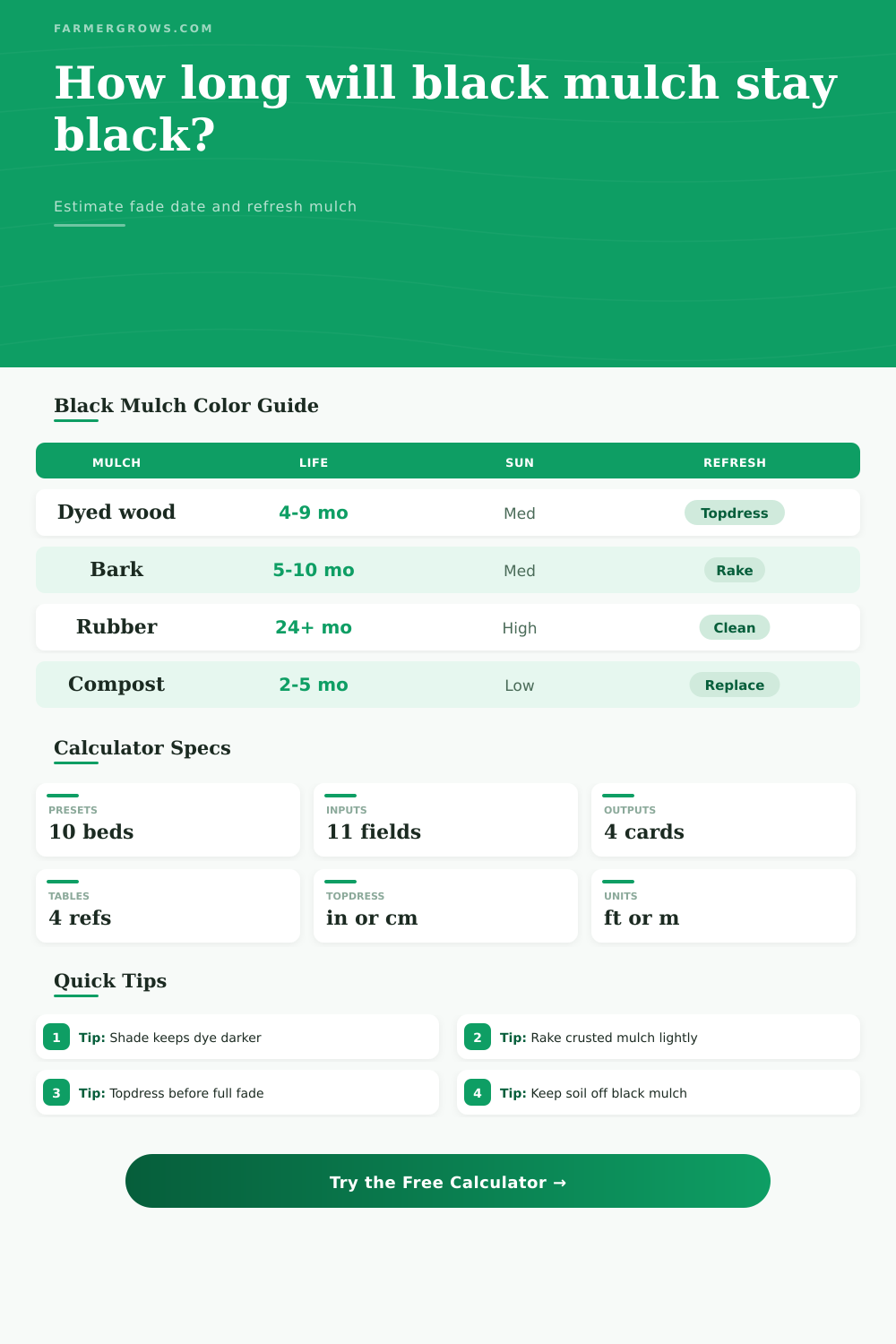
Black Mulch Color Life Calculator
Estimate how long black mulch will keep a dark, freshly dressed look from material type, dye quality, bed size, mulch depth, sun, heat, rain, irrigation, splash, traffic, and maintenance.
Load a realistic bed, border, tree ring, playground, or commercial frontage scenario, then adjust the exposure and refresh threshold for your site.
Black Mulch Color Life Results
Your black mulch color estimate will appear here after calculation.
Black color life depends on whether the darkness comes from dye, natural organic color, rubber pigment, or stone. These profiles drive the calculator.
Refresh before the black tone looks brown from the sidewalk. Good for front beds and commercial entries.
Let the bed fade longer when weed control and soil cover matter more than sharp color.
Full sun plus sprinkler wetting speeds dye wash, surface oxidation, and soil splash.
Part shade, drip irrigation, and light raking can keep black mulch presentable longer.
| Black mulch material | Typical dark-life range | Density used | Color behavior |
|---|---|---|---|
| Dyed shredded hardwood | 150 to 300 days | 700 lb/yd³ | Strong first color, then UV fade and brown wood show-through. |
| Dyed bark nuggets | 180 to 330 days | 600 lb/yd³ | Bark pieces resist crusting and hide splash better than fine shreds. |
| Dyed cedar mulch | 170 to 320 days | 560 lb/yd³ | Good color hold when not blasted by sprinklers or blowers. |
| Pine bark dark blend | 160 to 300 days | 520 lb/yd³ | Natural dark brown-black tones fade gradually rather than washing off. |
| Screened black compost | 80 to 160 days | 950 lb/yd³ | Looks rich when fresh but blends into soil and crusts with rain. |
| Black rubber mulch | 720 to 1200 days | 850 lb/yd³ | Pigment lasts longer; dust and debris usually dull the surface first. |
| Exposure factor | Multiplier | What it means | Color-life effect |
|---|---|---|---|
| Mostly shade | 0.72x | 0 to 2 direct sun hours | Slows UV fade and surface drying. |
| Mixed sun | 1.00x | 4 to 6 direct sun hours | Normal seasonal fading baseline. |
| Hot open sun | 1.45x | 8+ direct sun hours | Shortens color life sharply. |
| Downspout splash | 1.34x | Runoff or soil splash | Washes dye and covers black surface. |
| Topdress depth | Coverage per yd³ | 2 cu ft bags per 100 sq ft | Best use |
|---|---|---|---|
| 1/2 inch | 648 sq ft | 0.8 bags | Light color touch-up where base depth is still good. |
| 3/4 inch | 432 sq ft | 1.2 bags | Common cosmetic refresh for front beds. |
| 1 inch | 324 sq ft | 1.5 bags | Refresh plus minor settling repair. |
| 2 inches | 162 sq ft | 3.1 bags | Full seasonal topdress over thin old mulch. |
| Project size | Area | Topdress at 3/4 inch | 2 cu ft bags plus 10% |
|---|---|---|---|
| Small foundation bed | 80 sq ft | 0.19 yd³ | 3 bags |
| Tree ring, 8 ft diameter | 50 sq ft | 0.12 yd³ | 2 bags |
| Long border strip | 180 sq ft | 0.42 yd³ | 7 bags |
| Commercial entry bed | 500 sq ft | 1.16 yd³ | 18 bags |
Refresh color before the bed looks patchy. A 1/2 to 1 inch black topdress usually restores curb appeal if the original mulch depth still suppresses weeds.
Separate fading from dirt coverage. If the mulch is still black underneath, remove leaves, redirect splash, and rake the surface before adding more material.
In late spring you notice that once-crisp, ink-black mulch you applied in March is starting to look old. It isn’t actualy decomposing; the black dye is just fading from the time, rain, and sun. You know fresh mulch looks better, but why bother adding another cubic yard to a bed whose structure are already intact?
Use the calculator above to run the math for you, turning your vague concern over fade into volume estimate and specific refresh date.
How to Keep Black Mulch Looking New
Here’s the thing about black mulch: It isn’t really black (at least not at a molecular level). Bark and hardwood mulches is most often pigmented with dye that covers their surface but doesn’t bond with the wood fiber itself. Ultraviolet light can breaks the chemical bonds that secure the color; so can heavy rainfall washing away some of the loose particles.
You’ll notice that exposure settings in the tool are important. If you have a heavily watered bed getting regular soaking from the sprinklers in full sun, it will go through its finish much more quickly then a bed shaded beneath the drip line of a maple tree fed by drip irrigation. To make up for this, the tool multiplies your estimated life of whatever material you use as a starting point, so instead of the rosier-than-reality number stamped on the bag, you gets an accurate timeline.
How does all of this impact the longevity of that dark look? A lot depend on what you choose. Shredded hardwood dyed black will have a rich dark color right from the start. However, be sure to protect it with care. It can quickly get covered up by soil splash or fade due to UV exposure.
Bark nuggets tend to resist soil splashing and wear down over time to retain their appearance (even as the color fades), because they’re coarser pieces. Compost mulches starts off dark, too, but soon blend back in with the ground, meaning no visual contrast after several months. Rubber mulches holds their color for years, but they collect debris and dust that can dull the surface; just clean them instead of replacing them.
The comparison table on that page spells it out, and explains why your playground surface stay dark longer than your garden bed.
To avoid a brown or patchy-looking bed, get ahead of the problem by topping up the color instead. Topping up with another half- or full-inch layer of new black mulch can make all the difference, without replacing the whole depth of mulch, which is not only expensive but also time-consuming. The existing mulch beneath still retains moisture and inhibits weeds, even if it’s no longer looking like new.
Use the calculator to figure out just how much cubic yardage of material you’ll require for such a topdressing job, taking into account not only the shape of your beds, but also their original depth and how much to allow for waste. That way you won’t undershoot when it comes to estimating how much material will fit where (such as tree-ring shapes, or any other odd border).
Another factor that affects color life is how much you maintain it. The more raking you do, the more it will affect the color life of the mulch. For instance, if you have dark mulch, turning it over by raking lightly on the surface can bring the fresher color up to the top. There is no need to add any more furnitures.
Similarly, you can keep the mulch looking black longer by preventing soil from splashing onto it. Use good edging or redirect downspouts to avoid this. If you’re blowing off leaves, you may be scuffing up the mulch; another thing that speeds its fading. It’s all little stuff. But it matters.
There are fields in the tool where you can adjust the estimate based off your own site conditions and maintenance habits, including things such as splash exposure and maintenance intensity. But ultimately? Black mulch is a visual investment. It doesn’t make plants any healthier than naturaly brown mulch. It offers contrast with hardscape and green foliage.
Once that contrast fades, the bed just looks tired, regardless of how healthy the plant are. Knowing what causes those diminishing returns allows you to plan your maintenance with a goal in mind, visual, not guesswork. You decide whether to keep a front entry at seventy percent blackness and a utility bed at half-black.
Doing either or both on schedule, knowing when enough is enough, helps you control the story in your landscape one season at a time. Knowing the math lets you decide when’s enough is enough…so that you can enjoy the fresh, dark look just a little longer without spending too much.
You should of used it sooner.