
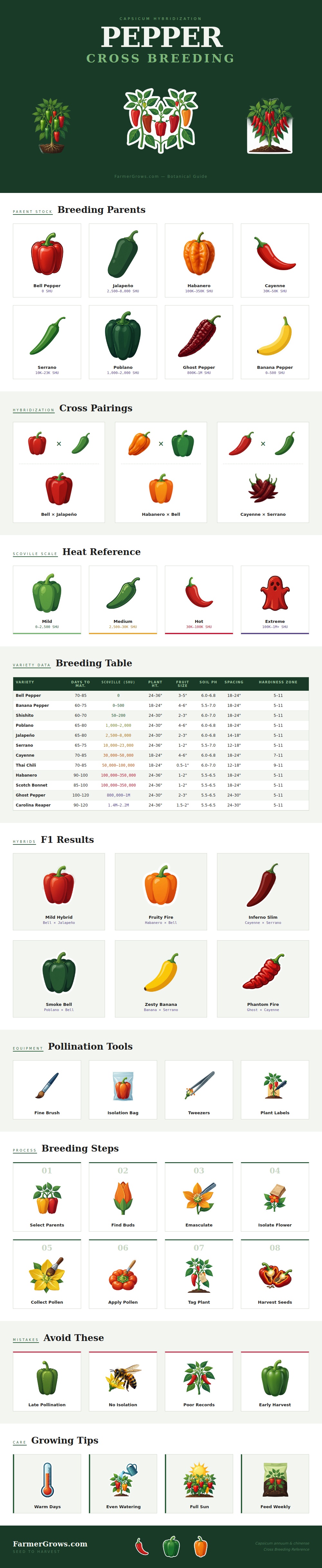
The particular kind of interest is in cross breeding peppers. When you do this, you’re pulling traits from one plant and splicing them onto another: You’re acting as your own genetic builder, creating something that didn’t exist before. Not only aren’t you growing food, you’re designing it, form and flavor and all, from scratch. And that’s what the chart above does: It maps out the possibilities. You see how the habanero and the bell pepper, for instance, can be mixed together to create hybrids whose characteristics is predictable. You see how to turn a complex biological process into a manageable set of choices.
Peppers aren’t all sexually compatible. The chart focuses on peppers of same genus (and species), C. These are annuum and chinense. That’s a tough biological restriction. Yes, you’ll get seed if you attempt to cross a banana pepper and a jalapeño. But unless you carefuly manage it, you’re probably wasting your time trying to make a baby between, say, a jalapeño and a ghost pepper. The guide sorts them out for you. It organizes them by their botanical lineages and relative heat profile, making it easier to identify which ones would be compatible and which would not. If there’s no hope in hell, why waste months on a fruitless experiment?
How to Cross Breed Peppers
The most glaring characteristic is heat, and that’s where I think many people go wrong in thinking about them. The Scoville scale used in the infographic shows how hot peppers can be. They range from nothing, like mild bell pepper, to around a million, like hot peppers such as the ghost pepper. Now what happens when you crossbreed a hot pepper with a milder one? Does the hybrid have half the number on the Scoville scale? No, because genetics isn’t an equation. You could end up with a more moderate plant, or you could end up with a doozy. The amount depends on how far from the center of the chart you go, as shown below: crossing a jalapeño with a bell pepper creates a mild hybrid. But crossing serrano and cayenne produces something significantly spicier than what you started with.
Success with your genetic experiment hinges on several key details: the space allotted for each variety, and its required soil pH. Most of these varieties do best in slightly acid conditions (pH ranging from six to six point eight), the table says, so check yours. If it’s too alkaline, they won’t be able to take up nutrients. No matter how perfect your pollination technique was, the plants will die if the soil is too alkaline.
Their need for elbowroom is also important. A habanero is a bushy plant that grows out rather than up, it requires eighteen to twenty-four inches of space per plant. A serrano’s more slim and tall. Overcrowd them, and you’ll have diseased beds in no time. As if to remind us that good genetics depend on good housekeeping, the data reminds you this, too. It’s not like taking a walk through the garden; it’s more like careful surgery. Tweezers are involved, and so are isolation bags and fine brushes.
The how-to guide lays out the details in a step-by-step fashion that seems manageable. First, choose your parent plants, then identify which ones have flower buds (before they open). Next: remove the male parts from the female flower to ensure there is no self-pollination. Once the flower is separated, apply pollen obtained from the male parent of choice. Sounds easy enough, but it all depends on when you do it. Too soon and the pollen won’t adhere. Too late, and it’s already been self-fertilized.
Don’t skip the isolation step, and make sure you keep good records (skipping these is a common mistake). If you didn’t label your plants clearly you won’t know what crossed what next season. If you didn’t bag up the flowers, wind or bees will contaminate your cross. These types of things are the silent killers of a breeding project, and the guide stresses why it’s important to avoid them. A few tags made with a marker is nothing. But it makes all the difference between guessing at the outcome versus having done something scientific.
In the end, cross breeding requires observation and patience. These are living systems, and they have rules. That chart (above) is a roadmap. Your garden is the territory. Begin simply by making some easy crosses, like the bell-jalapeño, to get the hang of it. As your confidence grows, move on to more complex traits and more extreme heat levels. What will you be rewarded with? You will receive not only the pepper itself, but also the knowledge of how you made it. One seed at a time, you are creating a new piece of your garden’s history.