
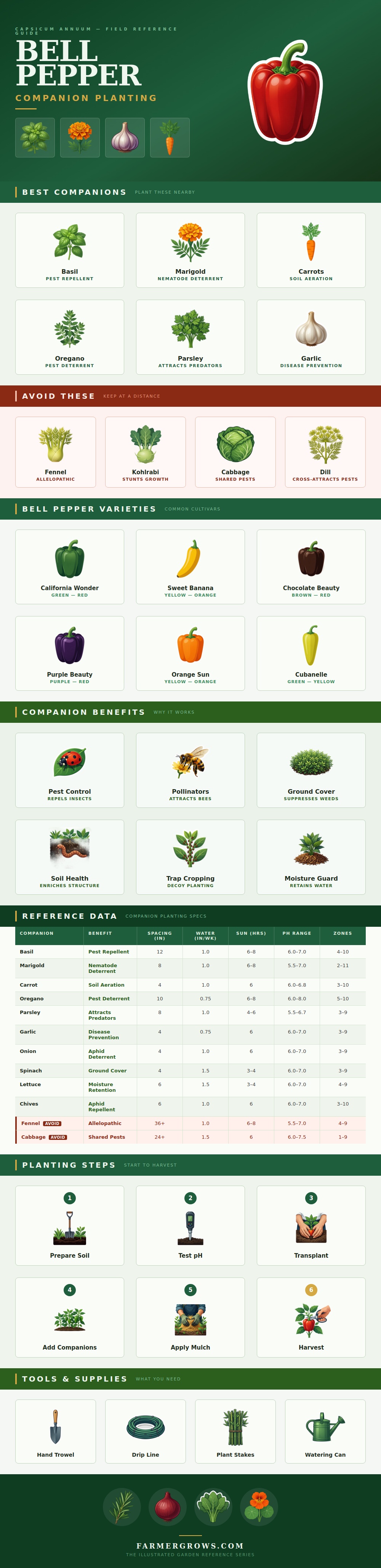
Bell peppers are one of those common garden casualties: suddenly, a plant you’ve watched thrive for months dissapears, or it just goes mysteriously limp and doesn’t recover. Even though you’ve been watering it faithfully and talking to it (ok, I admit that’s optional), something unseen were working against the plant. What? How do you stop such losses? You can use companion planting. It is not magic, exactly, but smart tactics.
Which plants will protect them, and which should you avoid growing too close to them? Find out in chart above. Think of your garden like A NEIGHBORHOOD: There are good neighbors (the ones who bring over casseroles and help in time of need) and bad ones (who poison the water or pollute the air).
Good and Bad Neighbors for Bell Peppers
That’s fennel, the kind of neighbor that release chemicals to stunt growth of everyone around it. Fennel is allelopathic, meaning it exudes chemicals that suppress other plants growing around them. Plant it near a row of peppers, for instance, and those peppers won’t fare well. The chemical suppressant stunts growth; there are no outward signs until its too late. Keep fennel away from everything else, pretty flowers or not.
Peppers has a friend in basil. Its fragrance confuses mites, aphids, and thrips, which is pests that adore young pepper foliage. Basil can also helps repel them from your plants if you plant some about a foot or two away. Basil acts as natural barrier around your peppers, which is all good news.
And then there’s marigolds, which act as another line of defense. Their roots releases compounds that repel nematodes (harmful roundworms, also known as microscopic creatures whose name begins with “n”). Marigolds in the soil provide proactive protection to prevent damage to root systems. There’s a lot about moisture retention and soil structure in this infographic too.
The carrots’ deep taproot does something else: It aerates the soil, allowing nutrients and water to reach the shallower roots of the peppers more better. This illustrates another part of complementary growth habits: planting not just for what you’ll harvest, but for environment that will support your harvest.
Living mulch: Low-growing plants like lettuce or spinach shade the soil, reducing evaporation. It make the root-zone cooler, which is important with things like peppers that is vulnerable to water stress in summer heat.
Plant mixing isn’t always good, either. Peppers have same pests as brassicas such as cabbage and kohlrabi. The two kind of plants are competing for resources, making both sets of plant weaker. Dill is the same. That attracts the same aphids you don’t want on your peppers. If you want problem-solvers instead of problem-makers, choose plants that actualy help.
Companion planting works if you understand which plants gets along. It’s not just about mixing things up; rather, it’s about creating an ecosystem where the whole is greater then the sum of its parts. What does that mean? Look at the garden for connections. Identify soil builders and defense lines. Don’t go near antagonists such as cabbage and fennel. Marigold and basil is a match made in heaven. The pepper plants grows taller and bear more heavily. You are working with nature, not against it. That’s what makes for a resilent garden. No need to feel anxious about growing your own peppers.