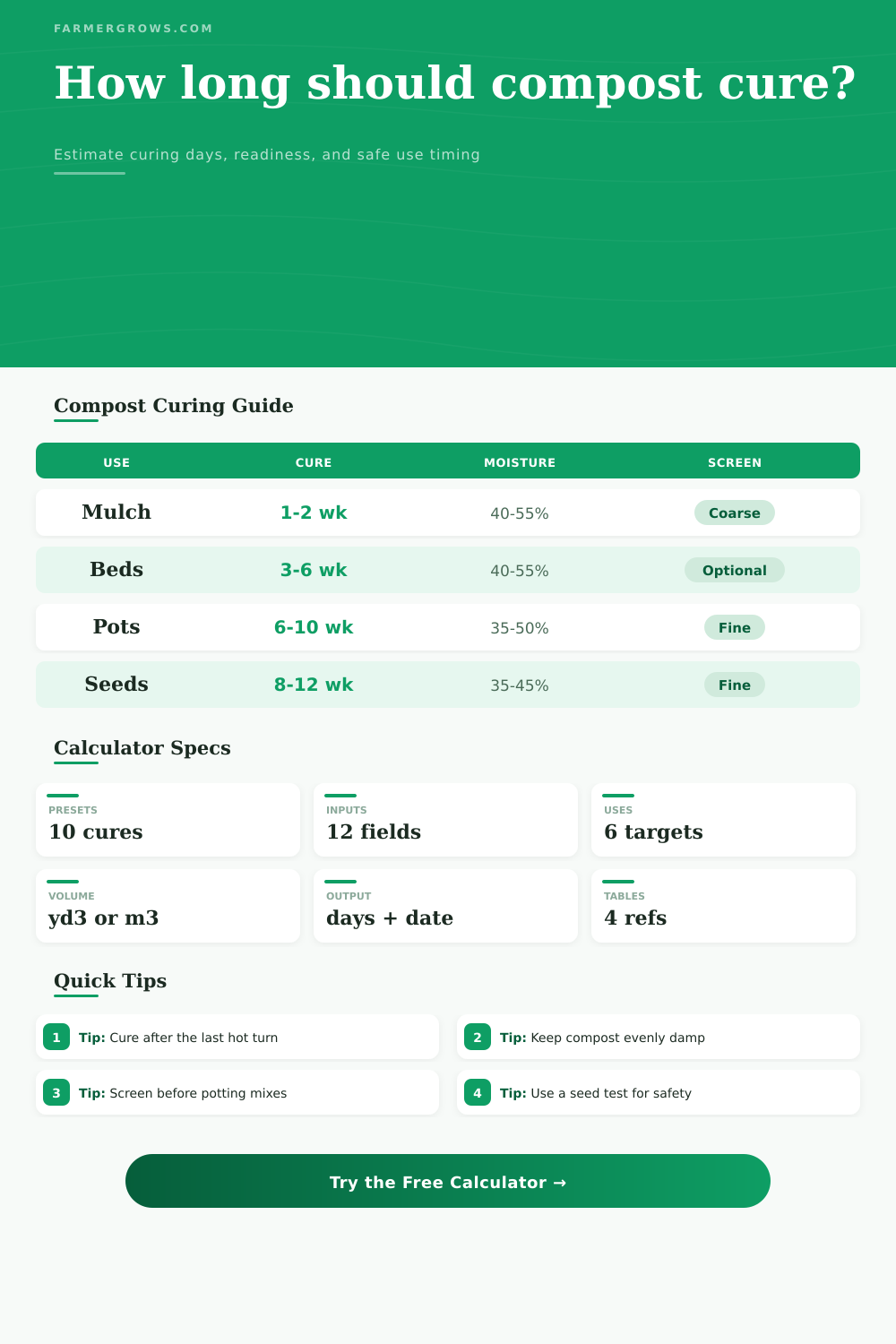
Compost Curing Time Calculator
Estimate the resting time compost needs after active breakdown so it can cool, stabilize, finish releasing ammonia, and become safer for mulch, garden beds, potting mixes, or seed starting.
Pick the closest real curing situation, then adjust the material, last heat, moisture, volume, screening, and intended use.
Compost Curing Estimate
Enter compost conditions to estimate curing time.
Breathes well and is easy to turn. Best when compost can stay damp under a breathable cover.
Side airflow and easy access help compost finish evenly while keeping batches separated.
Useful in rain, but tight tarps slow oxygen flow and can extend the curing estimate.
Works for finished material, but compost should be cool and stable before being sealed up.
| Intended use | Typical extra cure after active composting | Minimum maturity signs | Why the calculator changes time |
|---|---|---|---|
| Coarse mulch or trench compost | 1 to 2 weeks when cool | No ammonia, no sour odor, coarse pieces acceptable | Soil life can finish coarse compost in place away from seedling roots. |
| Field or orchard topdress | 2 to 4 weeks | Earthy smell and low reheat after turning | Established roots tolerate more texture than containers or seed trays. |
| Vegetable garden beds | 3 to 6 weeks | Cool, crumbly, and stable after a moisture check | Fresh vegetables and transplants benefit from lower ammonia and acids. |
| Container or raised-bed blend | 5 to 8 weeks | Screened texture with no heat rebound | Containers concentrate soluble salts and immature-compost effects. |
| Potting mix ingredient | 6 to 10 weeks | Fine screened, cool, earthy, and preferably germination-tested | Roots have limited escape space, so stability matters more. |
| Seed-starting ingredient | 8 to 12 weeks or longer | Fine screened, no ammonia, and passes a seed test | Seeds are most sensitive to unstable nitrogen, salts, and organic acids. |
| Compost material | Curing tendency | Main caution | Practical maturity check |
|---|---|---|---|
| Balanced finished compost | Moderate, usually predictable | May still reheat if screened too early | Turn once, then check that the center stays close to air temperature. |
| Food scraps and leaves | Moderate to slow | Wet pockets and recognizable scraps | Break open clumps and smell for sour or fruity unfinished zones. |
| Grass-heavy compost | Fast but risky | Ammonia and matting | Look for a sweet-earthy smell after fluffing and adding dry browns. |
| Manure and straw compost | Moderate to long | Pathogen and ammonia concerns | Use conservative curing time and avoid applying fresh material near harvest. |
| Chicken litter compost | Longer stabilization | High nitrogen and salts | Cure until no ammonia is detectable and use cautiously in containers. |
| Woody chip compost | Long and texture-driven | Carbon tie-up and coarse pieces | Screen oversized chips and return them to the next compost batch. |
| Leaf mold compost | Slow fungal finish | Cold, dry leaves stall | Check that leaves crumble by hand and hold moisture evenly. |
| Worm castings or vermicompost | Short hold when stable | Overwet storage and anaerobic bins | Let castings air-cure lightly before sealing or mixing into seed media. |
| Condition | Best curing range | What happens outside range | Calculator effect |
|---|---|---|---|
| Moisture | 35% to 55% | Dry compost stalls; wet compost loses oxygen | Dry or wet entries add curing days and lower score. |
| Temperature | Within 10°F / 6°C of air | Warm centers mean active breakdown is still happening | Warm or hot cores add a carryover delay. |
| Aeration | Light turning every 1 to 4 weeks | No air can leave wet pockets immature | Passive or bagged curing increases time. |
| Storage cover | Breathable cover or airy bay | Tight tarp or sealed tote can trap moisture | Limited airflow adds a storage penalty. |
| Screening | 1/2 inch for beds, 1/4 inch for mixes | Coarse particles finish unevenly | Fine targets require extra curing after screening. |
| Check | Ready sign | Needs more curing | Action before use |
|---|---|---|---|
| Reheat test | Does not warm strongly after turning | Center reheats again within 24 to 72 hours | Turn, moisten if needed, and restart part of the curing clock. |
| Smell test | Earthy, mild, and clean | Ammonia, rotten, sour, or silage smell | Add dry browns for wet piles and keep curing with airflow. |
| Visual test | Dark, crumbly, and mostly unrecognizable | Fresh scraps, pale bedding, or matted grass remain | Screen coarse pieces and return them to active compost. |
| Moisture squeeze | Clumps lightly, no water drips | Dusty dry or dripping wet | Correct moisture before judging the final curing time. |
| Seed test | Fast, normal germination beside a control | Poor germination or stunted roots | Cure longer before using in seed-starting or potting media. |
Start curing after active feeding stops. A pile that keeps receiving kitchen scraps, manure, or fresh grass is still composting, not curing. Build a batch, allow it to heat, then separate the finished-looking material for its quiet curing phase.
Use the strictest target in the batch. Compost that is fine for orchard mulch may still be too active for seed trays. If part of the batch will go into containers, cure and screen for that more sensitive use.
Backyard composting has its own kind of denial. “It’s done,” you think, turning the heap, seeing worms look happy, feeling it get hot. It feels like compost; it even stinks like earth, so it must be compost.
Not yet. And then in a week or two, those precious seedling go floppy, harvested before their time (and you know what? It wasn’t). Knowing the right time means knowing how to wait for it and understanding why curing is necesary. The garden thanks you.
Why You Must Wait Before Using Compost
Curing is not simply “letting it sit.” Rather, it’s active stabilization. During high-heat phase, seed and pathogens are killed… But so are other things, like volatile organic acids and excess ammonia. Though they’re great for microbes, these chemicals harm plant roots. If you use compost while it is still changing, those microbe will compete for available nitrogen. That ties up nutrients, and shortens growth.
The tool considers this and asks what the composted item will be used for. A potting mix for tender seeds must have zero tolerance (no roots can gets away from chemical burn). An orchard-floor mulch made of coarse materials has lower tolerance requirements because soil organism will do most of the work underground. That difference alters time required, by weeks.
How quickly does it stabilize? That depends on inputs. The largest variable is how much moisture you added. Too wet, too bad. A wet pile don’t aerate well; oxygen can’t get in and aerobic processes grind to a halt. The calculator punishes high moisture entries.
What about temperature? Can’t have an unstable pile that’s twenty degrees warmer than ambient air, right? The math is straightforward. Activity means heat. Activity means instability. You can’t have both going on in one pile at once.
Less obviously: volume matters. Unlike a bucket of leaf mold, a big pile called a windrow hold moisture and heat differently. That’s why the calculator adjust from scale to scale.
But the trickiest part is smell test. High nitrogen content that is non-bonded can lead to ammonia, which is potentially bad for your garden. Anaerobic patches where rot will set in mean sour odors. Longer waits ahead for both. Depending on the material (like grass clippings or manure) there is greater risk, as you see in the reference table. Turning grass prevents matting; all manure need extra time to be sure to kill any pathogens.
We all wish we could jump straight into gardening, so we tend to hurry this step. But composting isn’t about adding things; it’s about taking things away. It’s waiting for some volatiles to escape, for things to settle in place. The calculator will tell you a date, but think of that date as a goal rather than a promise.
Check with your own senses. Is it cool to the touch? Does it crumble readily, smelling like a just-rained-on forest floor? Then it’s ready. Otherwise, wait a week more (it’ll be hot then or have a sharp smell). Your hands and nose will confirm what the tool only shows.
The source doesn’t say that waiting too long means you won’t use it at all; it says waiting too soon can poison your plants or stunt their growth. Wait too soon, and you’ll poison things, or at least stunt their growth, and then you won’t have any compost to show for it. You should of waited longer.
Patience is key: Just when you think it’s time to turn it in, it isn’t. You’ll know it’s ready when you spread that stable stuff on your beds. And it won’t smell; it won’t even heat up again.
No, it just sits there feeding the soil life that feeds the garden. That’s the payoff of letting it cure.