Tumbler Composting Time Calculator
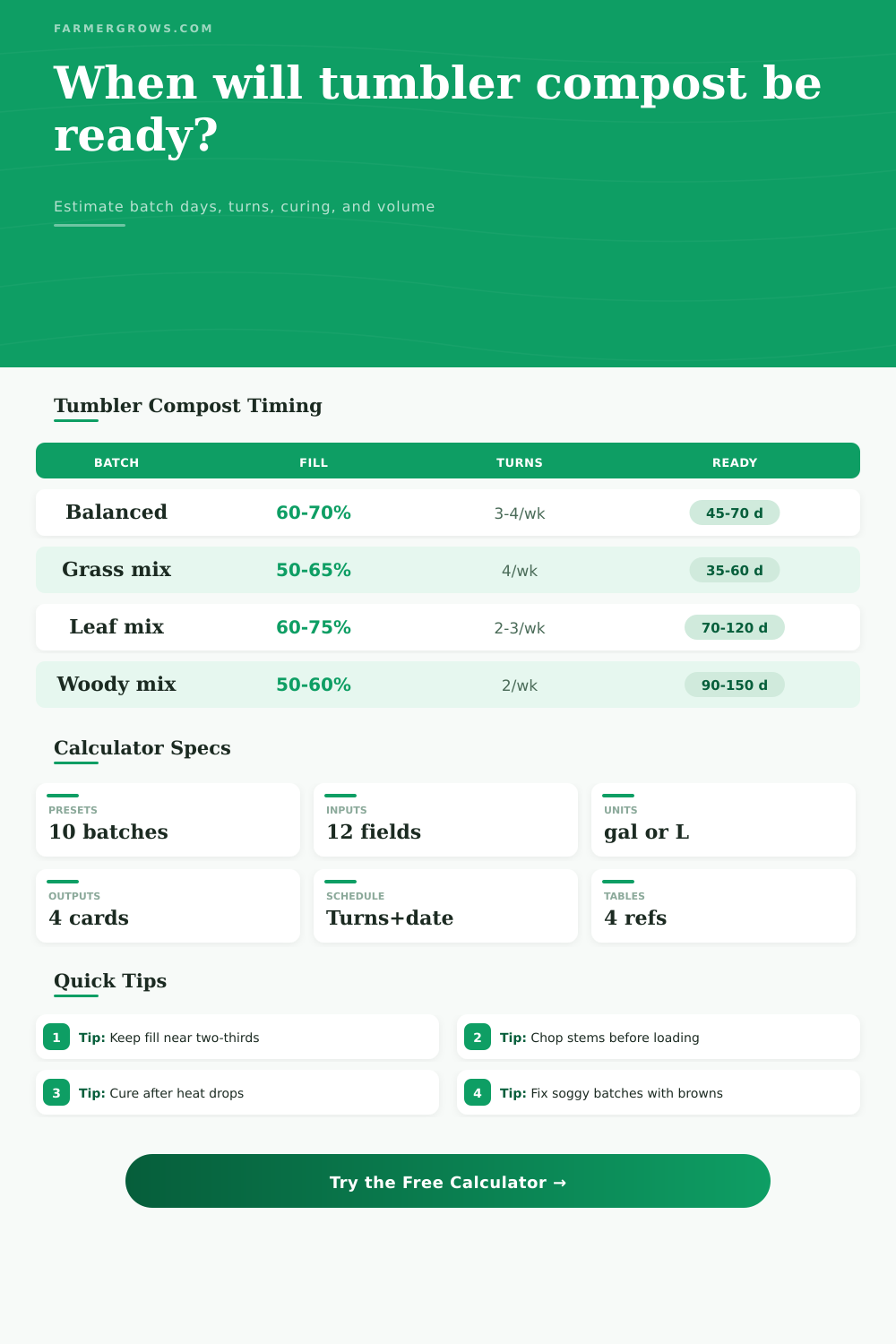
Estimate when a compost tumbler batch should finish active breakdown and curing from chamber size, fill level, recipe balance, moisture, turning rhythm, temperature, and batch age.
Pick the tumbler load that looks closest, then tune the inputs to match your chamber. Presets model closed-batch tumblers, not open piles.
Your Tumbler Compost Timeline
Adjust the inputs above to calculate a tumbler-specific estimate.
Best for small steady kitchen and yard loads that can be filled, closed, turned, and cured as one batch.
One chamber cures while the other fills, so finished compost arrives more regularly with less batch mixing.
Larger volume can heat harder, but it needs enough space, moisture checks, and fork turning.
Low labor and forgiving, but slower because oxygen, heat, and mixing are less controlled.
| Material profile | Typical active time | Common slowdown | Best tumbler adjustment |
|---|---|---|---|
| Kitchen scraps with shredded browns | 45-75 days | Too wet or too many food scraps | Add dry cardboard and turn 3-4 times weekly |
| Grass clippings with dry leaves | 35-60 days | Matting and low oxygen | Mix in loose dry leaves before loading |
| Coffee grounds with paper | 30-55 days | Dense, wet clumps | Blend with torn cardboard for structure |
| Mostly fall leaves | 70-120 days | High carbon and intact leaves | Shred leaves and add a small green boost |
| Woody stems or chips | 90-150 days | Lignin-rich pieces break slowly | Screen coarse pieces into the next batch |
| Fill level | Mixing quality | Heat potential | Timing effect |
|---|---|---|---|
| Under 35% | Good tumble but little mass | Low | Add 10-25% more time unless weather is warm |
| 35-50% | Good | Moderate | Slightly slower than the sweet spot |
| 50-75% | Best | Best | Fastest range for most backyard tumblers |
| 75-85% | Reduced | Good at first | Often slows from compaction and wet pockets |
| Over 85% | Poor | Uneven | Remove material or add coarse browns |
| Moisture feel | Approximate moisture | What happens | Correction |
|---|---|---|---|
| Dry and dusty | Under 40% | Microbes slow and heat fades | Mist while turning until evenly damp |
| Damp sponge | 55-65% | Fast aerobic breakdown | Keep vents open and turn on schedule |
| Wet clumps | Over 70% | Air pockets collapse | Add shredded dry browns |
| Leaking or sour | Over 75% | Anaerobic pockets form | Drain, add coarse carbon, leave vented |
| Outdoor temperature | Likely batch behavior | Expected adjustment | Practical note |
|---|---|---|---|
| Below 45°F | Low microbial activity | Much slower | Insulate, wait for spring, or accept a holding phase |
| 45-55°F | Warm composting possible | Moderately slower | Use smaller particles and balanced moisture |
| 56-75°F | Reliable aerobic breakdown | Baseline | Most calculator presets assume this range |
| 76-90°F | Fast but can dry | Slightly faster | Check moisture weekly |
| Above 90°F | Drying and ammonia risk | Variable | Shade the tumbler and add browns to wet greens |
Use the active date as a checking point. A tumbler batch is ready to cure when the mix is dark, earthy, and no longer dominated by visible food scraps. If it is still hot, sharp-smelling, or chunky, keep it active longer.
Do not keep adding fresh scraps to the same batch. Continuous feeding resets the clock. For faster compost, fill a chamber, balance it with browns, then stop adding fresh material while it finishes.
It’s tuesday morning, and you’re filling A TUMBLER full of hope and kitchen waste and expecting that come next weekend, it’ll be rich dark crumbly gold. Nope. That’s the lesson of all compost: Universal Composting 101, or something like that. The composting machines is perfectly good. But the biological side take as long as it wants, damnit. Enter the tumbler composting time calculator, which is designed to close the gap between expectation and real world. It does not require a microbiology degree. You just need to be honest about what is in your drum and consider a few things you can control, which will give you a time frame that might actualy match yours.
So what’s the biggest variable? It is the fill level. People overfill their tumblers and assume that bigger = better. Bigger = slower. Take a look at reference table on the page. As a drum fills up, it cannot tumble; it compresses and squeezes oxygen from all the composting organisms. They can’t do their thing without oxygen so they dies. The higher the fill percentage, the worse it will be (the penalty is reflected in the calculator). Physics wins. Your goal is to find a sweet spot between too little mass (not much heat retention) and too much mass (can’t tumble well; no good airflow). Eighty percent filled is a rough number where you’d expect the timeline to lengthen. There is a biological penalty associated with a suffocated pile, and that’s reflected in math.
How to Use the Compost Time Calculator
Then there’s moisture. How does it feel? That’s what the tool asks you to evaluate. Is it dry and dusty? It’s dormant, because microbes requires moisture to break down the carbon. Is it soggy and oozing? All the air pockets are depleted and now it’s anaerobic bacteria running the show. And those smell like rot. Not only is it an expression, but also a practical reference point. As soon as it feels like a wrung out sponge, tick tick tick… The timer begins. When it drips water, you wait for it to drain. Why? The texture tells the calculator how many active days there is. This is because moisture determines the rate at which enzymes do their thing. Biology can’t hurry when it’s holding its breath.
How often do you turn? That’s an obsession of people. There is a reason the default is three to four times per week. It is enough to give some air, but not let it get too cool. An hour means you’re cooling down the batch, and monthly means you’ve got anaerobic going on. If you enter how frequently you turn in the calculator, it will show you the total number of turns it estimates are still needed. So if you know you have 20 more turns to go, that can help you power through when it doesn’t seem worth it, maybe it’s raining on Tuesday and you don’t want to crank that thing, or whatever. The time calculator will translate work into days. It shows you exactly how much effort you’re putting in.
More people underestimate how much temperature matters. That’s why the same tumbler in February won’t compost as fast different than the same one would in July. And that’s where the calculator factors in: It adjusts the default rate to account for the season. Microbes slow down in the cold. Wait, or insulate. The tool tells you how long it’ll take, and therefore when to expect your finished compost. It doesn’t judge; it simply moves the expected completion date out farther, so you don’t dig into a frozen batch and wonder why it isn’t finished.
Yes, what you’re looking at is still uncooked ingredients, but the clock has stopped, so to speak. You get back a number that’s your date, but broken up into the active phase (fast decomposition while hot) and then the cure (slow stabilization after it cools down). That difference matter. If you plant in un-cured compost, your roots will roast. It may LOOK done, but it’s still cooking inside. The calculator tacks on those days so you get a date you can actualy put things in the ground by. It makes you plan all the way to the end, not just halfway there.
It’s an exercise in waiting. It’s an exercise in loading and balancing. And then you wait some more. Then the tool does the waiting for you. You don’t have to guess what is wrong. Trust the time. Waiting for the dark earth you desire, but the earth is on its own clock. Step back and let the microbes do their thing. Let the numbers tell you what to do.