Compost Tea Brew Time Calculator
Estimate aerated compost tea brew hours, air pump margin, food strength, apply-by timing, and risk flags from batch volume, temperature, compost type, recipe, and intended use.
Choose a real brew setup, then adjust volume, temperature, compost dose, food rate, aeration, and application timing to match the bucket or tank you are actually running.
Compost Tea Brew Timing Results
Your brew estimate will appear here.
Best when air, food, compost quality, and temperature stay in a tight range until application.
Short mixing pulls soluble compounds and organisms without trying to multiply them heavily.
Usually mild and bacteria-rich, with lower food rates for seedlings and container plants.
Longer, cooler, steadier brews suit leaf mold, humic inputs, orchard soil, and woody perennials.
| Brew purpose | Typical time | Best temperature | Use when |
|---|---|---|---|
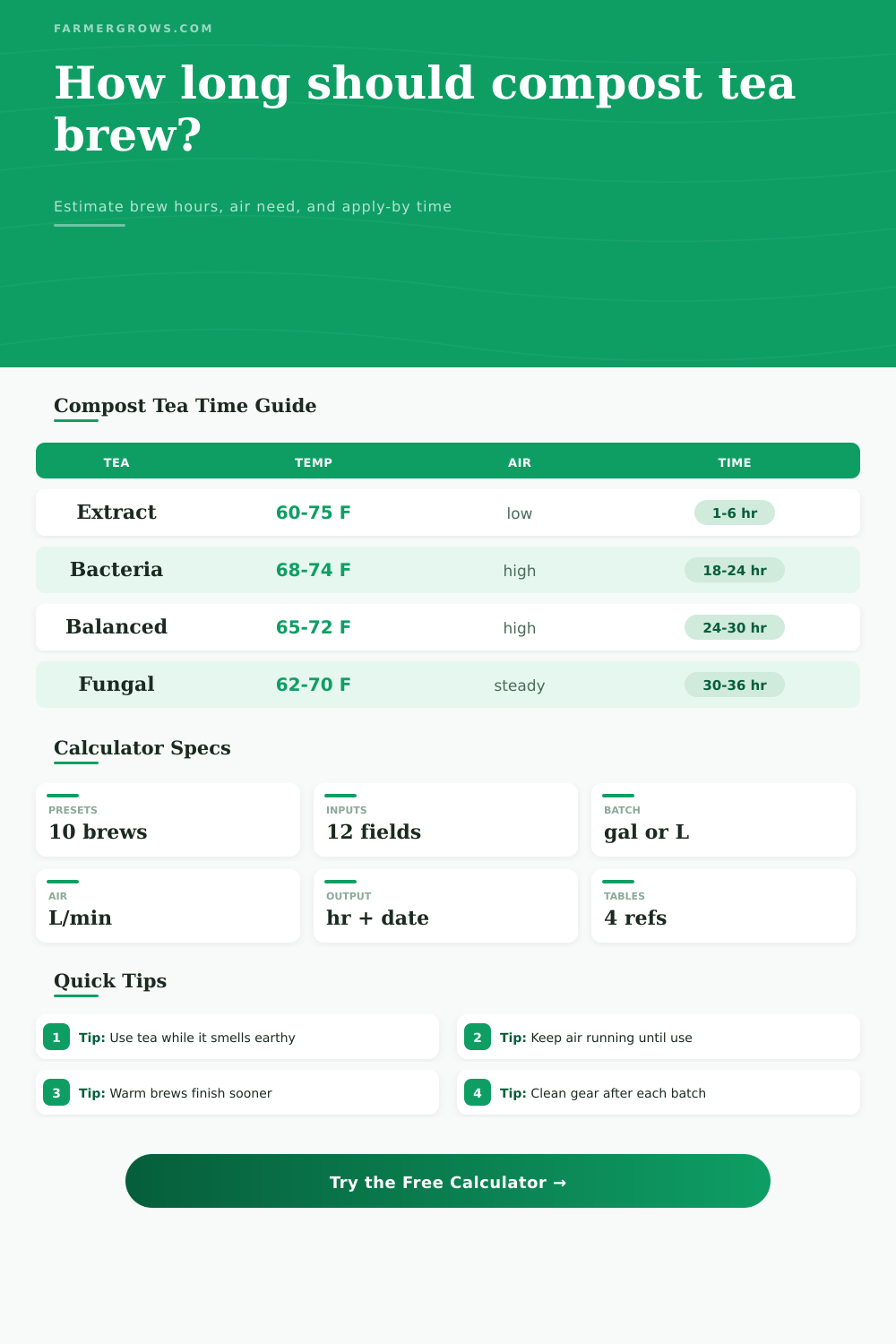
| Quick compost extract | 1 to 6 hours | 60 to 75°F | You want a same-day soil drench with low multiplication risk. |
| Bacteria-forward aerated tea | 18 to 24 hours | 68 to 74°F | Vegetable beds, active soil, and fresh worm casting brews. |
| Balanced soil drench | 24 to 30 hours | 65 to 72°F | General garden soil where compost, kelp, humic, and mild molasses are balanced. |
| Fungal-leaning perennial tea | 30 to 36 hours | 62 to 70°F | Trees, berries, vines, shrubs, and leaf mold based recipes. |
| Foliar spray | 18 to 24 hours | 64 to 72°F | You will strain well and apply soon after brewing. |
| Average brew temperature | Timing effect | Main risk | Practical adjustment |
|---|---|---|---|
| Below 55°F | Very slow | Weak extraction and little activity | Extend time, move indoors, or make a simple extract instead. |
| 55 to 62°F | Slow | Longer lag phase | Add time and keep the brewer insulated from cold floors. |
| 63 to 75°F | Normal | Low if air is adequate | Use the calculated timing and apply promptly. |
| 76 to 82°F | Fast | Oxygen demand rises | Shorten holding, increase air, and avoid heavy molasses. |
| Above 82°F | Unstable | Sour or anaerobic shift | Brew shorter, shade the tank, and use immediately if earthy. |
| Batch size | Minimum air | Stronger target | Notes |
|---|---|---|---|
| 1 gallon / 3.8 L | 0.5 L/min | 0.8 to 1.2 L/min | Small jars need gentle rolling bubbles, not foam overflow. |
| 5 gallons / 18.9 L | 2.5 L/min | 4 to 6 L/min | Split air across two stones for fewer dead zones. |
| 15 gallons / 56.8 L | 7.5 L/min | 12 to 18 L/min | Use a ring, manifold, or multiple weighted stones. |
| 30 gallons / 113.6 L | 15 L/min | 24 to 36 L/min | Tank shape matters; tall narrow tanks mix better than wide tubs. |
| 55 gallons / 208.2 L | 27.5 L/min | 44 to 66 L/min | Large brews need real circulation plus easy cleaning access. |
| Input | Mild rate | Active rate | Calculator effect |
|---|---|---|---|
| Finished compost | 0.5 cup/gal | 1 to 2 cups/gal | Too little lowers extraction; too much can clog bags and reduce air. |
| Worm castings | 0.5 cup/gal | 1 cup/gal | Often gentle and quick, especially for seedlings. |
| Molasses | 0.1 tbsp/gal | 0.25 tbsp/gal | Speeds microbial growth but raises oxygen demand. |
| Kelp or humic inputs | 0.05 tbsp/gal | 0.1 to 0.2 tbsp/gal | Supports balanced or fungal leaning brews without as much sugar load. |
| Fish hydrolysate | 0.05 tbsp/gal | 0.1 tbsp/gal | Useful in soil drenches; strong odor can signal overuse. |
Keep the clock tied to oxygen. The useful brew window assumes the pump runs the whole time. If air stops for a long stretch, judge by smell and shorten the holding plan.
Do not stretch a sweet brew just because it is bubbling. Extra molasses can make activity look strong while dissolved oxygen falls, especially in warm weather or weak aeration.
The basics is a bag of compost, an air pump, and a bucket. Sounds easy enough, but it’s a delicate ecosystem in there. If you brew too long or not long enough, oxygen goes down. The biology dies and you’re just dumping hot water on your plants. That’s an invitation for pathogens, not prevention. Oxygenation and brew time is crucial to making a good tea. Keep up with the microbes demand.
When you put your water temperature and batch size into calculator, it does all of that math for you. You don’t have to guess if your setup is heating the nutrients or creating bacteria. That’s where most growers fail. They forget about water temperature. Tea brewed in warm greenhouse will ferment quicker then a tea in the cold garage. Microbes metabolize more quickly with warmth and consumes oxygen at a higher rate. Dissolved oxygen goes down. The anaerobic bacteria win out and your tea becomes sour.
How to Make Good Compost Tea
In addition to the clock, selecting the proper food source is key. Molasses encourages bacteria to grow fast but consumes lots of oxygen. Too much molasses added will crash brew unless you have good air flow (not clogged tubing and a weak air pump). The tool looks at the food rate when calculating pump capacity.
For best brews, there should of been a steady rolling boil on top. A violent surge result in overflow foam, while a lazy trickle forms dead zones. Still surface? Oxygen isn’t getting in. Biology is already in trouble. The process depends off aeration… Lots of it. Compost has to be in suspension so that organisms can get to the food. Too much aeration just stirs up the water without dissolving oxygen, which isn’t good. Generaly speaking, fine air stones (rather than big bubble air stones) are better because they have greater surface area for gas exchange.
As the table of references show, a one gallon jar requires less flow then a five gallon brew. If you don’t have sufficient aeration the compost will sink and the sugars will pool on bottom where fermentation starts. So what does that mean? What should be end point of your tea?
If you’re making a quick compost extract, it only needs to last an hour or two. You don’t want to multiply organisms, but rather pull soluble compounds into the water. For aerated tea, allow eighteen to thirty-six hours to give time for bacteria or fungi to multiply rapidly. Fungal teas used for orchards need longer brew times because they require hyphal growth, which usually favors slightly cooler temperatures. Attempting to rush a fungal tea will result in a bacterial soup. This is the wrong tool for the job.
Lastly, you must clean. Previous batches of compost tea leave biofilm on air lines, which grows competing microbes. That can impede airflow. Don’t just rinse them; scrub or replace tubing every so often. Precise timing won’t protect a dirty rig.
Compost tea smells pleasant and earthy. Does it smell sweet, yeasty, or like rotten eggs? Stop right now. Better to waste a bad batch than spritz pathogens on your crops.
Attention to detail, and patience are required for good compost tea: watch the clock, run the air, and rely on your nose.