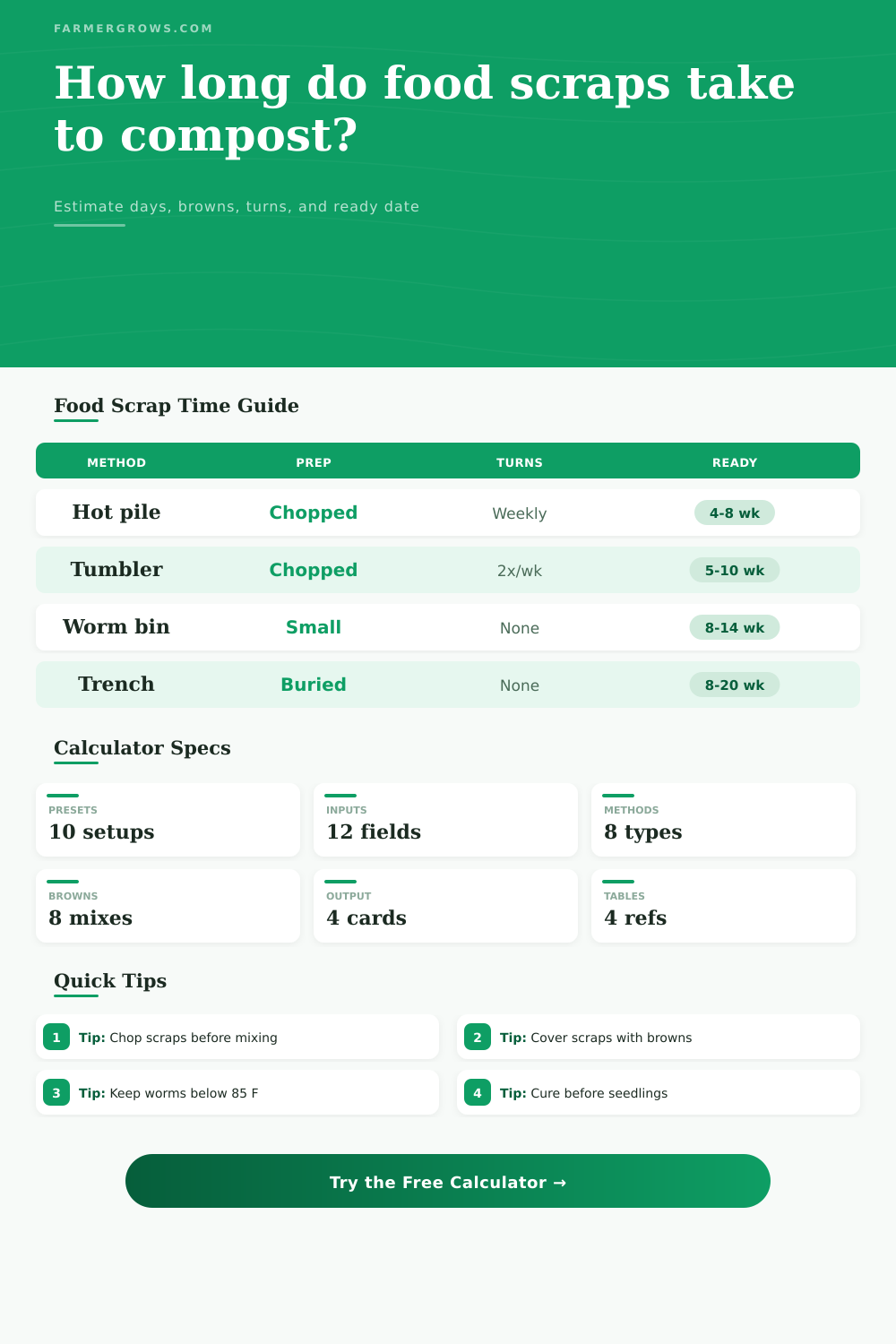
Food Scrap Composting Time Calculator
Estimate how long kitchen food scraps need to become usable compost based on scrap type, volume, browns, particle size, method, aeration, moisture, season, and curing target.
Load a realistic kitchen-scrap setup, then adjust the browns, moisture, method, and finish target to match your bin or pile.
Food Scrap Composting Estimate
Your compost timing summary will appear here.
Best for larger mixed batches with enough browns, weekly turning, and a warm center.
Good for chopped scraps and cardboard, but small drums often need extra curing outside the tumbler.
Excellent for steady peel and coffee scraps when food is buried under moist bedding.
Scraps decompose in soil over weeks to months; use only where digging and crop timing fit.
| Food scrap profile | Typical C:N | Moisture tendency | Composting note |
|---|---|---|---|
| Vegetable peels and produce trim | 17:1 to 25:1 | Medium-high | Chops easily and heats well with dry leaves or cardboard. |
| Fruit peels and cores | 25:1 to 40:1 | High sugar | Breaks down quickly but needs cover to reduce flies and odor. |
| Coffee grounds and tea leaves | 20:1 to 25:1 | Moist, fine | Works well in thin layers; too much can compact. |
| Cooked grains or bread scraps | 18:1 to 25:1 | Sticky | Use small amounts and bury deeply with browns. |
| Bokashi fermented food | Variable | Wet, acidic | Needs a soil or compost finishing phase after fermentation. |
| Brown material | Typical C:N | Best ratio by volume | Use with food scraps |
|---|---|---|---|
| Dry shredded leaves | 60:1 | 1.5 to 3x scraps | Balanced cover for most kitchen bins. |
| Shredded cardboard | 150:1 | 1 to 2.5x scraps | Great structure if shredded small and dampened. |
| Loose straw | 80:1 | 1.5 to 3x scraps | Adds air pockets to wet peel-heavy batches. |
| Untreated sawdust | 400:1 | 0.5 to 1x scraps | Use lightly; too much can slow the pile. |
| Fine wood chips | 300:1+ | 0.5 to 2x scraps | Good for airflow, slower to fully disappear. |
| Method | Typical active time | Curing time | Best fit |
|---|---|---|---|
| Hot pile with browns | 21 to 56 days | 14 to 35 days | Large chopped batches and active gardeners. |
| Managed backyard bin | 60 to 120 days | 21 to 45 days | Weekly food scraps and yard browns. |
| Batch compost tumbler | 35 to 90 days | 14 to 35 days | Small batches with frequent mixing. |
| Worm bin vermicompost | 56 to 120 days | 7 to 21 days | Cool, steady peels and coffee grounds. |
| Trench composting | 60 to 180 days | 0 to 30 days | Soil burial between crop cycles. |
| Warning sign | Likely cause | Calculator clue | Corrective action |
|---|---|---|---|
| Fruit flies | Scraps exposed | Low brown cover | Bury scraps under 2 to 4 inches of dry browns. |
| Sour smell | Too wet, low oxygen | Wet or sour moisture | Turn and add shredded cardboard or leaves. |
| Ammonia smell | Too much nitrogen | Low C:N estimate | Add dry high-carbon material before feeding more scraps. |
| No breakdown | Cold, dry, or oversized | Winter or whole scraps | Chop, moisten, and mix into an active center. |
Think in layers, then mix. Food scraps compost fastest when every wet layer is immediately covered with a dry carbon layer, then fluffed enough to keep small air channels open.
Do not judge by color alone. Dark material can still be actively breaking down. Let compost cure until it smells earthy, stays cool after mixing, and no longer shows recognizable fresh food.
What’s more, you begin with a bucket of coffee grounds and vegetable peelings, so how do you know how soon they’ll be transformed into soil? That depends on what you put in the heap; decomposition isn’t constant. Adding brown materials alters the rate; turning the pile does too; so does a change in outdoor temperature.
What to do? The complex math gets done by calculator above (after you input your own situation). You do not need to guess at conversions and coefficients, which is frequentely where we go wrong.
How Long Does It Take to Make Compost?
TIME: Most composters think of time as one variable. And most composters believe all this stuff just rots into soil over time. Wrong. There are different stages to the process. People often confuse the active stage of breakdown, when microbes is gobbling up what’s around, with the curing stage. Curing is the end, where things become softer and less fibrous and the mix stabilizes in terms of pH. Plant something like seeds in uncured compost and you’ll either kill the roots (burn) or kill seedling (starvation).
The tool helps you distinguish between these two timeline: knowing when the compost is ready for tender care in your bins, or knowing when it is only good for tilling into your beds.
It’s not just what goes in: particle size matters. How fast something breaks down depends a lot on particle size. If you cut up a watermelon rind into chunks about an inch across, you’ll have exposed more surface area to bacteria then if you’d added the entire rind. Small move, big impact. Whether or not you did this up front can be the difference between a four-week process and a twenty-week one.
Another key variable is moisture. You want the pile to feel more like a wrung-out sponge. Any drip indicates too much; it suffocates oxygen-loving aerobic bacteria and soon enough, you’re smelling sour. A wet pile needs more carbon to balance out its extra nitrogen. Because of this, the calculator will ask how it feels. Adding more carbon will slow down heat production somewhat, but it won’t stop the smell.
The key: ratios of carbon. Nitrogen-rich food waste heats up rapidly, but will also decompose too fast if not counterbalanced with sufficient carbon. The fuel bed consist of dry leaves and/or shredded layers of cardboard. Without this, all the nitrogen simply evaporates as ammonia gas. That’s why stinky compost doesn’t smell earthy; it smells like fertilizer.
Different types of browns vary in their carbon load (the reference table on that page can help explain). You can use less cardboard by volume than you would with fresh grass clippings because cardboard has a higher carbon-to-nitrogen ratio. Get this balance right, and tweak the mix accordingly.
Too much of one or the other? Your pile might still smell bad if it is short on carbon. It might also stay cold and stalled if it is short on moisture or nitrogen.
Many people fail to consider that season matter. A hot pile in July may only last three weeks. In January, it may take three months if not indoors and insulated. Because microbial activity greatly diminishes when temperatures drop below forty-five degrees Fahrenheit, this factor are accounted for in the calculator. You can’t control the weather; however, you can manage your expectations.
To begin in the cold months, choose a method that will hold heat. An insulated tumbler or a big old static bin would of work. A worm bin is also good…but sensitive! It has to remain cool (below eighty-five degrees) for the worms to do their thing.
Then there’s timing (which also depends on whether you’re feeding continuously or intermittently). For instance, a continuous feed bin will take longer to finish because the material gets added on the side while the stuff in the middle finishes up. With a batch process, you add material until full then stop and wait for the whole pile to rest before starting again. So with a continuous bin, you have a continuous cycle of decomposition that never quite finishes completely all at once. You have to keep feeding top and harvesting from the bottom. Again: you see the balance between speed and convenience shown by the tool.
One day soon, the contents of your heap will look like rich topsoil, being dark and crumbly. It will have an earthy aroma rather than an acidic or foul one. This will let you know it is ready.
That’s the ready date… When the number on the screen becomes something other then just a number. You can take what was once kitchen waste and turn it back into garden gold. And by knowing what makes the clock tick, you go from gazing at the pile to mastering the process. You will chop more, cover better, and wait longer for the cure. And then you dig in and enjoy what patience has reaped.