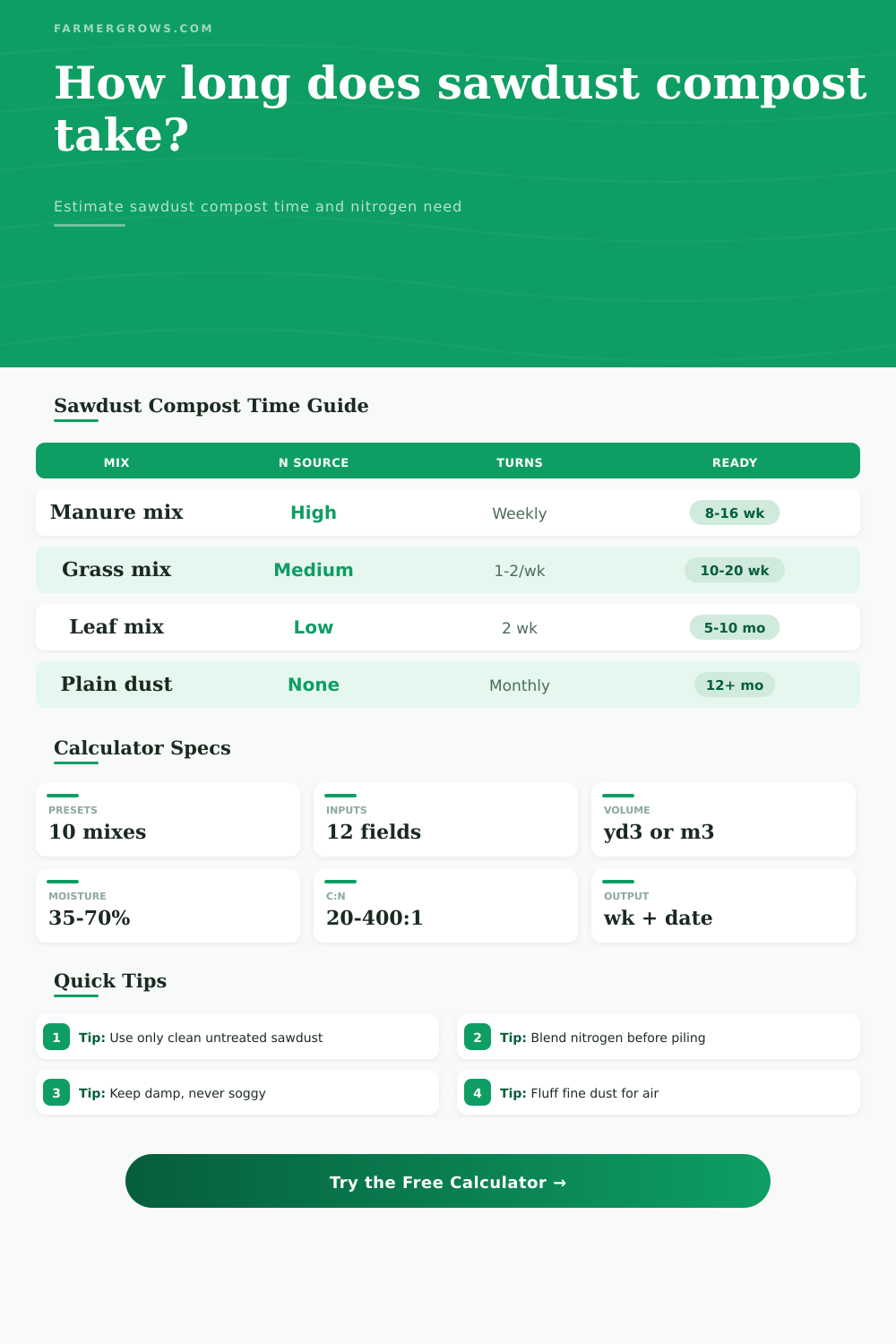
Sawdust Composting Time Calculator
Estimate how many weeks clean sawdust needs to become usable compost from dust type, pile volume, nitrogen source, moisture, aeration, turning frequency, climate, and finish target.
Choose a real sawdust composting setup, then adjust the pile size, nitrogen source, moisture, airflow, and maturity target to match the batch you are building.
Sawdust Compost Estimate
Enter sawdust compost conditions to estimate timing.
Best for clean sawdust mixed well with manure, grass, poultry litter, or measured nitrogen and turned before it mats.
Used bedding already carries nitrogen and microbes, but wet packs need fluffing and curing before garden use.
Low-turn sawdust piles become darker and fungal over time, useful as coarse mulch before they are fine compost.
Screened bed compost needs extra curing because fine sawdust can hide pockets of active carbon and nitrogen.
| Sawdust source | Typical C:N | Composting behavior | Best nitrogen partner |
|---|---|---|---|
| Fresh hardwood sawdust | 350:1 to 500:1 | Very carbon-heavy; slow without nitrogen | Manure, grass, or poultry litter |
| Fresh softwood sawdust | 300:1 to 450:1 | Can compost well but may resist wetting at first | Grass, urine, or diluted liquid nitrogen |
| Planer shavings | 250:1 to 400:1 | Airier than powder, so it turns and drains better | Horse manure or coffee grounds |
| Used animal bedding | 35:1 to 100:1 | Often heats quickly once moisture and air are balanced | Extra dry sawdust only if too wet |
| Poultry deep litter | 15:1 to 45:1 | Can be nitrogen-rich and needs enough carbon curing | Clean sawdust or dry leaves |
| Nitrogen source | Typical C:N | Use rate clue | Watch point |
|---|---|---|---|
| Fresh grass clippings | 12:1 to 20:1 | 30% to 80% of sawdust volume | Too much can mat and sour |
| Coffee grounds and scraps | 18:1 to 25:1 | 20% to 60% of sawdust volume | Mix well so grounds do not clump |
| Horse manure bedding | 25:1 to 45:1 | 50% to 120% of sawdust volume | Bulky bedding may need extra turns |
| Poultry litter | 8:1 to 15:1 | 10% to 35% of sawdust volume | Strong nitrogen can smell if wet |
| Measured urea or blood meal | 3:1 to 8:1 | Small measured additions only | Overuse can burn microbes and plants |
| Condition | Calculator range | Effect on sawdust | Correction |
|---|---|---|---|
| Too dry | Below 45% | Fungal and bacterial activity slows sharply | Water in thin layers while turning |
| Active target | 50% to 60% | Damp enough to decompose while keeping pores open | Maintain like a wrung sponge |
| Borderline wet | 61% to 68% | Fine particles start losing oxygen | Add straw, chips, or dry sawdust |
| Too wet | Above 68% | Sawdust can sour, compact, and stop heating | Rebuild with coarse structure |
| Finish target | Typical use | Extra curing | Ready clues |
|---|---|---|---|
| Coarse mulch | Paths, tree rings, perennial beds | Little to moderate | Darkened, earthy, no sour smell |
| Garden compost | Vegetable beds and topdressing | 2 to 6 weeks after active heat | Cool after turning, crumbly texture |
| Screened bed compost | Raised beds and fine topdress | 4 to 8 weeks after screening | Oversized pieces removed |
| Seedling-safe blend | Small fraction of potting mix | Long cure and conservative use | No reheating, earthy smell, stable |
Blend before wetting deeply. Sawdust forms dense pockets when it gets soaked first. Mix nitrogen and coarse structure through the dry material, then water in layers until evenly damp.
Be conservative with unknown wood. Compost only untreated, unpainted sawdust. Keep black walnut, aromatic cedar, plywood dust, MDF, and shop sweepings away from food-garden compost.
Sawdust: One of the most stubborn materials in the composting world. It has a pure carbon structure and is waiting to break down. If the conditions aren’t right, it sits in a heap, idle and dried-out, for years.
The calculator do the math for you. How do the numbers change? Knowing what makes the difference can help you avoid common mistakes.
How to Compost Sawdust Correctly
The problem with sawdust? Carbon-to-nitrogen ratio. Microbes need food; if they only consume dust from wood, they’re starving. Feed them. That’s why the tool seeks information on your nitrogen source (whether fresh horse manure or freshly cut grass clippings, for example), and without that fuel, the biological process will never begin.
Adding some green matter isn’t enough. It’s also about how much. A little manure won’t transform a big heap of shavings. The calculator figures out how much of each ingredient you’ll need to hit that tipping point when things starts cooking.
Another problem is moisture. Sawdust soaks up moisture like a sponge and holds it in small spaces where it will smother any bacteria that you are trying to promote. Too moist, and your pile will smell sour from lack of oxygen. Too dry, and the microbes won’t be active. How do you know when it’s right?
Moisture and aeration go into making that happen. Since air is getting into the middle, the inputs about those things matters. Powdery stuff tend to pack down, shutting out air. This is why texture are an important input. Planer shavings tend to retain their shape better than fine sawdust. Allowing oxygen to get further into them.
With a fine-dust pile, you’ll need to turn it more frequently to compensate…extra work! I provide a turning plan in the results. Twice-weekly turns creates heat faster. Otherwise, a static pile waits months for fungi to break it down slow.
If you look at reference table on the page, you’ll notice that hardwood sawdust will be slower and denser then softwood. Animal bedding will already have been partially composted by animals and be closer to being finished. Keep in mind that the estimate of finished volume on this table includes shrinkage (good compost shrivels up big-time). The empty spaces collapse; the organic matter breaks down into something else. Your huge pile of dust gets reduced to a smaller heap of dark soil. Which is what you want.
Good compost means conversion has occurred. Be patient and don’t hurry the process. Nature has her pace. While the calculator gives a timetable, the active heating phase might last about eight weeks. Then there’s the stabilization (curing) stage, which could of being equally lengthy. Too-early compost can rob nitrogen from the ground, or injure delicate seedlings.
Wait till the compost is uniform in color and aroma, earthy. How to tell if it’s ready?
Wood species matter. Never use black walnut sawdust, treated lumber, or painted wood. Toxins will remain in the soil and inhibit growth. Use only untreated softwoods or hardwoods. Unknown source? Out it goes.
Compost making takes time. You’re creating soil; not fertilizer. Time spent adjusting ingredients yields steady changes that support plant health for many years. Begin with an intention; turn things together well; let biology take over. It’ll be worth the wait.