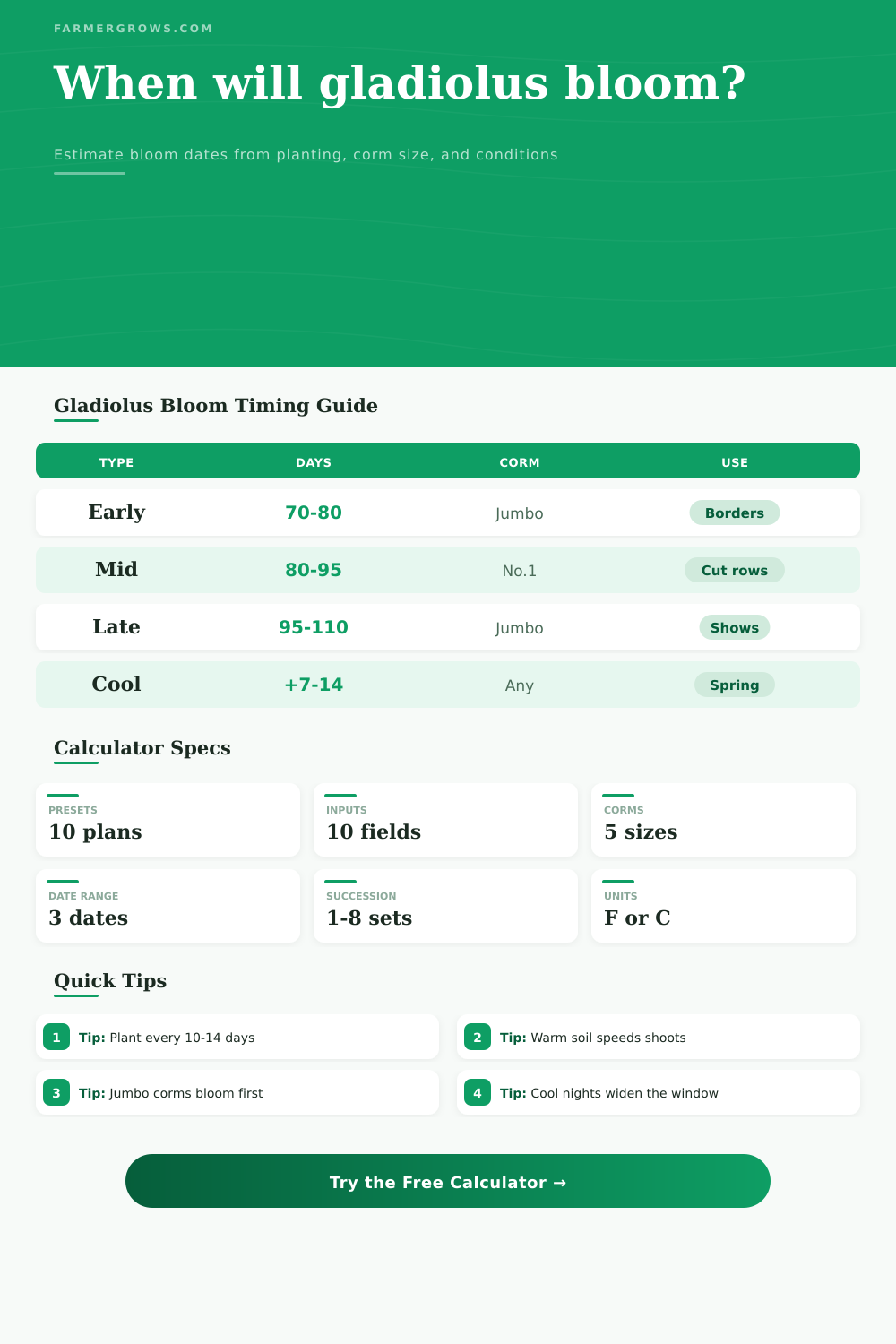
Gladiolus Bloom Time Calculator
Estimate when gladiolus spikes will color, peak, and finish from planting date, cultivar timing, corm size, soil temperature, depth, sun, moisture, and succession spacing.
Choose a real planting situation, then adjust the planting date and local conditions. Bloom timing is an estimate because variety, spring soil temperature, and stress can shift spikes by a week or more.
Your Gladiolus Bloom Window
Bloom timing will appear here after calculation.
Use No. 1 or jumbo corms, full sun, and 10-day repeat plantings for a steady vase supply.
Plant clumps of the same cultivar together, then stagger nearby clumps by one to two weeks.
Containers warm quickly, but shallow roots dry fast; even moisture keeps spike timing tighter.
For a wedding or show, plant several batches and include early, mid, and late bloom classes.
| Bloom class | Typical days to bloom | Best use | Timing note |
|---|---|---|---|
| Early dwarf or nanus | 70 to 78 days | Borders, containers, early cuts | Often flowers first from spring plantings |
| Early garden hybrid | 76 to 84 days | Early-season rows | Useful for starting the cutting window |
| Midseason large-flowered | 84 to 95 days | Main garden display | The common planning baseline |
| Late large-flowered | 96 to 106 days | Late summer color | Needs a longer frost-free runway |
| Giant or exhibition | 102 to 114 days | Show spikes and tall rows | Plant early enough for full development |
| Corm grade | Diameter guide | Timing effect | Expected result |
|---|---|---|---|
| Jumbo | 1.5 inches or larger | 3 to 5 days earlier | Strongest spike and earliest reliable bloom |
| No. 1 | 1.25 to 1.5 inches | Baseline | Standard garden and cutting quality |
| No. 2 | 1 to 1.25 inches | About 5 days later | Good flowers with slightly lighter stems |
| Small flowering corm | Under 1 inch | About 10 days later | May bloom, but timing is less uniform |
| Cormel grow-on | Small juvenile corm | Often no bloom | Usually grown to size for a later season |
| Condition | Fast range | Slow range | Bloom planning note |
|---|---|---|---|
| Soil temperature | 60 to 75°F | Under 55°F | Cool soil delays shoot growth and bloom |
| Sun exposure | 8 or more hours | Under 6 hours | Light shade often delays and weakens spikes |
| Moisture | Even, well drained | Dry or waterlogged | Stress widens the bloom window |
| Planting depth | 4 to 6 inches | Very shallow or deep | Deep planting may emerge later but supports stems |
| Succession goal | Planting interval | Number of batches | Typical display stretch |
|---|---|---|---|
| Short border flush | 0 to 7 days | 1 to 2 | About 10 to 20 days |
| Home cutting row | 10 to 14 days | 3 to 5 | About 5 to 8 weeks |
| Long flower supply | 10 days | 6 to 8 | About 8 to 12 weeks |
| Event insurance | 5 to 10 days | 3 to 4 | Several overlapping bloom waves |
Use soil warmth as the starting signal. Gladiolus may be planted after frost danger has passed, but corms sit longer in cold soil. Wait for workable, warming soil when you need predictable stems.
Plant more than one batch for important dates. A single planting can miss a target week after a cold snap or heat wave. Succession plantings spread the risk and give better cutting continuity.
Choosing a gladiolus is not about which kind to pick but when it will bloom (though I’m sure everyone has their favorite shade of pretty). There are no guarantees as to whether there will even be a bloom on a given day, though most of us just guess at what might work (and hope…no wonder we stop hoping and start planning!). Enter the calculator to do math for you.
The corm itself is single largest variable. It sounds fancy, but it is actualy just physics. Big corms has stored up enough energy to shoot up fast. Little cormels must spends weeks producing foliage before they will flower. Are you planting a tiny thing and hoping for some July flowers? You’ll end up with a tall stick of green and frustration. To account for that, the tool change the base timeline to match the size you choose. This is because when you buy little cheap corms, you spend more time waiting for them then you saved at checkout.
How to Use the Gladiolus Calculator
Soil temperature is the silent killer of gladiolus scheduling. It’s easy to assume it’s time to plant when the calendar says to based off the last frost (plant now!), but then there was that freakish late spring rain… and ground remains cold. The corm will wait until the ground warms; the calculator allows you to plug in what the average soil temperature is during that early couple of weeks. Leave option set to the default “mild” setting if you have cool, clay-like soil. That means the bloom dates will slide an entire week later or longer, a whole week that can mess with timing of a cutting schedule. A little soil-check with a soil thermometer can save a world of pain down the line.
The calculator also does succession planting, how do you go from a bunch of flowers for a moment to a season’s worth? It makes sense: If you plant all your corms on the same day, you’ll have a big mass of them open at once then nothing. But if you stagger your plantings by about a week or two (ten to fourteen days), you’ll have a succession of blooms that roll on like a wave. From when you planted the earliest to the last day you will see any, the calculator tells you range of color you can expect. And it lays out its reference tables to show how many more corms you need if you want a full season of flowers; not just bigger corm, but more batches. For that, look at difference between a cut-flower row vs. A short border flush.
Sun and moisture are the supporting players. Glads is thirsty giants; again, a stressed-out plant flowers poorly, and since they need deep, even watering, proper hydration is essential. Dry soil stress them. The calculator takes into account moisture patterns (and adjusts accordingly) to provide a realistic estimate. It also considers direct sun hours. Six or fewer hours delay blooming and weakens stems. Eight hours are the sweet spot. These inputs refine the estimate into a prediction for you and your yard.
How deep should you plant? It sounds simple, but most people overlook it. Oh, just dig in four or six inches, it’s all the same.” Yes, but planting deeper means those tall spikes won’t blow over as easy in the wind. It also mean they will take a little longer to pop up. That’s why variable is built into the tool… It accepts the messiness of gardening facts. You don’t have ideal conditions, but you do want some control.
If you don’t know where to begin, use the presets as a starting point for typical situations like a hot inland garden or one near the coast. Then play with the numbers. Change the corm size and adjust the date. See what happens when you nudge that bloom window around. It’s the way to learn the sensitivity of these guys to slight adjustments, and after you’ve learned the input-output relationship, you will no longer be hoping you get lucky. You’ll be in charge of your own garden by intent.
A plan eliminates the panicky-empty-vase feeling. Now you’ll know just when to expect color, when to water, when to dig. Your summer garden will be running on time. The mounds of dirt will be dependable allies and the spikes will stand up at your command.