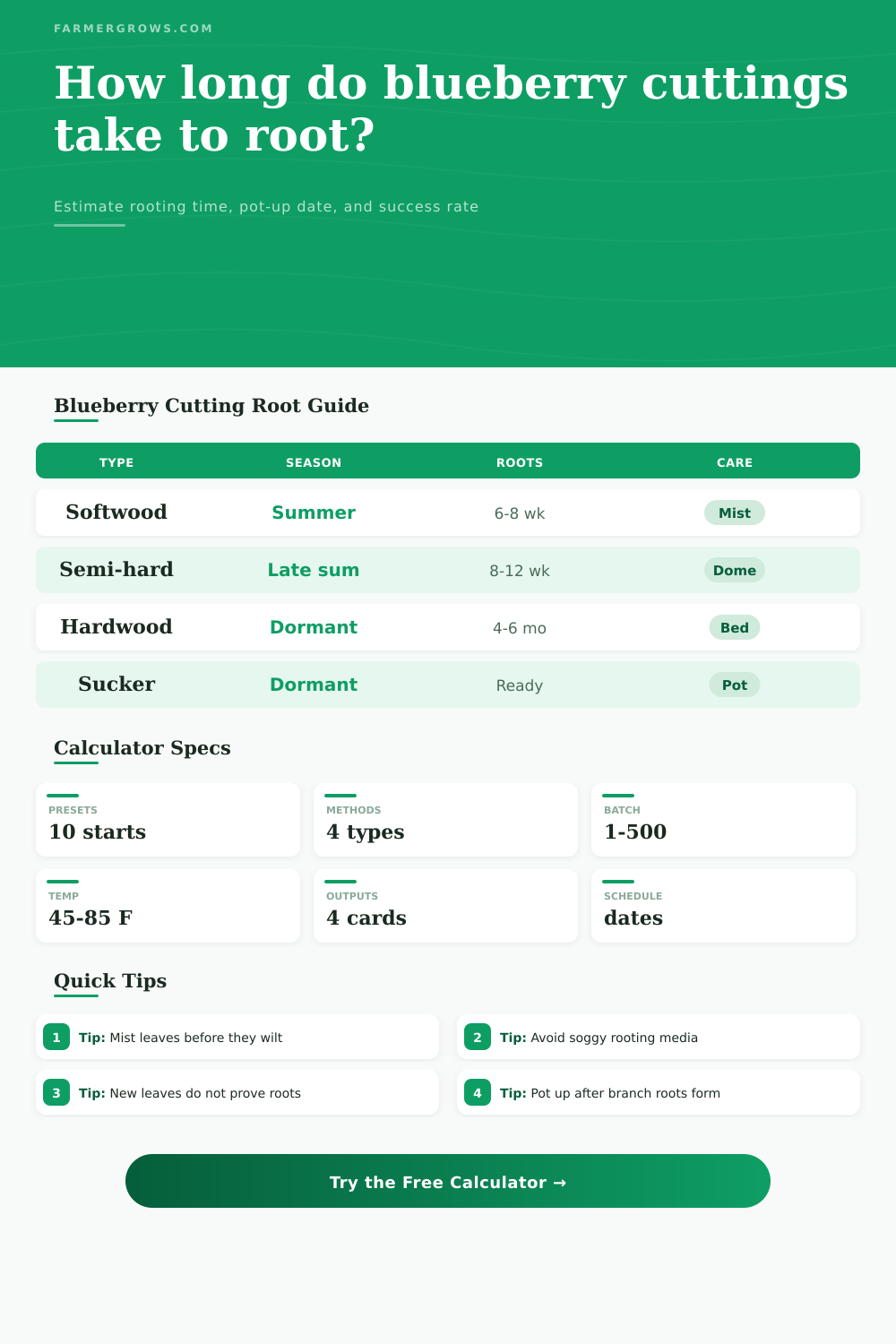
Blueberry Cutting Root Time Calculator
Estimate when blueberry cuttings should form first roots, when they are ready to pot up, and how many rooted plants to expect from your propagation setup.
Start with a practical blueberry propagation situation, then tune the timing, temperature, medium, mist, and hormone choices to match your own tray or rooting bed.
Estimated Blueberry Cutting Schedule
Your rooting estimate will appear here after calculation.
Best for leafy summer shoots when mist is reliable and media drains freely.
Useful for late summer shoots, but ventilation and leaf trimming matter more.
Lower daily care once stuck, yet roots may not be ready until the next season.
Already has roots, so the schedule shifts to pruning, pot recovery, and grow-out.
| Cutting method | Best collection stage | Rooting window | Management note |
|---|---|---|---|
| Softwood leafy cutting | Early to mid-summer growth that bends cleanly | About 6 to 8 weeks under good mist | Keep a thin water film on leaves and prevent wilting |
| Semi-hardwood cutting | Late summer shoot, firm but not brittle | About 8 to 12 weeks in a steady enclosure | Trim leaves, vent domes, and avoid hot trapped air |
| Dormant hardwood cutting | Winter wood, 4 to 6 inch sections from the lower cane | Often 4 to 6 months before nursery handling | Keep one bud exposed and maintain moisture until rooted |
| Rooted sucker division | Dormant season sucker with attached roots | Rooted at separation, 4 to 8 weeks recovery | Head back top growth so limited roots can support it |
| Environment factor | Faster range | Slower or risky range | How the calculator scores it |
|---|---|---|---|
| Root-zone temperature | 65 to 75°F, or 18 to 24°C | Below 60°F slows callus; above 80°F raises wilt risk | Adds or subtracts rooting weeks |
| Mist and humidity | Short mist bursts every 5 to 10 minutes in daytime | Open air or uneven hand misting dries leafy cuttings | Changes both time and success estimate |
| Medium moisture | Moist but airy with no saturated bottom layer | Waterlogged media favors root and stem rot | Strong penalty for saturated media |
| Light exposure | Bright shade or protected propagation house | Full sun without reliable mist can desiccate leaves | Reflected through humidity and temperature inputs |
| Rooting medium | Drainage behavior | Best fit | Watch point |
|---|---|---|---|
| Peat and perlite | Moisture retentive but airy | Home trays and humidity domes | Pre-moisten evenly before sticking cuttings |
| Aged pine bark fines and sand | Acidic, open, drains quickly | Blueberry nursery flats and outdoor beds | Do not var bark dry at the edges |
| Peat and coarse sand | Firm contact with moderate drainage | Small hardwood or semi-hardwood batches | Avoid fine sand that compacts |
| Dense potting mix | Variable, often too fertile or wet | Only if amended for aeration | High fertility is not needed for unrooted cuttings |
| Pot-up signal | Meaning | Action | Common mistake |
|---|---|---|---|
| Gentle tug resistance | Early roots may be forming | Check only a sample cutting, then wait | Pulling every cutting loose |
| White roots near the edge | Rooting is confirmed | Reduce mist gradually before moving | Moving from high humidity to dry air in one day |
| Branching roots near 1 inch | Ready for a small acidic pot | Pot into peat or bark-based blueberry mix | Using alkaline garden soil |
| Only new leaves | May be stored stem energy | Do not count as rooted by itself | Potting up before roots can support leaves |
Separate leaf moisture from media moisture. Blueberry softwood cuttings need hydrated leaves, but saturated media can cause rot. If squeezed media releases more than a few drops, reduce watering.
Use dates and labels like tools. Record cultivar, cutting type, stick date, hormone, and first root check. The next batch gets easier when you know which tray rooted fastest.
When propagating blueberries: Know the difference between bottom progress and top growth.
Maybe you tucked in those cuttings with their stems all hormonal and what-not, but no roots to speak of…and the leaves are still perkier then a 5-year-old on Christmas morning. The new leaves can be tapping into stored energy in the stem, not an existing root system, and if potted up prematurely that energy runs out and down they go. Knowing the distinction is key to success.
Why Your Blueberry Cuttings May Not Root
How long will it take? This page has a calculator that lets you plug in details (medium, humidity method, type of wood) to get an idea of what rooting window would be under those circumstances.
If you take softwood cuttings in early summer, they’ll root fast, usually within six to eight weeks if they’re misted regularly. Take hardwood cuttings in winter; expect four to six months before you actualy see signs of real root and callus development. You shouldn’t of waste a hardwood batch because it’s merely taking longer to develop, which is why the tool factors in such variation.
This is highly dependent on temperature. Ideally, blueberries wants the root zone to be between sixty-five and seventy-five degrees Fahrenheit. Below that enzyme activity slows down and callus formation stops. Above eighty, the rate of leaf water loss exceed the capacity of young roots to compensate via replacement water. The calculator takes all this into account, adding time to the estimate based on cooler-than-average temperatures; it’s not penalizing you, but merely reflecting the biology: Cold roots does take more time to divide cells.
Heating things up doesn’t necessarily make them develop, but instead just forces them to wilt.
Surprisingly, the choice of media also matters. Standard is peat and perlite, which drains well but holds moisture to keep stem hydrated. If the growing medium compacts (e.g., heavy soil or dense potting mixes), it will be an anaerobic mess; perfect conditions for rot. The pages’ reference tables illustrates how some types of media are bad news. So long as the medium remains saturated, the tool reduces your chance of success. Even with hormones and good misting, you can’t grow roots in waterlogged soil. You need air space in the soil for survival.
The other factors involved with the cutting is about managing humidity: Because it has no roots, the plant can’t take up any water from beneath so misting keeps a light coating of water on foliage to slow down water loss. If the leaves gets too dry, they will die; if you overdo it and there’s excess moisture, the roots will rot. It becomes a balancing act, and the tool takes into account how often you should mist (and what kind of container you’re doing your misting in).
For example, a humidity dome might be a good solution for semi-hardwood cuttings in late summer. But it also needs some air circulation or else things could start to go funky. Misting in open air do work quicker, but requires tighter control of when to do it.
Last but not least, the calculator tells you how many of your cuttings is likely to be successful. For instance, if you’re using forty-eight cuttings, it may calculate that thirty-five should take. Knowing what percent to expect can help you make plans for your nursery (how much room to devote to each one), since not all must be alive in order for there to be a good season.
Loss is normal; this is where knowing when to stop intervening (and start potting things up!) comes into play. Don’t assume they’ve made it just because there’s new foliage; look for branching roots, too, and wait until you feel some resistance on the tug test. Use the tool to set your expectations, and let your own eyes tell you whether it’s right or not.
Data + patience = better than frenzied intervention.