Hoya Cutting Root Time Calculator
Estimate when a hoya cutting should show first roots, when it is ready to pot, and how many cuttings are likely to establish from nodes, medium, warmth, humidity, light, and handling.
Start with a real propagation scenario, then tune the calculator for the exact cutting you have on the bench or in the grow box.
Rooting Forecast
Adjust the inputs to estimate a rooting window for this hoya cutting.
Best default for many hoya cuttings because moisture surrounds the node while oxygen stays high. Clear boxes make inspection easier.
Excellent for small cuttings if it is fluffy, not packed. Too-wet moss can hide stem rot until leaves suddenly yellow.
Simple for sturdy vines, but water roots can need a careful transition into chunky mix so they do not stall after potting.
Slower to show progress, yet it avoids transplant shock when the mix is airy and the node stays evenly damp, not soggy.
| Hoya group | Typical examples | First root range | Pot-up range |
|---|---|---|---|
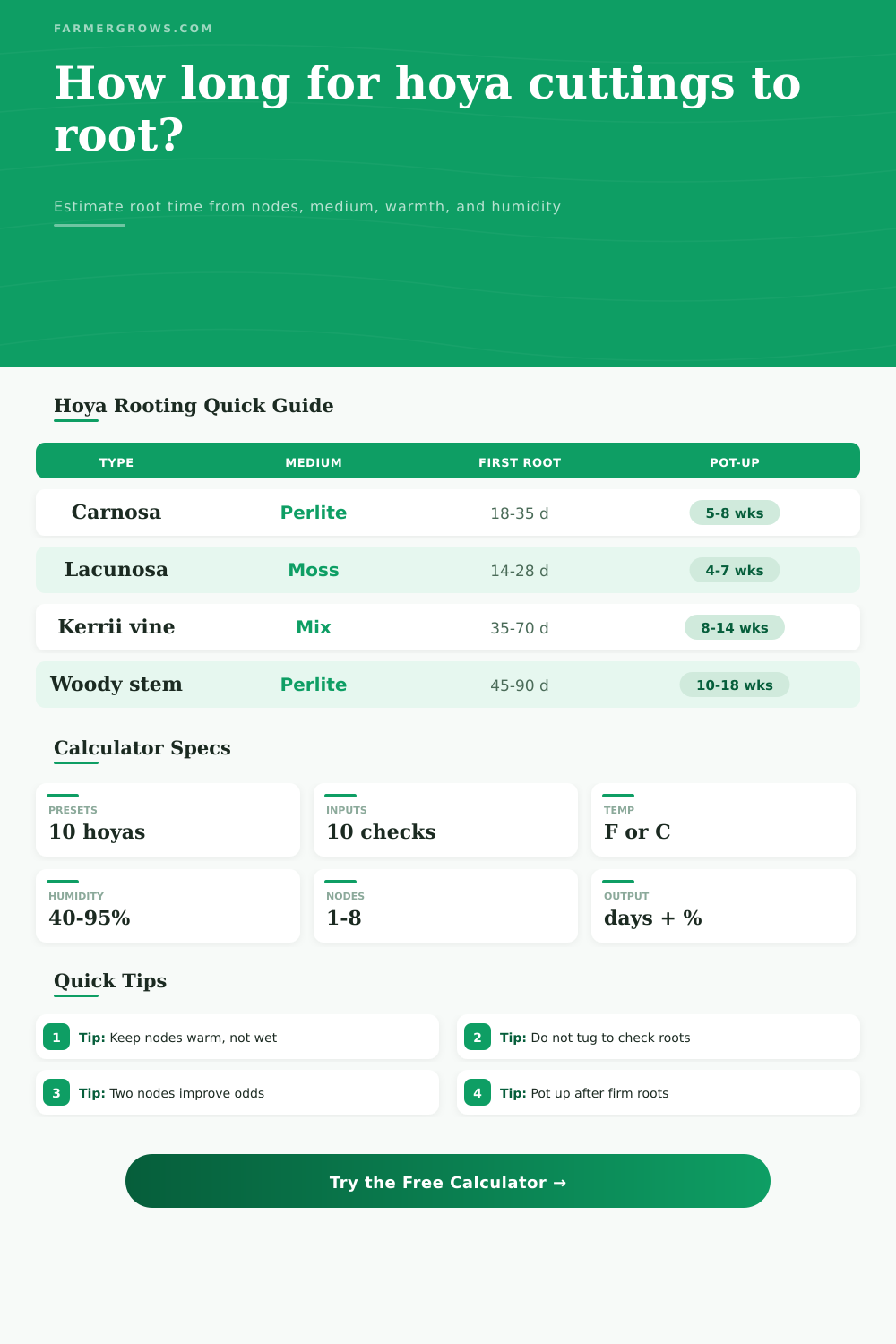
| Fast fine-stem hoyas | H. lacunosa, H. bella, H. krohniana | 14-28 days in warm humidity | 4-7 weeks when roots branch |
| Steady common vines | H. carnosa, H. pubicalyx, H. australis | 18-35 days in airy media | 5-8 weeks for a small pot |
| Thick-leaf hoyas | H. obovata, H. latifolia, H. pachyclada | 25-50 days, often slower to show | 7-11 weeks if leaves stay firm |
| Slow or compact vines | H. kerrii vine, H. compacta, H. caudata | 35-70 days under good care | 8-14 weeks, sometimes longer |
| Rescue or leafless nodes | Imports, woody nodes, dehydrated vines | 45-90 days if still viable | 10-18 weeks after swelling starts |
| Rooting method | Root-time effect | Best use | Main watch-out |
|---|---|---|---|
| Moist perlite box | Usually 10-15% faster | Most node cuttings and small vines | Do not leave water pooled at the base |
| Loose sphagnum moss | Often fast when airy | Thin stems and tiny-node hoyas | Packed wet moss can rot the stem |
| Water propagation | Easy to monitor, medium speed | Sturdy carnosa or pubicalyx pieces | Transition water roots gently into mix |
| Chunky hoya mix | Slower visible progress | Direct-potting sturdy cuttings | Dense soil around the node slows oxygen |
| Pon, pumice, mineral mix | Steady if evenly moist | Growers who prefer semi-hydro | Small cuttings may dry before rooting |
| Dense potting soil | Often 20-30% slower | Only very sturdy rooted starts | Low oxygen and overwatering risk |
| Condition | Good target | Why it matters | Adjustment if off target |
|---|---|---|---|
| Root-zone temperature | 70-82°F / 21-28°C | Warm nodes initiate roots faster | Add gentle bottom heat below 70°F |
| Relative humidity | 60-85% | Leaves stay hydrated while roots form | Use a vented box or bag if leaves soften |
| Light | Bright indirect or LED | Supports leaves without overheating | Shade direct sun through glass |
| Media moisture | Evenly damp, airy | Roots need water and oxygen together | Squeeze moss until barely dripping |
| Ventilation | Brief air exchange | Reduces stagnant mold pressure | Open sealed boxes every few days |
| Stage | What you see | Typical action | Risk if rushed |
|---|---|---|---|
| Callus only | Cut end sealed, no root nub | Keep warm and slightly moist | Potting up now may stall |
| Root nubs | White bumps at node or cut end | Stop tugging and keep stable | Nubs snap easily |
| First roots | One or more roots under 1 inch | Maintain medium and humidity | Dry roots can abort |
| Pot-up ready | Several roots about 1-2 inches | Move to small airy hoya mix | Too large a pot stays wet |
| Established start | New leaf or vine growth begins | Ease into normal hoya care | Sudden low humidity can wilt leaves |
Keep the node stable. Hoya cuttings often fail from repeated checking rather than slow rooting. Use a clear cup, bag, or box so you can inspect moisture and roots without lifting the stem.
Balance humidity with airflow. High humidity keeps leaves firm, but sealed stale air encourages mold. Vent a propagation box briefly and remove yellow leaves or blackened stem tissue right away.
That’s where the timing starts, from the moment you cut the stem. For as long as it remains connected to that little bit of life, it’s still a living thing. And then you wait for its roots to develop.
Weeks pass. You peek at the plant. There is no change. So you take another look. Another day passes. Your confidence drop. What’s going on?
How to Root Your Plant Successfully
Enter the calculator: Instead of guessing, you get a realistic time frame tailored to your specific conditions. Variables you can’t control; variables you can. Timeframe, not a date. That’s how it begins to make things clear.
The node is most critical. Beginner newbies tend to believe the leaf’s the star. Not so. The leaf connects to the node, which is where the action is. Roots sprout from it. Leaves connect to it. You’ve got two of them? Twice as many opportunities for success. Biology is simple on that front, and the tool factors all that in. Greater opportunity through greater entry points.
The engine is warm. A cold node sleeps. Want your roots to wake up fast? Make sure they’re not chilling out in your house when it’s winter time. They’ll be awake and working in weeks, not months. The calculator takes both temperature and metabolism into account.
And yes, it’s not just about keeping the thing alive; you also want to get the chemistry humming along. Humidity is another variable. “The idea that humidity feeds roots is a misconception,” people say. Nope. Humidity maintains integrity of leaves until there are some root nubs. Without humidity, as soon as air around it is dry, the leaf will suck life out of the stem (which begins to wither) before even one little nub shows up down below.
Your typical home humidity helps the tool figure out how stressed-out the cutting is feeling. Generally speaking, high humidity is better then low, but still air won’t do; it becomes a deathtrap. Still air is what mold loves. What you want is a dynamic mix. That’s why the tool tells you when to check, not to put it in a ziplock and leave it sealed permanently. It provides a rhythm, a guideline.
This is important. A lot of cuttings gets killed off by someone who yanked on ’em to see if they’re ready yet. Tug testing is bad news. The tool warns against it. Go by the schedule, not by feel.
But also the medium… Turns out, that makes a difference. Perlite is forgiving. It is moist but breathing. Moss is tricky. A sponge for holding water; good in one way, bad when it’s too much and rots stem. Oxygen is as important as water. The calculation adjusts for it. If there is no air at the rootzone, the tissue collapses.
Propagation with water is easy to see…but the roots are delicate. They hate the transition to soil. The tool knows that. If roots grows in water, it gives a wider window before potting up is OK. It is a gentle warning.
Don’t overthink light. Light makes the cuttings’ leaves firm; it doesn’t want sun. Sun cooks the stem. The calculator assumes bright indirect light is the starting point. You can use a grow light, which is good. But make it cool.
The percentage output isn’t a promise of success. It’s a statistical probability generated by the data you enter. The lower the humidity, the denser the soil, and the woodier the stem, the lower the percent. It tells you the odds aren’t in your favor. Don’t freak out. Adjust one factor. Increase humidity. Warm up the room. The math changes. You’re back in control.
But the biggest error is potting them up prematurely. It is not with just one little root. No! With multiple, strong, branching, maybe-inches-long roots. That’s what the calculator tells you: here’s your pot-up range. Don’t rush it. Transplant shock. Those roots are tender. Let them get established first; let them work at their own pace after that.
Then when you do eventually see some new growth, ahh! It will be there. The stem won’t collapse; the leaf will remain firm. The node has done its thing. Time for the plant to take over.
You don’t need a botany degree to root a hoya. You just need some patience and an understanding of what they like. Warm. Humid (but airy). Don’t pull on them.
Once you plug your conditions into the calculator, it does the math for you (no more guesswork about conversions or coefficients), but don’t worry, the work is still all you.
And, the last ingredient? Patience. Tick tick. The clock is ticking, but this time it’s on your side. Be patient; wait for roots. They’ll come.