
When do you think spring begins? The last frost leaves the ground, right? You toss off the covers one last cool night, pick up your trowel, and go digging into dirt.
It is a romantic thought, but it is a tactic that almost assures you’ll spend the entire season chasing yourself. What’s realy underway is long before your nearest neighbor brings home her first seedling: while she’s counting down the days until frost leaves, you’re counting down the weeks. It happens in fluorescent-lit corners of your sunroom or spare room.
Timing Is Key to Growing Flowers
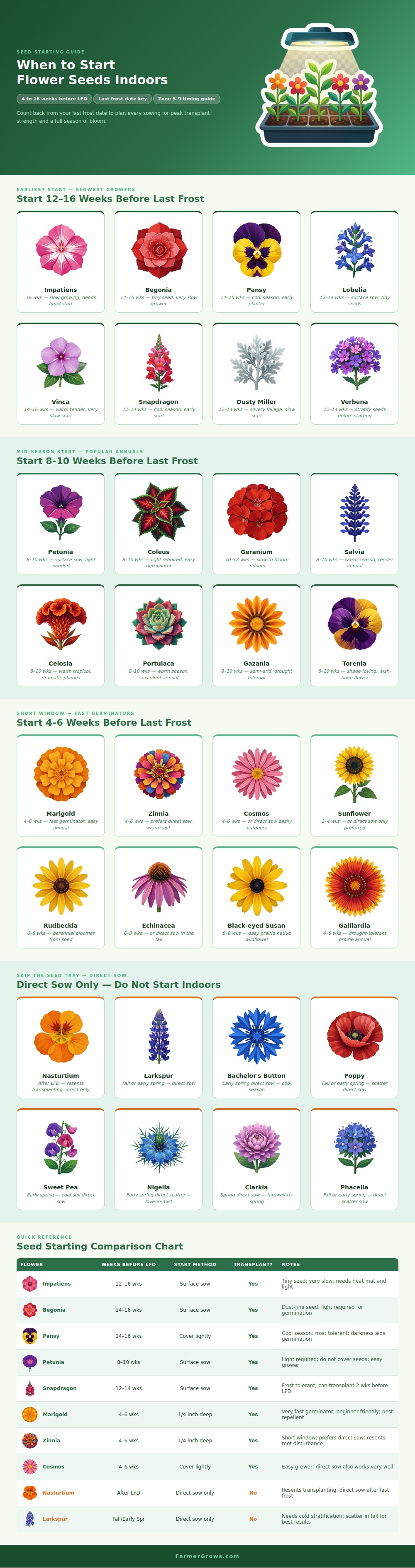
The thing everybody misses is this: Starting seeds isn’t about planting. It’s about timing. This chart are not simply a list of dates, but one breaking things down into three general groupings of flowers (slow), medium, fast, based off how long each takes to reach transplant size.
Flowers such as begonias and impatiens require 16 weeks or longer from the moment of sowing till your final frost, which sounds like forever. Want to wait till March to get going? Good luck. Begonias and impatiens, among other slowies, grows very slowly indoors. If you do, you’ll end up with sad little seedling that either don’t bloom at all or bloom much more late. To succeed, understand: Some flowers is asking you to think ahead to the season before it arrives. Trust the process, even when all looks still in trays.
And finally, there are the popular annuals, the kind everybody buys at big box store. Geraniums, coleus, petunias fall in this category. They require about eight or 10 weeks of head start. For most gardeners, it’s just right. It is not too soon, so you don’t have to battle leggy seedlings under grow lights for months. It is also not later, so the plant is big enough. Flowers that forgive. They germinate easily, tolerate light well, and will repay you with a long season of color.
If you’re new to seed starting, these are a safe bet. Learn how to do humidity domes and ventilation with them; don’t risk delicate plants on something you haven’t yet got the hang of. But this is where many of us go wrong. We throw all our seeds into one heap. Oh, I’m sowing my marigolds and zinnias with my pansies, and so on. Wrong!
As the graphic makes clear, fast growers like marigolds or zinnias takes just four to six weeks. And then again, they really don’t like it any more than that. Sow your zinnia 12 weeks too soon, and what do you get? It becomes a root-bound mess that doesn’t want to flower anyway. Why? Because these guys don’t like their heads squashed down in a pot. They want speedy and roomy. The sooner out they come, the happier they’ll be. Rule: Coarse (big) seeds generaly require less precociousness in starting, meaning fast and not early.
And then there’s another group, poppy- and nasturtium-type flowers, that don’t even deserve a place in a tray. Poppy and nasturtium taproots is delicate; they’re taproots, which means they hate being dug up and transplanted. Dig them out and try to move them somewhere else, and no: They won’t grow. The roots can’t take it, and you’ll be frustrated. Direct sow those, says the chart, when danger of frost has passed. Counterintuitive as it may sound, waiting is the only way to get healthy bloom. Scatter the seed and let nature take over in the ground. It is a lesson in restraint.
Sometimes the greatest act of gardening is picking up your trowel and laying it down. You should of letting nature just do its thing with the planting. When you understand the time frames, you see your garden differently. Instead of thinking in terms off one starting date, you think in terms of a schedule. The slow ones starts in late winter, the medium ones in early spring, and the fast ones just before summer. Think: rhythm instead of chaos.
When you honor the biology, the clock ticking inside each seed, you’ll find that your garden flow better. If you pay attention to the timing, the seeds will let you know what’s coming. And then the first bloom will arrive, as it should, and you’ll have the best reason of all why planning makes sense. It always came down to that initial choice, which was to count the weeks until the frost is gone.