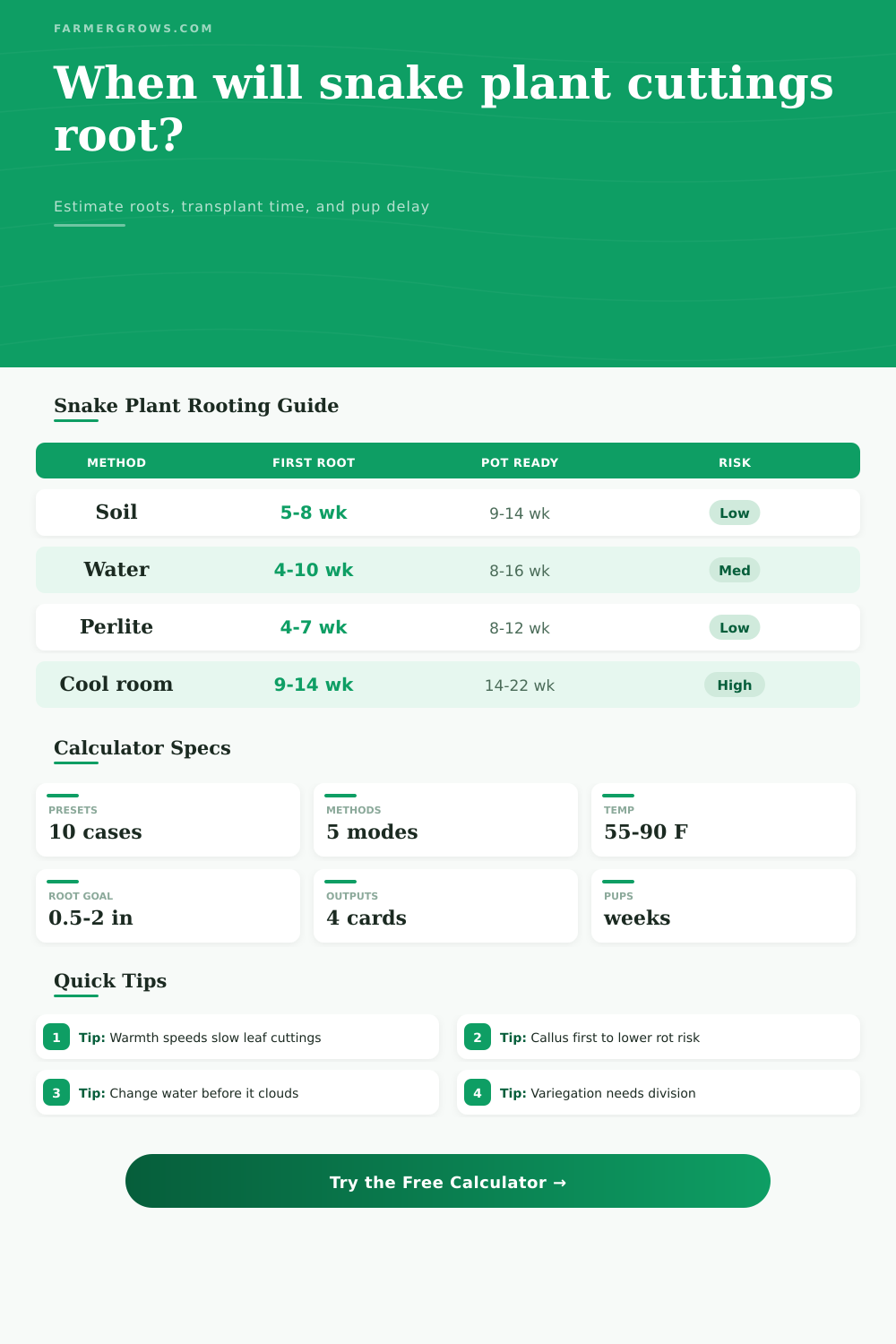
Snake Plant Cutting Root Time Calculator
Estimate how long a snake plant leaf cutting may take to form first roots, reach transplantable root length, and push a new pup based on method, warmth, callus, light, and moisture.
Start with a common snake plant propagation setup, then adjust the leaf segment, room temperature, moisture rhythm, and root-length goal.
Estimated Rooting Timeline
Adjust the inputs to estimate first roots, transplant readiness, and new pup timing.
Best long-term root adaptation when the mix is airy, barely moist, and warm.
Roots are easy to watch, but soft rot and transplant adjustment can add delay.
High air around the cut end often supports quicker roots with lower sogginess.
Use division instead of leaf cuttings when you need to preserve variegated edges.
Use these tables to sanity-check the calculator against real snake plant propagation behavior. Leaf cuttings are slower than division and can take weeks to months.
| Propagation method | First root estimate | Transplant-ready estimate | Best fit |
|---|---|---|---|
| Fast-draining soil | 5 to 8 weeks | 9 to 14 weeks | Lowest transplant shock for most leaf cuttings |
| Clean water jar | 4 to 10 weeks | 8 to 16 weeks | Growers who want visible root progress |
| Damp perlite or pumice | 4 to 7 weeks | 8 to 12 weeks | Warm shelves where air and moisture stay balanced |
| Barely moist sphagnum | 6 to 10 weeks | 10 to 16 weeks | Small segments that need gentle humidity |
| LECA cup | 6 to 9 weeks | 10 to 15 weeks | Semi-hydro growers with careful water levels |
| Average temperature | Rooting effect | Expected change | Care note |
|---|---|---|---|
| 55 to 60°F / 13 to 16°C | Very slow | Add 4 to 7 weeks | Move off cold glass and avoid wet media |
| 61 to 64°F / 16 to 18°C | Slow | Add 2 to 4 weeks | Check less often and water lightly |
| 65 to 72°F / 18 to 22°C | Good | Baseline pace | Common indoor range for leaf cuttings |
| 73 to 80°F / 23 to 27°C | Fast | Subtract 1 to 2 weeks | Warmth helps if the cut end stays airy |
| Above 85°F / 29°C | Mixed | Rot risk rises | Use shade, airflow, and lighter moisture |
| Cutting preparation | Rooting impact | Risk impact | Practical checkpoint |
|---|---|---|---|
| Bottom end marked before cutting | Normal rooting | Low risk | Snake plant leaf sections must be planted right-side up |
| Cut end callused 1 to 3 days | Slightly slower start | Lower rot risk | Dry, firm cut tissue is ready for media |
| No callus, wet medium | May stall | High rot risk | Recut to firm tissue if the base softens |
| Segment under 2 inches | Slower roots | Medium risk | Small pieces have less stored water and energy |
| Firm whole leaf base | Often stronger | Low risk | Best when the parent leaf was hydrated and healthy |
| Milestone | What to look for | Typical timing | What to do next |
|---|---|---|---|
| Callus ready | Cut end looks dry and sealed | 1 to 3 days | Place in airy mix or clean water |
| First root nub | White or tan bump at bottom cut | 4 to 10 weeks | Keep conditions steady and avoid tugging |
| Pot-up roots | Roots near 1 inch long | 8 to 16 weeks | Move water cuttings into a small pot |
| First pup | New shoot near cutting base | 3 to 6 months | Increase light slowly after it is established |
| Established start | Leaf feels anchored in mix | 4 to 8 weeks after potting | Resume normal snake plant care gradually |
Do not judge by leaf growth alone. Snake plant leaf cuttings often root quietly before showing any new top growth. Check for firmness and wait for roots before increasing water.
Match the method to the goal. Water is easy to monitor, but soil or perlite usually creates roots that adapt faster to a pot. Divide variegated plants to keep the pattern.
When you bought your snake plant, some kind of assurance was probably included with it: indestructible. True, mostly, except when you attempt to propagate it. And then you find that while the plant itself is indestructible, you are not.
You slice off a chunk of leaf, plop it into a vessel of water and wait…and wait…and wait…for something that never happens. Eventually, you give up and figure the cutting’s dead, unaware that the cutting is going about its patient business underground, slowly working things out on its own time and math.
How to Grow Snake Plants From Cuttings
Whether it rots or thrives is often a question of unseen factors, such as how hot the room gets where it’s livig, or whether you allowed the cut to callus over first before potting it up. Growing snake plants from cuttings isn’t so much a matter of garden skills as it is of when.
After all, you’re asking a succulent (a succulent!) to create a whole new set of roots from scratch. First it has to deal with the wound, allowing time for healing; and then establish infrastructure. Bacteria enters through that open wound far quicker than roots do if the medium remains wet during this vulnerable period.
This is why the above calculator runs the numbers for you. Instead of delivering a generic guess that doesn’t apply to anyone, it figures out the timetable for your unique set of conditions. Because yes, a cutting on a warm windowsill may well surprise you in weeks; another in a cool, dark corner will take months more then. Where you start determines all else.
Soil is typically the safest bet because the conditions resemble those the plant would experience in nature, lessening the shock to its system during transplant time. Although watching the root development might be cool, propagating in water also presents a new set of variables to contend with. Roots developed in water will be more tender and susceptible to shock when planted in earth. After all, why would roots grown in water learn how to push through soil?
Perlite is sort of the happy medium here; providing the moisture needed while keeping air circulating to prevent rot.
The secret behind the hurry-up is temperature. Because snake plants are tropical creatures (and thus love to be warm), they will root much more slowly in cool conditions. Rooting time will lengthen considerably if you live in a cool home and it’s 60 degrees during winter months. This is biology: Those cells need to divide, and warmth is required for them to do so. You can shave many weeks off the wait. Use a heat mat. Or maybe just move the plants to a warmer room. That means it becomes a summertime endeavor instead of a yearlong one.
Light: While this does matter, it isn’t as you would expect. Although snake plants will root even in low light, a cutting exposed to direct sun will dry out before the roots can replace the lost moisture. Think of bright, indirect light (the sweet spot). Enough energy for them to grow, but no cooky-cooky in direct sun. You want the leaf to stay firm and stiff, meaning there’s still enough stored water to wait out the time until roots gets growing.
Everybody skips this one thing, and it saves the most cutting: callusing. Giving the cut end of the cutting a couple days’ drying time forms a kind of barrier, protecting the exposed tissue from soft rot that’s an open invitation without it. I know you feel like you’re wasting time waiting those few days, but those few days are what keep you from a disaster that will take weeks to undo. It is a little thing, but it is bigger than which pot you put them in or what brand of soil you choose.
The last ingredient is patience. It’s not uncommon for snake plant cuttings to root well before you see anything new happening up top. Go weeks without seeing anything, and then one day you’ll spot a new shoot that popped up months or even longer ago. Just know that all those unseen roots are doing their thing below, laying down the groundwork for the eventual plant.
Stay steady through these conditions, trust the process, and let the plant slowly do its work. Eventually that green thing you began with will be anchored in place…and it will prove to be worth the wait.