
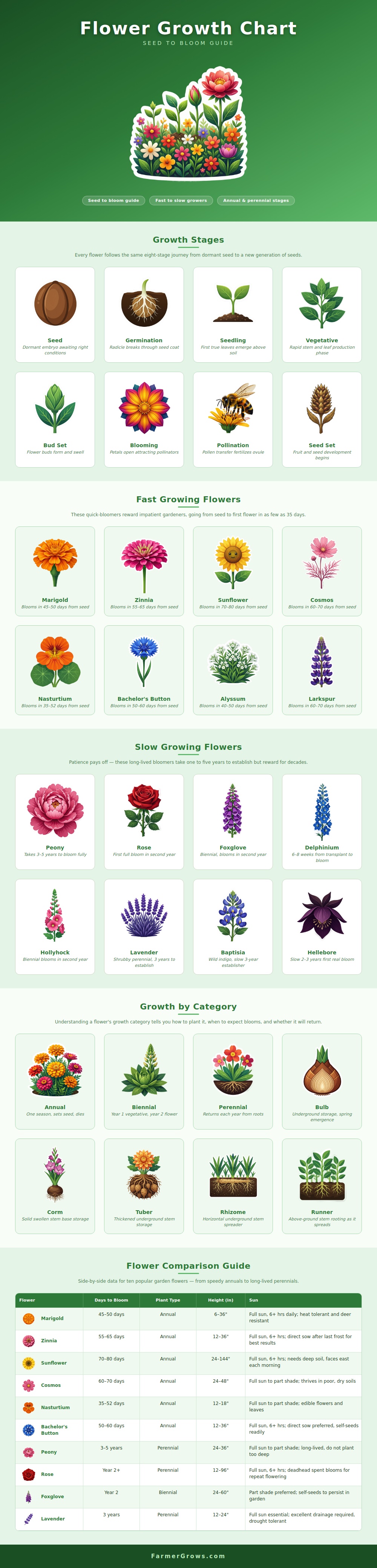
Midsummer is panic time in the garden: My neighbor’s flowers are blooming over there, but my patch look more like grass. That kind of aggravation has little to do with whether anyone loves it, or what kind of soil it’s growing in. More likely it’s simply got to do with timing: The way we go around treating every flower like it’s on the same calendar is not a good thing. Knowing the true rhythm of plants lives changes our sense of success…and also our waiting and worrying habits.
From seed to adult, here is how each flower work in a nutshell. First comes dormancy or germination. Then come seedling stage. After growing many leaves, buds appear, and finally, the flower bloom. Sounds easy, but growing a flower are really a biological marathon, with strict conditions needed at each step along the way. Pull out a seedling prematurely, for instance, or water a bulb improperly while it’s still dormant…and the chain gets broken. This chart explains each step, including why you need to be patient (literally) to get anything going.
Understanding Flower Timing and Types
New gardeners gets confused by what they expect: They mix up perennials and annuals. Cosmos and marigolds is sprints. From seed to flower, they’re programmed to go fast, as in less then two months. They are fast and forgiving, making them perfect for the want-it-now gardener who wants some instant gratification.
Perennials run on an entirely diffrent clock. Lavender and peonies is investment flowers that may not fully bloom for several years. They builds a strong enough root system to endure winter, and only then do they really take off. Rush a peony? You can’t. Let it grow. The process doesn’t work otherwise.
The biennial category is another wrinkle in things: Why bother planting something that just sits there for a whole year? That’s why it tricks so many people; they dig it out after first season thinking it didn’t work, but hollyhocks and foxgloves (among others) grows leaves the first year, and flower riotously the next, and die. Seems like a trick…but no, just biology. Knowing that will spare you from digging up a perfectly good plant that wasn’t showing off yet and seemed dead.
Knowing what you’ve got, annual, biennial, perennial, is the key to all sorts of other care strategies, too. If you think a slow-growing perennial is actualy an annual that needs to be replaced every year, you’ll kill yourself; or the plant, with to much attention.
Light requirements is another huge factor in whether your theoretical growth chart will show up in your yard or not. Some sunflowers, for example, require really strong light and heavy, loamy soil to reach those great heights. Other flowers, such as cosmos, are happier growing in slightly drier, poorer soil where they does not have to compete. Less fertile ground equals better color in some species, which seems counter-intuitive, but there you go. Match the place to the plant (rather than try to make the place fit the plant). That’s what most beginning gardeners fail to do.
It all boils down to this: Gardening is a study in letting go. You provide the setting, then trust the plants to tell you when they want to show themselves. They has their own time to wake up, grow leaves, and show their color. Knowing which ones are fast friends and which ones take years can mean the difference between an overgrown mess of weeds and a lush garden. When I realize that a rose bush takes years to establish, whereas a nasturtium will be blooming in weeks, I gets less anxious about time. Then I don’t fight it anymore; I work with it.
The darkness you face now, while your seed is underground, is only temporary; it is just a matter of time before that flower opens. And it speaks.