Jade Plant Cutting Root Time Calculator
Estimate when a jade plant cutting should show first roots and when it is ready for a small pot, using cutting type, callus time, medium, temperature, moisture, season, and light.
Choose a real Crassula ovata propagation setup, then tune the conditions to match the cutting on your bench, windowsill, shelf, or greenhouse tray.
Rooting Forecast
Your jade cutting forecast will appear here.
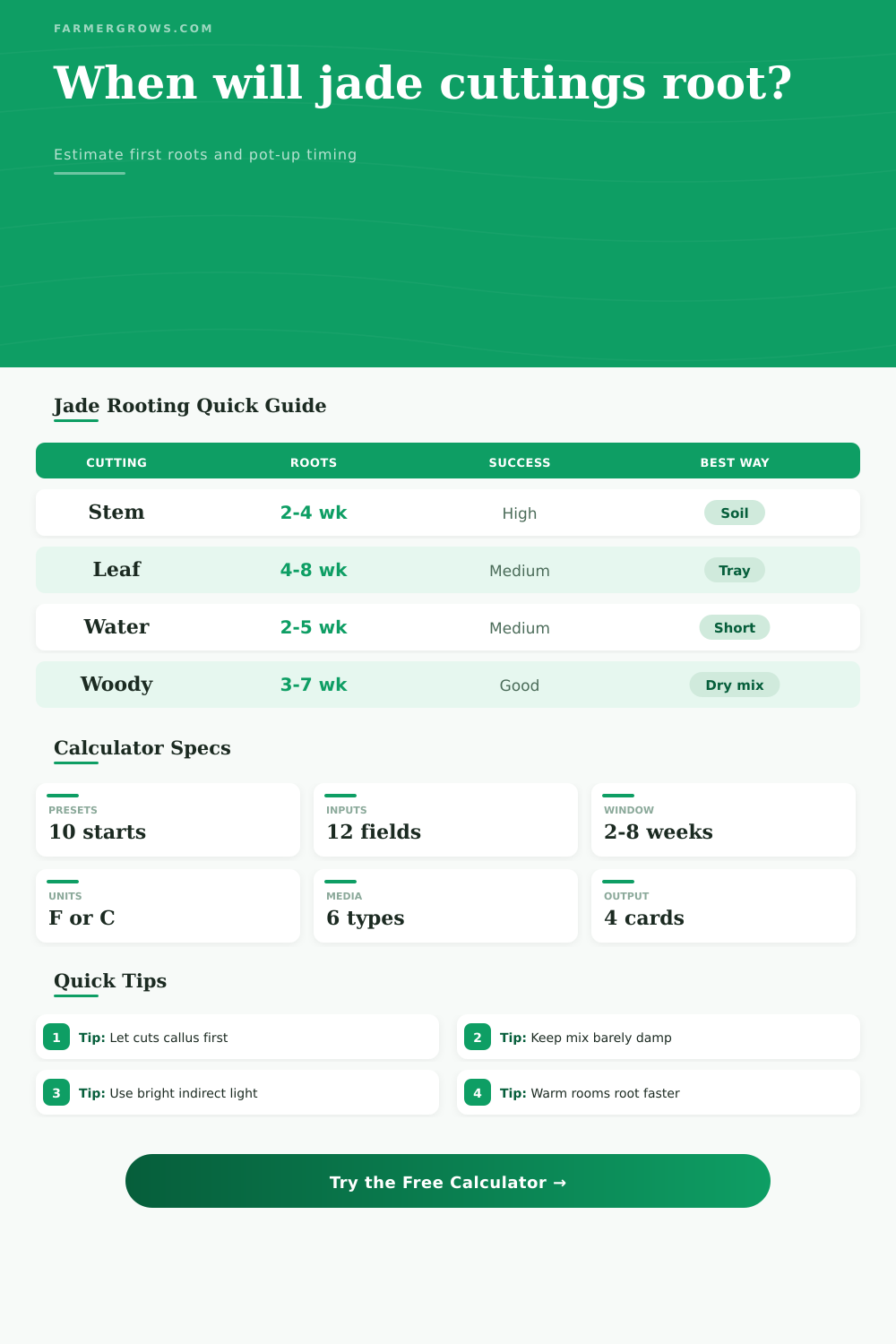
Usually roots in 2 to 4 weeks when callused, warm, and kept only barely damp.
Leaves often form roots before a plantlet, so visible progress can take 4 to 8 weeks or longer.
Roots may show quickly, but the cutting needs a careful move to gritty soil before water roots weaken.
Older jade wood carries reserves, but slower cambium response can stretch rooting toward 5 to 7 weeks.
These reference ranges reflect common home propagation behavior for jade plants: warm temperatures, bright indirect light, a dry callus, and a fast-draining medium usually shorten the wait.
| Cutting type | Typical first roots | Pot-up readiness | Best signal to check |
|---|---|---|---|
| Green stem tip, 2 to 5 inches | 2 to 4 weeks | 4 to 6 weeks | Gentle resistance to a light tug |
| Semi-woody stem | 3 to 5 weeks | 5 to 7 weeks | New firmness and slight top growth |
| Older woody branch | 4 to 7 weeks | 7 to 10 weeks | Stable stem and no shriveling |
| Single healthy leaf | 4 to 8 weeks | 8 to 12 weeks | Roots plus a small plantlet nub |
| Large top cutting | 3 to 6 weeks | 6 to 9 weeks | Firm stem base and anchored weight |
| Water-rooted stem | 2 to 5 weeks | Move when roots are 1 inch | White roots without blackening |
| Temperature range | Effect on root time | Rot tendency | Practical interpretation |
|---|---|---|---|
| Below 55°F / 13°C | Add 12 to 20 days | Moderate if damp | Jade metabolism is slow; keep very dry. |
| 55 to 64°F / 13 to 18°C | Add 5 to 12 days | Low to moderate | Possible, but progress is quiet and slow. |
| 65 to 75°F / 18 to 24°C | Baseline timing | Low | Best home range for reliable rooting. |
| 76 to 82°F / 24 to 28°C | Subtract 2 to 5 days | Rises if wet | Fast if airflow and drainage are good. |
| Above 83°F / 28°C | Variable | Moderate to high | Heat plus wet media can soften the stem base. |
| Medium or method | Rooting speed | Moisture target | Common problem |
|---|---|---|---|
| Gritty succulent mix | Reliable baseline | Barely damp after callus | Too much peat slows drying. |
| Perlite-heavy mix | Slightly faster | Light moisture, strong air | Cutting may wobble if not supported. |
| Bagged cactus mix | Baseline to slow | Dry top, light water | Some mixes stay wetter than expected. |
| Regular potting soil | Often slower | Let dry well between sips | Fine texture raises rot risk. |
| Coarse sand and pumice | Steady | Slight moisture below surface | Can dry so fast roots pause. |
| Water glass | Visible but variable | Clean water, shallow base | Black base or weak transition roots. |
| Season and light | Rooting pace | Best placement | Adjustment to make |
|---|---|---|---|
| Spring, bright indirect light | Fast and steady | East window or bright shelf | Check gently after week 3. |
| Summer, warm room | Fast if not overheated | Bright shade, no hot glass | Increase airflow and avoid wet soil. |
| Fall, shorter days | Moderate to slow | Brightest indirect window | Expect one extra week. |
| Winter, cool low light | Slowest | Warm shelf with gentle grow light | Keep dry and be patient. |
| Hot afternoon direct sun | Stress-prone | Move back from glass | Prevent leaf scorch and dehydration. |
Wait for a dry callus before moisture. Jade stems store water, so the cut end should seal before it sits in mix. A dry, firm base is safer than a freshly cut, wet base.
Judge roots by resistance, not impatience. A gentle tug after the estimated first-root window is enough. Repeated lifting breaks new roots and resets the clock.
For example, when you take a cutting of a jade plant, there’s usually a wait. A couple days later, the cut calluses over, but nothing realy happens below-ground that shows up for weeks. Weeks!
That seem like such a waste of time, as if you’re just waiting and nothing are progressing. With the calculator, you eliminate all that uncertainty. You get an idea of what is realisticly going to happen and when it will happen, based off your room temperature, growing medium, and kind of cutting you took. No more guesswork; now you can knows ahead of time how long the roots will take to form and make plans accordingly.
How to Know When Jade Roots Will Grow
How fast something roots depend greatly on what you’ve cut. Soft, green stem tips has fast-growing cells known as cambium and root very fast, sometimes in only a few weeks. Woody stems tend to be slower and rely on reserves from stored cells rather then rapidly dividing cells; so, an old woody cut will take longer to root. Leaves also take longer still, first they need to produce a new plantlet, then roots. It’s a less successful method. Why? Because there are biological factor that the tool takes into account to prevent you from expecting a leaf to behave as if it were a stem. Know what you’re rooting, and adjust your expectations accordingly.
How quickly things take root depends most of all on temperature. In general, about sixty-five to seventy-five degrees is a good range for rooting jade plant, being neither too hot nor too cool. Below that, body function slow; above that, with moist media, the danger of rot rise.
The calculator takes into account the temperature of your room. If it’s warmer, it will shave days off; if cooler, it will add days, because many of us are inclined to overwater cool cuttings to make up for chilly conditions. Persistence doesn’t pay, patience does. That’s why moisture management is where so many rookies goes wrong. The calculator assesses how long you let your cut callus (as well as the type of medium you use) vs. Your watering schedule.
Succulents can handles gritty mixes that dry fast; they’re forgiving. If you’re using regular potting soil, it’ll hold water like a sponge, and a lot of mister-spritzing will smother emerging roots. If bad drainage, soggy soil, and poor callusing happens at the same time, the tool flashes a “high rot risk.” Don’t try to skip this step because it ruins everything before you even begin.
Indirectly, light levels enter the picture. Without stressing the leaves, bright indirect light signals the plant to use its energy for root development and growth. Hot direct sun will fry and dry out the cutting. Too deep a shade will cause stretching and produce weak roots. That’s why the pages’ reference tables breaks down the scenarios: how springtime light compares with winter gloom and how shorter autumn days may mean waiting an additional week.
The tool isn’t meant for nailing down an exact date. Instead, it’s intended as a way of knowing what factors is under your control and influence. So if the tool predicts that roots will show up in another couple of weeks, just go gentle around then. A little tug will tell you if it’s in there (not harming any new growth). Do not disturb them by digging around to look, since every disturbance reset the clock.
If the number feels too early, maybe your soil dry fast; check your temperature, or use a faster-draining medium. Too late? Did you let the callus dry thoroughy first? All those factors gets boiled down to a simple prediction, no more fretting through quiet waiting.
Timing is just as important as method in propagation. Even with the best soil and the right knife, rushing a cut or failing to account for conditions will make all the difference. The calculator shows you the big picture. From the first snip to the last pot-up. It tells you that jade plants may be tough, but they’re picky too. Provide them air, light, warmth and they’ll do the same for you.
Quiet confidence comes with knowing what to expect. And then? Trust the process, and stop gazing at that pot.