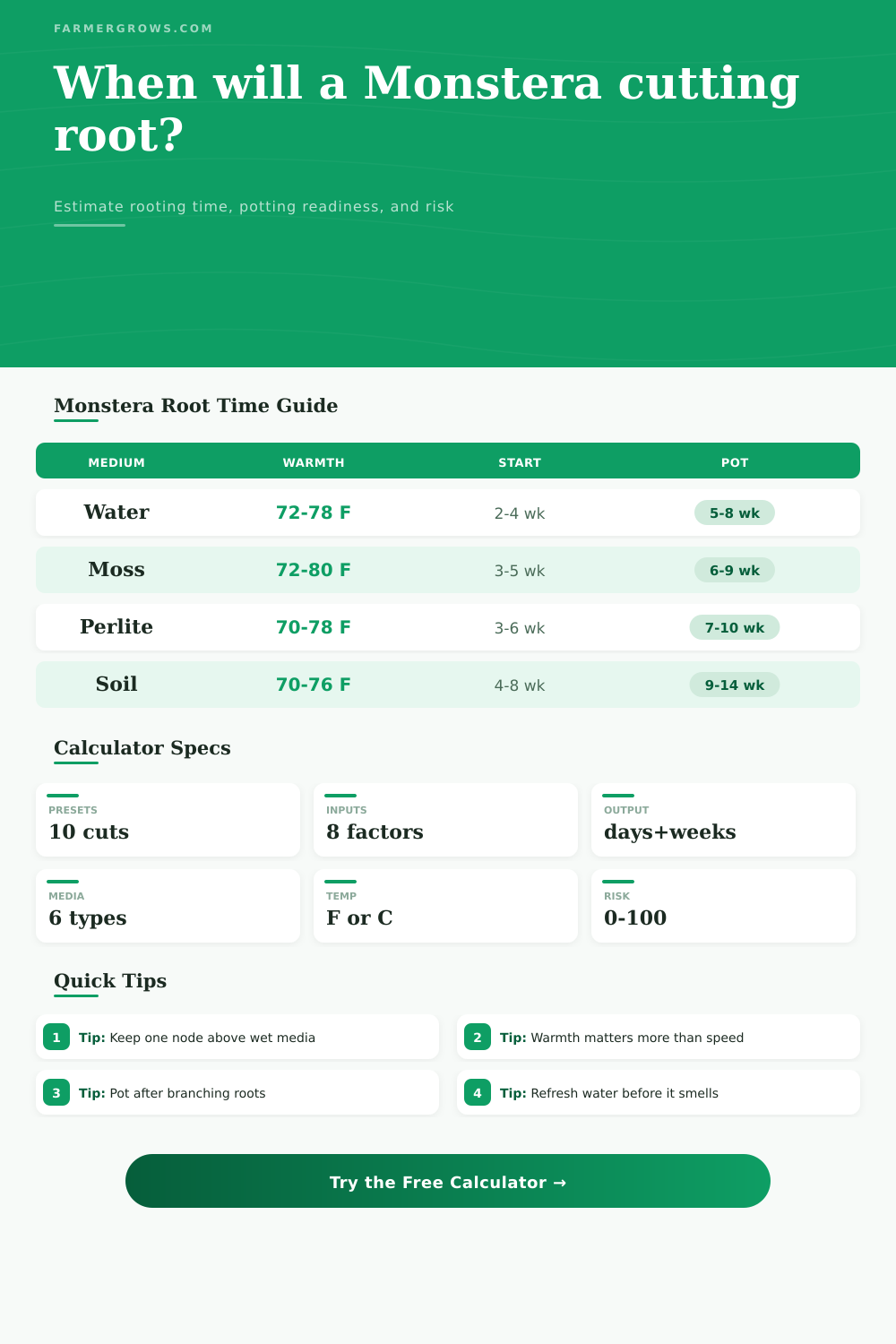
Monstera Cutting Root Time Calculator
Estimate when a Monstera deliciosa cutting may show first roots, reach potting length, and move safely into soil from its node quality, medium, warmth, humidity, light, and cutting condition.
Pick a real propagation setup, then adjust the cutting and room conditions. These presets cover water jars, moss boxes, perlite cups, leca jars, and direct soil starts.
Rooting Estimate
Your Monstera cutting estimate will appear here.
Good for watching early roots and changing course quickly if the stem clouds the water.
Often steadier for nodes with aerial roots, but too-wet moss can hide rot until it spreads.
Clean and airy when damp, especially useful for growers who overwater moss or soil.
Slower to confirm roots, but the cutting avoids a water-to-soil transition later.
| Medium | First root signs | Potting roots | Best use |
|---|---|---|---|
| Clean water | 2 to 4 weeks | 5 to 8 weeks | Easy monitoring for healthy leaf cuttings |
| Moist sphagnum moss | 3 to 5 weeks | 6 to 9 weeks | Aerial roots, nodes, and humidity boxes |
| Damp perlite | 3 to 6 weeks | 7 to 10 weeks | Airy rooting with fewer soggy pockets |
| Leca or semi-hydro | 3 to 6 weeks | 7 to 11 weeks | Stable moisture with oxygen around roots |
| Direct potting mix | 4 to 8 weeks | 9 to 14 weeks | Strong cuttings started in final-style media |
| Temperature | Rooting effect | Risk effect | Practical reading |
|---|---|---|---|
| Below 65°F / 18°C | Slow, often 30% to 60% longer | Higher wet-stem risk | Move warmer before adding more water |
| 65 to 69°F / 18 to 21°C | Slightly slow | Moderate | Acceptable, but patience is needed |
| 70 to 80°F / 21 to 27°C | Fastest normal range | Lower if air is clean | Ideal for most Monstera cuttings |
| 81 to 85°F / 27 to 29°C | Fast but watch moisture | Rises if stagnant | Vent humidity boxes regularly |
| Over 85°F / 29°C | Stress can offset speed | Higher bacterial risk | Bright shade and airflow matter |
| Cutting feature | Typical effect | Why it matters | Calculator use |
|---|---|---|---|
| One firm node | Normal pace | The node holds the root bud tissue | Baseline setting |
| Two or more nodes | 5% to 15% faster | More viable growth points | Node count reduces days modestly |
| Existing aerial root | 1 to 3 weeks faster | Root tissue is already active | Aerial root lowers the waiting window |
| Leafless wet stick | 1 to 4 weeks slower | Less stored energy and no leaf photosynthesis | Cutting type adds time and risk |
| Soft or yellowing stem | Unreliable | Stored energy and tissue quality are lower | Health raises the risk score |
| Stage | Root length cue | Normal timing | Action |
|---|---|---|---|
| Callus and swelling | White nubs or bumps | 1 to 3 weeks | Keep steady and do not scrape the node |
| First root | Root reaches 0.25 in | 2 to 8 weeks | Keep the same medium stable |
| Extension | Root reaches 1 in | 4 to 10 weeks | Increase airflow if the stem stays wet |
| Potting ready | Roots reach 2 to 3 in | 5 to 14 weeks | Pot into airy mix and keep evenly moist |
| Established | New leaf or firm tug | 10 to 20 weeks | Return to normal Monstera care slowly |
Pot for roots, not for the calendar. A cutting with a 2 to 3 inch root or a few branching roots usually adapts better than a cutting moved as soon as the first white nub appears.
Keep the node oxygenated. Monstera cuttings need moisture around the node, but stagnant water, packed moss, or heavy soil can slow rooting and raise rot risk.
Growing things isn’t all guesswork. There are factors like light and temperature and humidity and what growing medium feels like to calculate, too. That’s where this thing up top comes in…
To help you manage propagation, rather than wait around for it to happen. It all comes down to temperature. Metabolism happen at a cellular level; roots are metabolically active tissue. Heat lowers the energy barrier for cells to divide; that’s why a cutting in a warmer environment (like seventy-five degrees) root more quickly then one in a cooler environment (like sixty-five); it has less energy to expend on fighting rot. The calculation assumes your average room temperature, which is what the tool want you to enter.
How Plants Start Roots
If you’re growing cuttings in winter, the calculation take into account slower growth. It is not dead, it is just moving. Most people mistake slow growth for failure. People pull on the stem to see if any roots has formed (and then damage the delicate callus), and start again. Setting realistic expectations prevents such interference with the process which is where the calculator help.
What about medium? Oxygen availability are key here. Everybody begins with water (clear and controllable). However, water does not have air-filled pockets next to node. Humidity-retaining sphagnum moss is risky because it might get too wet… But it also won’t let roots dry out. Airy perlite drain well and limits rot…but dries more quickly. The example chart shows that water might show roots in two weeks while soil take eight.
The soil method isn’t flawed; it’s just a middle ground between the two. Eventually (if you keep watering), soil roots adjust best when potted because they never experience the shock of moving from being entirely in water to an environment with air. There’s also a supporting role for humidity: The drier the air, the more leaf must withdraw water from stem to replace what was lost during transpiration (a process that keeps the plant firm). In humid conditions, the plant can conserves its energy by focusing on rooting instead of hydration. For those of us in dry houses, the calculator factors in that additional stress on cutting; it works harder and adds time to the estimate. Leafless cuttings can be put into sealed bags or even made into high-humidity tents to remove any water pressure at all.
Another source of stumbling is light. Ideally, it should be bright indirect light. It cook the node and exposed stem. However, that is actualy burning rather than cooking, as direct sun will burn. No photosynthesis equals starving the roots which are forming. Because the tool takes into account your light hours, it adjusts accordingly for how fast it grows. The guess will get more accurate if you’re under a grow light, or less accurate if you have a north-facing window in January.
Don’t blast a weak cutting with light to force it to grow. That’s what health at the beginning means: a clean cut on a firm, green stem contains more stored energy. A yellowing or bruised stem contain less. Softer cuttings gets higher risk scores in the calculator. It’s like a warning label. Treat these guys gently. Keep their medium drier and cleaner so they don’t succumb to bacterial rot.
You get a window, not a deadline. Not all genetics are created equal; even one cutting may root in ten days, another in twenty. Both are normal. Estimate timing. If you haven’t seen any roots in that first period and have no luck, test hygiene and temps. Wait. Propagating plants too fast kills ’em.
It’s about patience; let the node stay moist, the air be warmish, and the roots undisturbed. When everything goes right, the white nubs will show up.