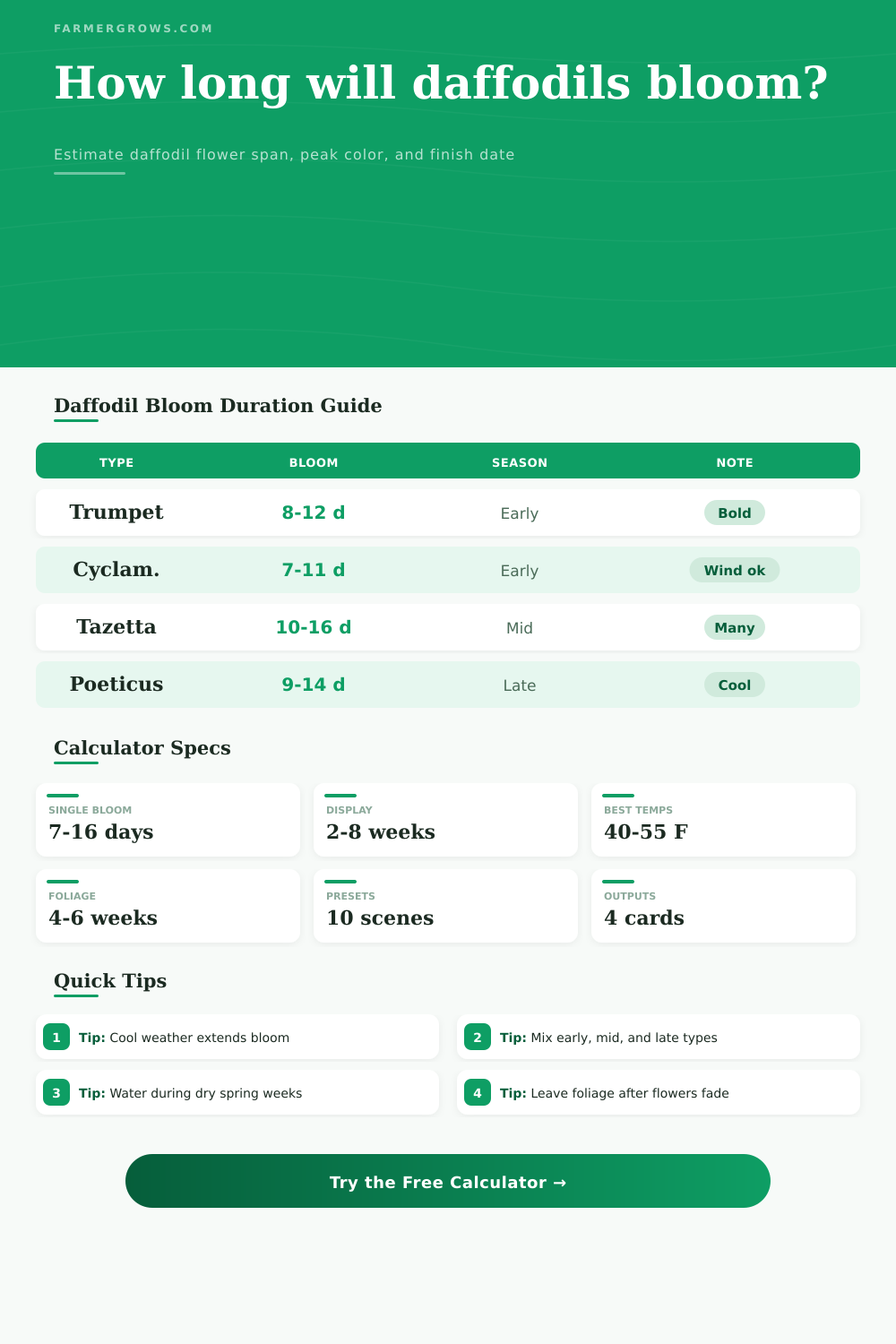
Daffodil Bloom Duration Calculator
Estimate how long daffodil flowers will last from cultivar group, opening stage, spring temperatures, sun, moisture, wind, rain, and succession planting.
Start with a real garden scenario, then tune the weather and planting mix to match your spring bed, border, lawn drift, or container.
Daffodil Bloom Forecast
Your estimated bloom duration will appear here.
Best when you want a clean block of color. Expect a shorter but more synchronized display.
Adds roughly one extra week when bloom times overlap instead of leaving a gap.
Extends the planting window while keeping enough flowers open for a clear spring display.
Works in lawns and orchard edges where a rolling display matters more than perfect uniformity.
| Daffodil group | Typical season | Single bloom estimate | Best use in calculator |
|---|---|---|---|
| Miniature cyclamineus | Very early to early | 7 to 11 days | Containers, edging, small drifts |
| Trumpet and large-cupped | Early to midseason | 8 to 12 days | Bold bedding and classic spring borders |
| Triandrus and jonquilla | Midseason | 9 to 14 days | Light shade, rock gardens, fragrance |
| Tazetta and double types | Mid to late | 10 to 16 days | Clustered stems, cutting patches, sheltered beds |
| Poeticus types | Late spring | 9 to 14 days | Late-season extension in cool borders |
| Average bloom weather | Effect on open flowers | Calculator factor | Practical interpretation |
|---|---|---|---|
| Cool days, 40 to 55°F | Slower petal aging | Extends duration | Best weather for long daffodil color |
| Mild days, 56 to 65°F | Normal spring aging | Near baseline | Most common garden estimate |
| Warm days, 66 to 72°F | Faster bloom finish | Shortens duration | Expect peak color to pass quickly |
| Hot spell above 72°F | Rapid petal decline | Strong reduction | Common reason spring displays collapse early |
| Wind, heavy rain, or frost | Bruising and stem lodging | Stress reduction | Sheltered sites hold flowers longer |
| Succession plan | Typical display span | How to plant it | Bloom-duration note |
|---|---|---|---|
| One cultivar | About 1 to 2 weeks | Plant a single named variety in blocks | Strongest color, shortest calendar |
| Two timing groups | About 2 to 3 weeks | Pair early miniatures with midseason cups | Good for small front beds |
| Early, mid, late | About 4 to 6 weeks | Mix miniatures, large cups, and poeticus | Reliable garden succession |
| Long naturalized blend | About 6 to 8 weeks | Drift several groups through lawn or orchard edge | Best for extended spring color |
| After-bloom task | Timing | Why it matters | Calculator connection |
|---|---|---|---|
| Deadhead spent flowers | As blooms fade | Prevents seed formation from using bulb energy | Does not extend current petals, but helps next year |
| Keep leaves standing | 4 to 6 weeks after bloom | Leaves recharge the bulb for next spring | Shown as foliage recharge period |
| Water dry containers | During bloom and foliage growth | Dry roots shorten bloom and reduce bulb recovery | Moisture setting adjusts duration |
| Divide crowded clumps | After foliage yellows | Relieves competition and restores flower count | Clump age setting adjusts peak window |
Use weather, not the calendar alone. Daffodils can bloom from late winter into spring depending on region and cultivar, but open flowers last longest in cool, settled weather.
Plant for overlap instead of one long flower. A single daffodil flower may last only days, while a bed with early, mid, and late cultivars can carry color for several weeks.
If daffodils fizzle by end of weekend, this is what you’re in for: Your hopes were high; you planted them to get that first blast of gold in earliest days of spring, an antidote to last gasps of winter greys. And then the sun shine, and thermometer rises…and here’s your perfect-looking garden edge: a mess of spent brown stems. It was a failure! Or was it?
It’s physics more often than it’s carelessness. That’s where the calculator on the page above take over. You just input details about your weather (where you live) and kind of flower you grew (what cultivar). You won’t have to guess anymore whether you grew normal plants or if something went wrong.
Why Your Daffodils Stop Blooming Early
Turns out: Bloom time isn’t a single digit printed on the back of the bulb label. It’s more like a dance between your instant surroundings and plant itself.
What you must understand first: Daffodils of all kinds come in groups with wildly varying clock speeds. The ones you’ll see opening earliest, sprinters such as well-loved Tete-a-Tete (a miniature form called cyclamineus)… Can handles cooler soil, so they do, but then they’re done fast; each flower last only seven to eleven days. Marathon runners are the Tazetta types (multiple florets on a stem), that last up to 16 days or more by opening one bud after another.
Bet house on any one kind of daffodil and your chances is slim. The chart below show that Tazetta and doubles will outperform Trumpet-types. To beat calendar, mix ‘em up.
But then there’s weather, which has a bigger influence on us all different than we’d like to think. The secret: cool weather lengthens blooming time. Petals age much slower in cooler weather, specifically when day-time high temp ranges from 40 to 55 degrees F. Cells in the flower walls slow way down. This results in good-looking flowers with vibrant color and strong structure.
But the moment daytime highs climbs above 72 degrees, things happen fast. Flowers begin to wilt and tire; they’re literally breathing faster and evaporating at a faster rate, thanks to heat. A hot snap can be devastating to a show within a couple of days, which is why quick warm streak can derail it so quickly.
The calculator knows this, too. It includes what I call a stress factor in your entered temperature data, since yes, heat do damage delicate petals as well as cold.
Moisture: Yes. But only so much of it, and not to little. Once established, daffodils don’t require constant watering, but they do need consistent moisture during the bloom week. The flowers are first thing to go if soil dries out entirely when they’re open; then plant shuts off non-essential functions to conserve itself. Keeping the soil consistently moist, but not sodden, help them keep their flowers fresh and perky-looking by keeping flower parts firm (filled with water).
They also like light and moisture. Full sun is best, though it can get too hot when high summer afternoon sun burns the flowers’ faces. Often a slightly shaded location (say, getting morning sun and afternoon shade) means longer-lasting flowers, as the plants gets the energy they seek but aren’t cooked by hotter part of day.
The silent killer of spring shows: wind. Not only do battered blooms look awful, but physical damage from torn petals and bruised flower stems shortens visual life of clump. You may find yourself with far fewer bloom days then a sheltered bed in same garden.
The value of the succession planting option in tool comes into play here. Mixing in early, mid and late blooming cultivars doesn’t just extend the season, it also insures that one bad weather day won’t wipe out your whole display. Toss a storm at the early miniatures and late poeticus types are safely in bud form.
And lastly: What comes after flowers? The bulbs’ foliage is no trash. It’s engine of plant that charges up bulb for another try next year. If you leave foliage intact for four to six weeks after bloom, the bulb would of stored up enough energy to do the whole thing again. Cutting back too soon may make bed look nice now, but it will guarantee a sparse display next spring.
This post-bloom care is every bit as critical as weather conditions that exist at bloom time, so the calculator breaks it down to include foliage recharge time. Learning about such tradeoffs turns a quick springtime flower show into something that lasts all season. Stop fighting the flowers; learn to work with their natural rhythms.