Daffodil Bulb Chill Time Calculator
Estimate cold weeks, remaining chill, ready-to-warm dates, and bloom windows for forcing or outdoor scheduling of daffodil and narcissus bulbs.
Choose a real forcing or planting scenario, then tune the variety group, cold storage, completed chill, pot depth, and warm-room conditions.
Daffodil Chill Schedule
Enter bulb and storage details to estimate the cold period.
Best for timed forcing when the refrigerator holds 35–45°F and contains no ripening fruit.
Works when temperatures stay cold but above hard freezing; add time if warm spells are common.
Good for potted bulbs protected from soaking rain, rodents, and repeated freeze-thaw swings.
Counts local winter chill for landscape bloom, but mild areas may need earlier planting or pre-cooled bulbs.
| Daffodil group | Typical cold period | Warm bloom stage | Notes for forcing |
|---|---|---|---|
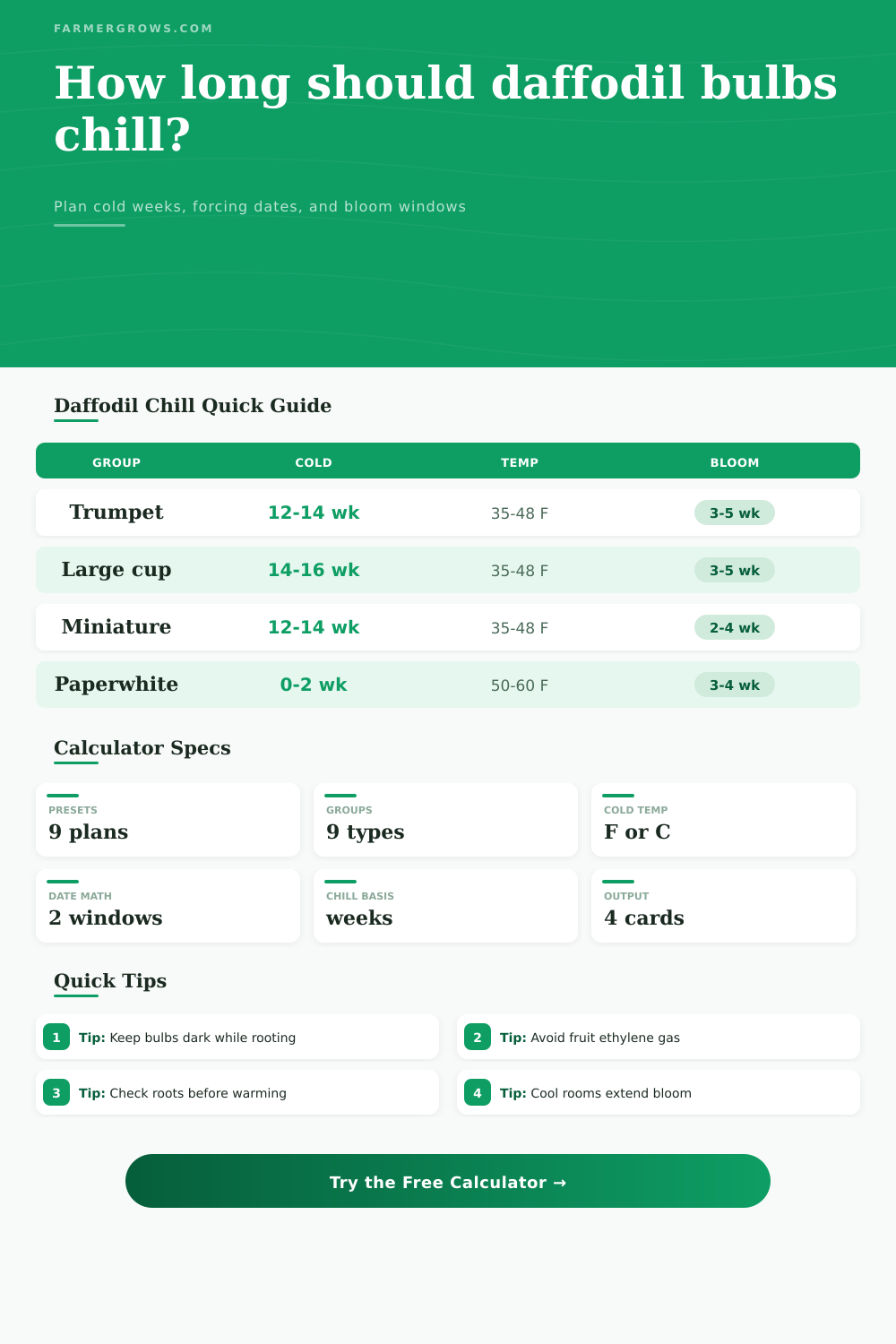
| Trumpet daffodil | 12–14 weeks at 35–48°F | 3–5 weeks | Reliable large-flower type when roots fill the pot before warming. |
| Large-cupped daffodil | 14–16 weeks at 35–48°F | 3–5 weeks | Benefits from the longer end of the chill range for event timing. |
| Small-cupped daffodil | 13–15 weeks at 35–48°F | 3–5 weeks | Moderate chill need with a steady cool finish. |
| Double daffodil | 14–16 weeks at 35–48°F | 4–5 weeks | Heavy flowers need strong roots and bright, cool finishing conditions. |
| Miniature daffodil | 12–14 weeks at 35–48°F | 2–4 weeks | Often finishes faster in small pots after sufficient rooting. |
| Tazetta narcissus | 8–10 weeks at 40–50°F | 3–4 weeks | Less cold than hardy daffodils, but some cooling improves compact growth. |
| Paperwhite narcissus | 0–2 weeks, usually optional | 3–4 weeks | Commonly forced directly in water, stones, or shallow media. |
| Average storage temperature | Chill quality | Calculator effect | Grower note |
|---|---|---|---|
| 32–34°F / 0–1°C | Cold but slow rooting | Add about 1 week | Avoid frozen pots; roots do not grow well in frozen media. |
| 35–45°F / 2–7°C | Ideal | No added time | Best range for predictable rooting and flower initiation. |
| 46–48°F / 8–9°C | Usable cool storage | Add about 0.5 week | Still useful, but check for early shoot stretch. |
| 49–52°F / 9–11°C | Marginal | Add about 1.5 weeks | Works better for tazetta than for hardy daffodil forcing. |
| 53–55°F / 12–13°C | Weak chill | Add about 3 weeks | Expect uneven rooting unless bulbs were pre-cooled. |
| Above 55°F / 13°C | Not dependable | High risk warning | Use a cooler location or buy pre-cooled bulbs. |
| Finish temperature | Expected bloom speed | Stem quality | Best use |
|---|---|---|---|
| 50–55°F / 10–13°C | Slower by about 1 week | Strongest, compact stems | Cool greenhouse, porch, or bright cellar window. |
| 56–65°F / 13–18°C | Normal forcing speed | Balanced | Best indoor range after roots are established. |
| 66–70°F / 19–21°C | Faster by several days | Can stretch | Useful for catching up, then move cooler as buds color. |
| Above 70°F / 21°C | Fast but short-lived | Weak or floppy | Avoid for display unless the bloom date is urgent. |
| Scheduling goal | Start cold by | Move warm about | Planning note |
|---|---|---|---|
| Early January bloom | Mid September | Early to mid December | Needs pre-cooled bulbs or a very early potting date. |
| Valentine display | Early October | Mid January | Good target for large-cupped and double types. |
| March indoor bloom | Late October | Late February | Comfortable schedule for most hardy daffodils. |
| Outdoor spring bed | Fall planting | Naturally warmed by soil | Plant before soil freezes so bulbs can root. |
Count chill only when bulbs are actually cold. A refrigerator, bulb cooler, cold frame, or consistently cold garage should stay cool enough for rooting, but not so cold that pots freeze solid for long periods.
Warm bulbs gradually after the cold period. Move rooted pots into dim, cool light for several days, then brighter light. Hot rooms speed bloom but shorten the display and can stretch stems.
Do you recall purchasing the daffodil bulbs back in early November? A certain kind of quiet panic sets in. There they are, dormant and indifferent to your holiday party calendar, all of them packed into a paper bag. They are not yellow trumpets on Valentine’s Day. Instead, they are leafy green sticks that race for the light, only to flop over and die in the vase a few days later.
Rarely do success or failure depends on watering or even planting medium. Mostly they depend on temperature, and mostly on time. Yes, daffodils is biological clocks, and won’t agree to bloom unless they believe it’s still winter. Skip the part about being cold, and you’ll skip out on the show.
How to Force Daffodil Blooms
All you have to do is plug in what type of variety you’re growing (above) and how you’ll store them, and the calculator does the rest. No more guessing if your garage will be cold enough.
That’s the trick: How many weeks of chill does each variety require? In general, bulbs in the daffodil group. Such as trumpet types or big-cupped kinds, is divas; expect 12 to 16 weeks for them. The miniatures are a little easier on the system, and even happier with 12 weeks.
Then there are the exceptions that prove the rule: Paperwhites. These are tender narcissus. They don’t need any cold whatsoever. Stashing a paperwhite in the fridge is about as effective as freezing a banana to hasten its ripening. It just confuses the bulb. Most people who get this wrong grow all their narcissi together.
Not all narcissi grows the same. The other half of the equation is temperature. Hardiness daffodil bulbs like temperatures somewhere between thirty-five and forty-eight degrees F., which is cool enough to promote root development but not so cold that it freezes the ground solid. They will spend all those hours at fifty degrees in your storage space but won’t even notice; they don’t register those non-chilling hours as such. What happens is nothing, except maybe feeling slightly agitated.
So the tool includes this reality about what’s needed in terms of time. Spend days at fifty-five degrees in the garage? You’ll need additional weeks to make up for inefficiencies. It is a simple tradeoff. Cold buys you quality; warmth buys you speed.
Many people are frightened by the dark period because they imagine having to plant those bulbs deep in the ground right away. Actually, what grows well underground are the roots (which do so in the dark); aboveground, it’s all about getting some light on the shoot. As the general rule goes: Leave the pots out in the cold until you notice the appearance of some roots through the drainage holes. That should take a couple of weeks. When you spot the telltale whiteness. Stringy and alive, you transfer the pots to somewhere cool and dark, like another room. A few more days pass, and then comes the exposure to light.
Don’t rush it. Shoving a cold, rooted bulb into a hot, sunny window will shock the system. The stems will quickly stretch for cover and what happens next? Floppy flowers, unable to hold up their own weight.
Then there’s the bloom window output, which will tell you what day you can expect color. For typical forced bulbs, that’s going to be three to five weeks after starting the warming phase. Want something for a particular date? Work backward by figuring out how many chill days you want, then add that amount and the warming adjuster (above), and finally add the bloom time. When your storage temp varies, you’re into some tricky math.
The best setup is a refrigerator all to itself that keeps it steady. An unheated garage…well, it’s a roll of the dice. Great if you always have a really cold winter; bad news if you get unseasonably warm spells. The calculator takes all those factors in. It lets you know if it thinks your setup is at risk and gives you a score of its readiness.
They are not quite paperwhites. They go right from package to vase. No cold required; they bloom in three to four weeks, which is nice if you want to do last-minute gifts. But don’t count on them smelling like a field in April. Their scent is heavier, musky. Some people adore that; some open a window.
The hardy daffodils are more delicately structured, and fragrant too. The chill gives them stronger stems. If they don’t get it, they’re just expensive green sticks.
Don’t stop chilling till you check your roots: Are they white below? Is the pot heavy with soil? Good to go. Any that look soft or shriveled? Toss. Don’t tempt fate with any soft bulbs in the wet cold; they’ll rot. Firm ones will wait patiently.
Buy healthy stock; nature will do the rest and the timing will work out. No amount of good math can fix a bad bulb. Make it firm, make it cool, and let nature do the work. They’ll be ready when they’re ready, and often just right on time if you paid respect to winter.