Tulip Bulb Chill Time Calculator
Schedule tulip cold treatment by cultivar group, target bloom date, storage temperature, already completed chill, rooting time, and warm forcing conditions.
Choose a real cultivar scenario, then adjust the bloom date, temperature, pot size, bulb count, and cold weeks for your forcing setup or outdoor climate.
Tulip Chill Schedule
Your tulip chill plan will appear here.
Best for indoor forcing when the refrigerator stays near 38–42°F and has no ripening fruit stored beside bulbs.
Works when nights and days stay cold enough, but warm spells slow the effective chill week count.
Good for cold-winter climates; protect pots from freeze-thaw heaving, rodents, and waterlogged soil.
Count supplier-listed cold weeks as completed, then finish rooting or move into a cool bright room.
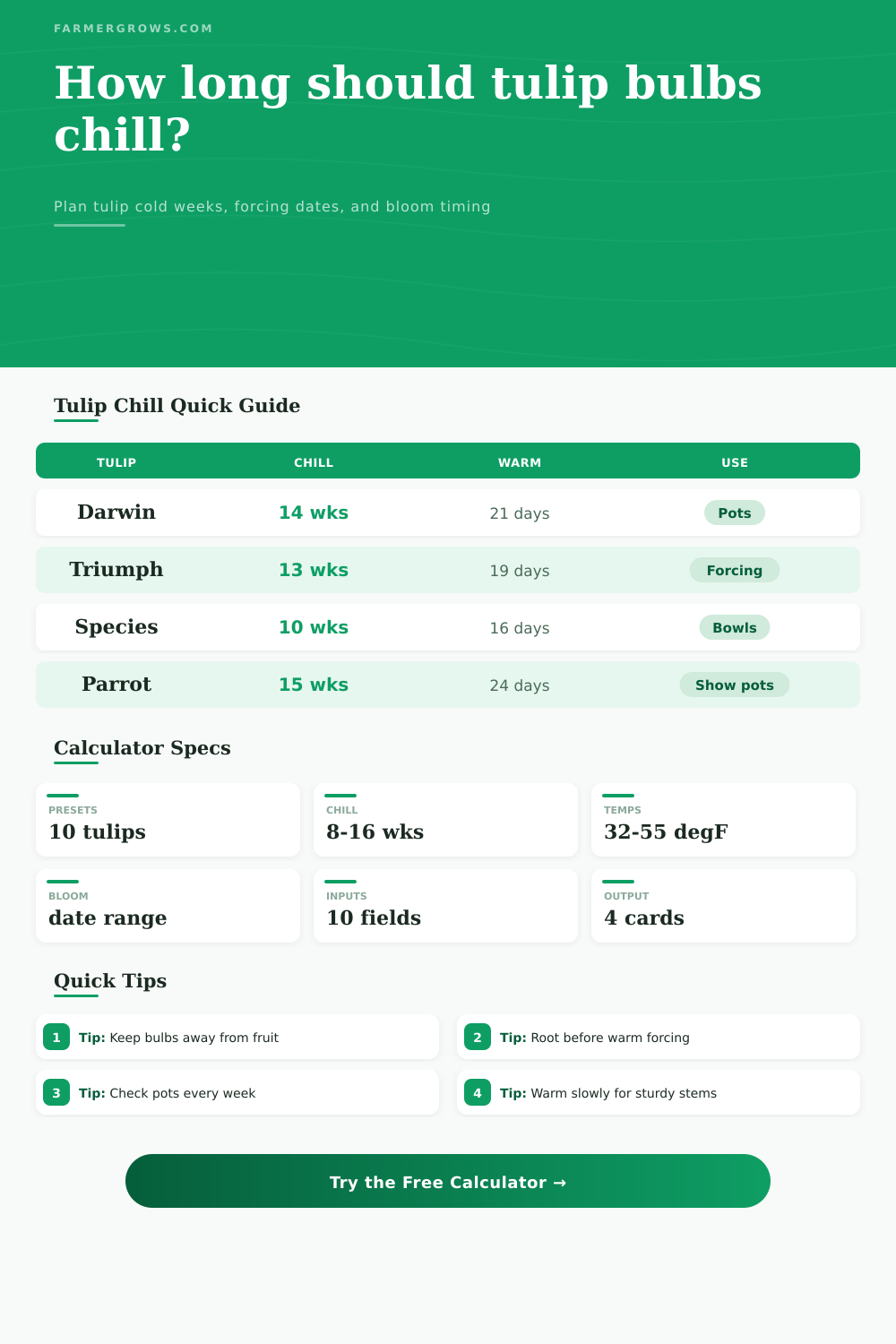
| Tulip group | Typical chill range | Warm forcing range | Best use |
|---|---|---|---|
| Single Early | 12–13 weeks | 16–20 days | Early holiday or late-winter pots |
| Triumph | 12–14 weeks | 17–21 days | Reliable indoor forcing and medium stems |
| Darwin Hybrid | 14–16 weeks | 20–24 days | Large flowers, patio tubs, outdoor beds |
| Species or botanical | 10–12 weeks | 14–18 days | Bowls, shallow pots, naturalizing displays |
| Parrot or late fancy | 15–16 weeks | 22–28 days | Show pots where bloom timing can be flexible |
| Storage temperature | Chill credit | Risk level | Planning note |
|---|---|---|---|
| 35–45°F / 2–7°C | Full credit | Low | Ideal refrigerator or very steady cold room range |
| 46–48°F / 8–9°C | About 85% | Low to moderate | Usable, but add extra calendar time |
| 49–52°F / 9–11°C | About 55% | Moderate | Cold accumulation slows and stems may stretch |
| 53–55°F / 12–13°C | About 25% | High | Too warm for dependable tulip forcing |
| Below 32°F / 0°C | Limited credit | Freeze risk | Bulbs may pause rather than root well if pots freeze hard |
| Pot or container | Common bulb count | Rooting allowance | Spacing cue |
|---|---|---|---|
| 6 inch pot | 5–7 tulips | 2–3 cold weeks after potting | Bulbs almost touch, flat side outward |
| 8 inch pot | 7–10 tulips | 3 cold weeks after potting | Shoulder-to-shoulder planting for a full display |
| 10 inch pot | 11–15 tulips | 3–4 cold weeks after potting | Use deeper mix for large Darwin bulbs |
| Bulb crate | 20–40 tulips | 4 cold weeks after potting | Keep roots moist and evenly cold |
| Target bloom | Typical start chill | Move to warmth | Best class |
|---|---|---|---|
| New Year display | Early September | Early December | Single Early or pre-cooled Triumph |
| Valentine display | Late October | Late January | Triumph, Double Early, Fosteriana |
| Early March bloom | Mid November | Mid February | Darwin Hybrid or Triumph |
| Easter or April pots | December to January | March | Darwin, Lily-flowered, Viridiflora |
Keep bulbs cold, moist, and dark. Potted tulips should root in barely damp mix, not wet soil. If using a refrigerator, avoid apples, pears, and other ethylene-producing fruit.
Do not rush the warm finish. After the cold period, start pots in cool bright light for a few days before normal room warmth so stems stay shorter and stronger.
Something special about tulip growers: They tend to be dissapeared in a special way. This usually happens just about now, around Easter (and sometimes Valentine’s Day), when they carry their chilly pots indoors, thinking there will be color, but all they get is dirt. Right?
What happened? Oh, right; you have the bulbs; you planted them properly, and you even stored them cold. But no flower. Why not? It is not necesarily because of any flaw in bulb at all. More typically, we are just confused about how cold actualy sets the tulip’s clock and causes it to wake up.
How to Grow Tulips
There’s a critical number of days of sustained coolness that must happen for a tulip to begin waking up, and that coolness has to trigger a change in hormones that signals the tulip to push its stem upward. If the coolness isn’t sustained long enough, or if it varies too much in temperature, the tulip doesn’t wake up…hence the calculator above, a tool to help you do the math.
No more guesswork: Is my garage cold enough to count?
Today’s links
So what’s all this talk about effective chill, rather than calendar weeks? One full week in the fridge at a constant thirty-eight degrees advances things a full week. But one week in the garage where the temperature bounces between thirty and fifty degrees might only provide three or four days of actual chill time, making the process slower.
And tulips really don’t like variable temperatures. Just like hours of work add up to “units” of accumulated cold, so do weeks of exposure to them. But unlike human workers, who can slow their pace when conditions get uncomfortable (or even stop working altogether), the tulip will plod along more slowly if the conditions are too warm.
Too cold, say, near freezing, and its inner biochemical workings stall. Enzymes that drive root development don’t operate efficiently in icy temperatures. The sweet spot is small: right around thirty-five to forty-five degrees Fahrenheit.
People greatly underrate storage. Isolated, a fridge works fine. In winter, an outdoor pot is dicey (soil temperatures may be too low for root growth).
That can be shortened (or lengthened) a lot depending on which variety you choose: For instance, the Darwin hybrids are big and bold and make nice flower in a vase. That’s great…but there is a price: Because they’re bigger and brawnier, they also demand a longer (and harder) cold treatment then their smaller cousins. Want to push a Darwin hybrid into service for your New Year show? The biology isn’t going to oblige. It takes a minimum of fourteen weeks of sustained chill before the flower wakes up. Push things along too fast, and what you’ll end up with are puny, floppy stems that can barely support the flower itself.
Wild tulips are more forgiving. They’ve evolved to break dormancy earlier in the natural world, where they have to flower relatively early in the season, so they don’t “need” such a long exposure to accumulating cold.
Knowing all this means no more waiting for a bloom that will never arrive. It’s not just temperature, either: How a bulb is stored matters more than many gardeners think.
If storing them in your refrigerator (as opposed to a cold basement), know this: Fruit should never be stored with bulbs. Why? Because fruit emits a ripening gas called ethylene. To a tulip bulb, ethylene says “time to bloom” or “time to decay.” This is not what you want when they are trying to root. Keeping them in a separate unit, or at least in a sealed plastic bag if using a shared fridge, will help. It might seem like a small thing, but it really makes the difference between whether or not the forcing succeeds.
Another variable that people tend to overlook: How long does it take those bulbs to get rooted? There’s an allowance for that (rooting) in the calculator as well, and the bulb has to have time to set its roots once you put it in the ground, even if it has had the necessary chill. That’s why you don’t just bring the potted thing into your nice warm room the instant the cold weeks are done. For a few days more, at least, it needs to be in a cool and bright place and let the roots set and the soil firm back up before moving on to the part where things really grow. Plants grown without waiting for this will end up top-heavy, flopping all over the place from the weight of their blooms.
The warmer the forcing period that follows, the faster the bloom; but with that comes thinner stems. The cooler the forcing, the slower the bloom, but the stronger and longer-lasting the flower. A tradeoff: speed versus quality.
The only way to get things to flower at a certain moment is to plan ahead. There’s no way to trick a tulip into thinking Christmas means it should flower on that day if you haven’t been cooling them off for months first. Backwards math: take your target bloom date and work backwards. How long will they be forced warm? Subtract that. And how long will they take to root? And how many weeks of chill did they require before that? Subtract that. The answer: that’s when you need to have your bulbs in the cold.
That date may be months away. In that case, get your storage space ready now. Or the date may already be behind you, which means no dice with those bulbs this year.
That’s what I love about all this: Once you figure out the variables, you can plan flowers to open on whatever date in early spring you like. Gardening becomes less of a crapshoot and more of a science. There’s nothing like forcing tulips to make the wait for their natural emergence worth while. That’s because, at least to your mind, you proved yourself smarter than the tulip. You knew what this plant wanted: enough cold to shake it awake, and so you obliged. You knew it wanted stability, and you supplied it with just that. And then, in gratitude, it rewarded you with a splash of color, as if to say, I’ve got you now, winter out there be damned.
What’s the secret to forcing bulbs? The secret isn’t the bulb; it’s the clock. Make sure the clock stays on track: Keep it cool; don’t let it go warm, ever, unless you’re ready for it to come out of dormancy. Keep it away from fruit. Don’t touch it. Don’t tinker. Don’t get distracted. Just keep it cold, keep it still, keep it apart from the apples, and the flower will follow.