
You may not notice it, but there’s lots of invisible aggression going on out in the garden. I mean: you look at your plants, right? They is all passive and just exist over there until it comes time for you to cut them back.
Not so much! Look at the boggy margins of the world, and you realize what’s really up with some 700+ species of plant that has engineered themselves into carnivorous predators, flipping the table on insects that typically eat them. Nature isn’t just about surviving; it’s about engineering, to. How do these plants work, and how does understanding them change how we see plant world?
How Carnivorous Plants Work
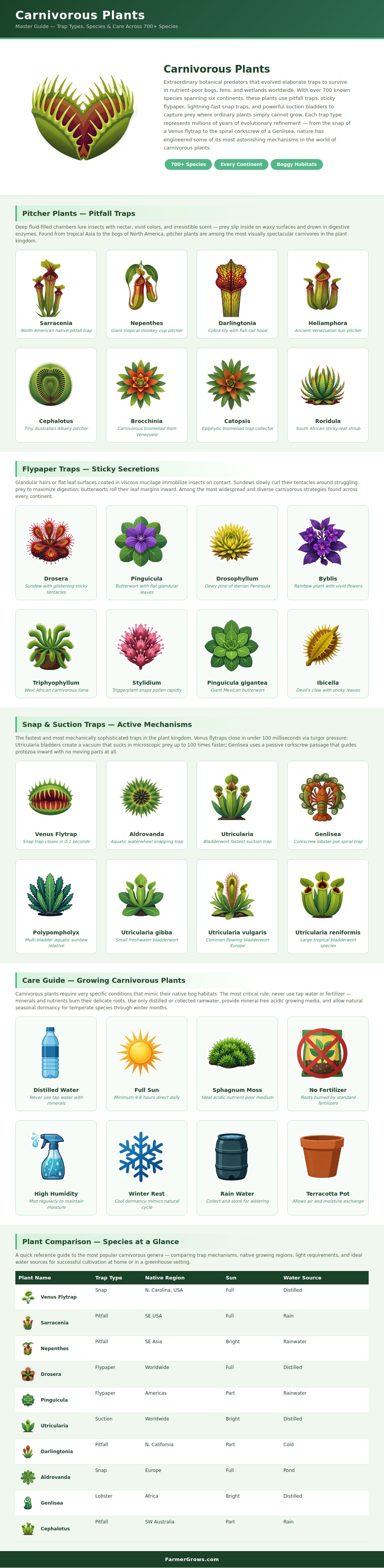
The infographic above breaks down how these creatures are engineered, from suction bladders to mechanical traps for getting nitrogen. And once you know how something works, it never looks the same again. It no longer seems like static background but a world of evolutionary innovasion.
But that’s also why there are so many kinds of traps: These plants aren’t particularly close relatives. A pitfall trap is just what it sounds like: a simple hole in the ground. Brilliantly colored pitchers attracts insects, which fall into a watery pit filled with digestive juices. It works, but slowly, and is basically a sit-back-and-wait tactic.
That’s the story with pitcher plants like *Sarracenia*, and it’s the story with *Darlingtonia* and *Nepenthes* (those two genera), too, which are found on opposite sides of the world, just look at them compared side by side in the chart. They has different styles for the same purpose. And this is proof of the concept of natural selection in action: When you have a need, say for food that’s really urgent, you don’t have to have a common ancestor to arrive at the same solution.
Another example are sticky traps. Butterworts (and sundews) has leaves (or hair) covered with sticky fluid to capture insects. And here’s where the trick come in: There’s some action involved. No, they don’t sit there waiting. The tentacles of a sundew curl themselves gradualy over the prey and hold it tight while they digest it. It’s not fast, just a gradual motion, but deadly all the same.
The infographic says this tactic is found on every continent and is very versatile. From the rainbow plant to dewy pine growing in the Iberian Peninsula: It’s the same deal. Catching prey with stickiness works. Digest it efficienty. Catch what you can get.
Suction mechanisms and snap traps goes like lightning. Pressure causes the Venus flytrap to close in under one-tenth of a second. Bladderworts can does better, if anything: They generate a vacuum that pulls in tiny prey a hundred times faster than the flytrap snaps. It is a mini-hydraulic shockwave. The chart compares these dynamic tactics to the passively trapping *Genlisea*, which moves no parts but simply leads its prey into a trap.
Put them all side by side and you begin to grasp the scope of what plants will do. And some of them, some, are mechanical engineers; others is ambush predators.
To grow these plants successfuly indoors, keep their origin in mind. One main rule stands out on the care guide: Use only rain water or distilled water. Why? These plants evolved in nutrient-poor bogs and tap water has too many minerals which burn the tender roots. No fertilizer is necessary. I know “fertilize” sounds like an oxymoron, but the right word for what they need is insect food. They don’t require nutrients from the ground, they obtains them by catching insects as part of their prey.
To succeed with temperate species, provide bright light (full sun is best), high humidity, and a correct winter rest period. Don’t coddle them; instead, try to recreate the severity of where they come from. Once you have the scoop on the trap, you’ve got the scoop on the plant. And once you’ve got the scoop on the plant, you’ll be able to keep it. You should of known that!