
Growing fruit trees requires a particular kind of patience; it seems as if you’re waiting on the earth to inhale. Dig the hole, plant the bare-root sapling, water it, then wait. And wait.
With a persimmon tree, the second is more a lesson about timing than a trial of faith. It go slow at first, then steady, then it gets itself all settled down into a rhythmic thing that’s a reward to the patient.
How to Plant and Care for Persimmon Trees
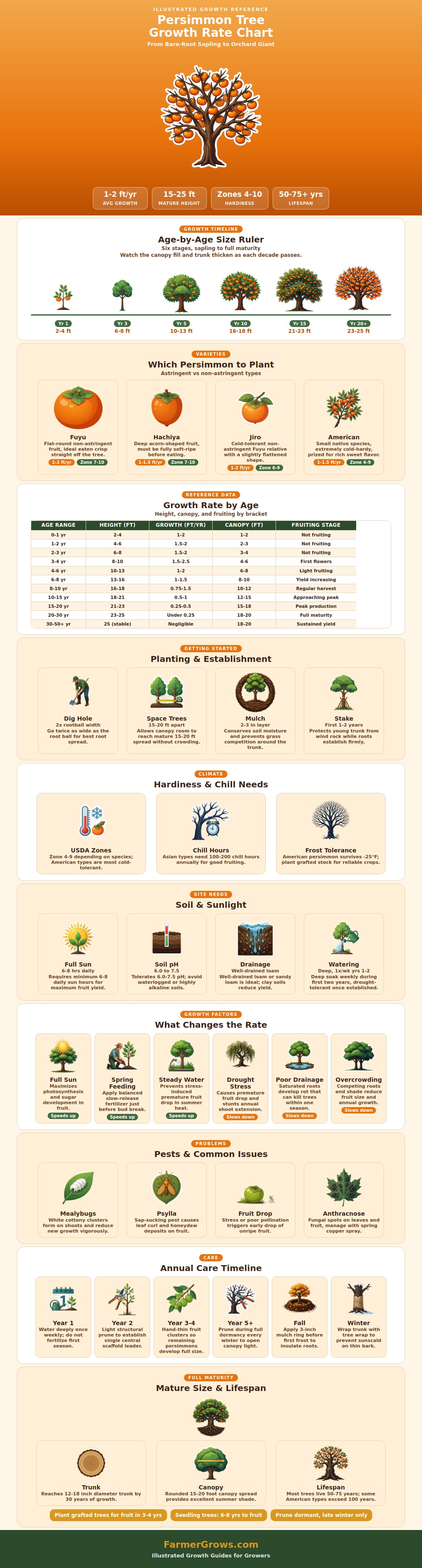
How long does it take a young tree to get rooted before it really begins growing up? Most folks don’t know. To help you see what is happening in those first few years, here is a concrete breakdown based off the timeline above.
Maybe there’s just a couple of feet of vertical growth the first year, but all kinds of action happens below ground. That initial two or three years are the groundwork; no fruit yet. The trunk gets wider, though; the canopy starts to fill out, slowly, over many years. Ten-year-old trees has probably hit around sixteen to eighteen feet tall.
At that point, they’re saying “okay, I’m an adult,” and are ready to move from adolescence to their fruit-bearing years. Why does it take so long? This provides something real to help you know when to stop worrying about its height and start preparing for production.
Choosing the right variety is just as important as where and how you plant it. If you want your persimmon to be more like an apple… Crisp rather than meltingly ripe (the one for you is Fuyu). Non-astringent, this baby can simply be plucked off and eaten out of hand (as opposed to having to wait until it’s really softened up).
The astringent Hachiya poses quite a challenge to the quick-and-dirty gardener, who has to wait till it’s nearly gooey-gelatinous, soft all over to the core, before it’ll lose its astringency.
You’ll find those distinctions highlighted in the visual guide, but it also points out another reason to consider American persimmons: They’re adapted to harsh-winter climates where even their Asian cousins couldn’t make it. Without at least the American type, the tree wouldn’t stand a chance where you might have really cold winters.
How you plant will affect how well it grows in its first couple of years. Dig a hole that’s twice the width of rootball. Yes, I know this is obvious. But if you don’t make a large enough hole, the roots will just go round and round in circles. They will choke each other and never be able to spread out to where they can reach food.
Also, stake it for the first couple of years. Young trees are at great risk for wind rock. This means their tender root systems is shaken repeatedly until they lose anchorage before they even have a chance to grab hold.
Mulch around the base, too, to keep grass from stealing moisture (especially important those first couple of years, when the tree literally has no other choice but to rely on you). The mulch will also help keep moisture in for the tree.
The rate at which your tree will mature depends heavily upon environmental conditions. For best fruit development (i.e., sugar production), persimmon trees need full sun. Six to eight hours per day of direct exposure to light is ideal. Less than this, and the tree will still live (but won’t love you back).
Proper soil drainage is equally important. Persimmons are not happy growing in wet spots; soggy soil may cause root rot and kill the tree within one season’s time. In areas where ground is especially heavy with clay, consider amending the soil, or planting on a mound so water runs off well.
It does have pests and disease… Yes, but it’s all manageable. The usual culprits, like mealybugs and psylla, sap energy from the tree, causing reduced growth and curled leaves. To control them, inspect regularly and occasionally spray with organic insecticides that are not harmful to the surrounding ecosystem.
There’s also the matter of fruit drop, which is usually caused by poor pollination or some other kind of stress. By hand-thinning the fruit in the early years, you train the tree to concentrate its energies on fewer, bigger persimmons rather than dozens of small, undeveloped ones.
Patience yields a tree which may stay on your property for half-a-century or more. Some American species have been known to reach one-hundred-plus and become landmarks in their communities. Its canopy expands with age, casting good shade in summer; its trunk swells, too.
After establishment, the tree is tolerant of dry conditions and needs little attention except an annual prune around winter to keep some light coming through.
When you plant a tree like this, you do so not only for what you’ll eat fresh this year, but also for its legacy: the way it will slowly rise from that vulnerable sprout to a mature tree. It should of been worth waiting for.