
You plant a tree, and you’re anxious. You invest a piece of time into something that won’t return investment for years and years to come.
You dig a hole, set the sapling, and wait. Nothing happens aboveground the first year. That’s the worst: nothing happen aboveground. And yet underground the roots is doing their thing, getting established, just as they should, but all you see is what you don’t have. Patience, that’s the first lesson of owning a crabapple.
How to Plant and Care for a Crabapple Tree
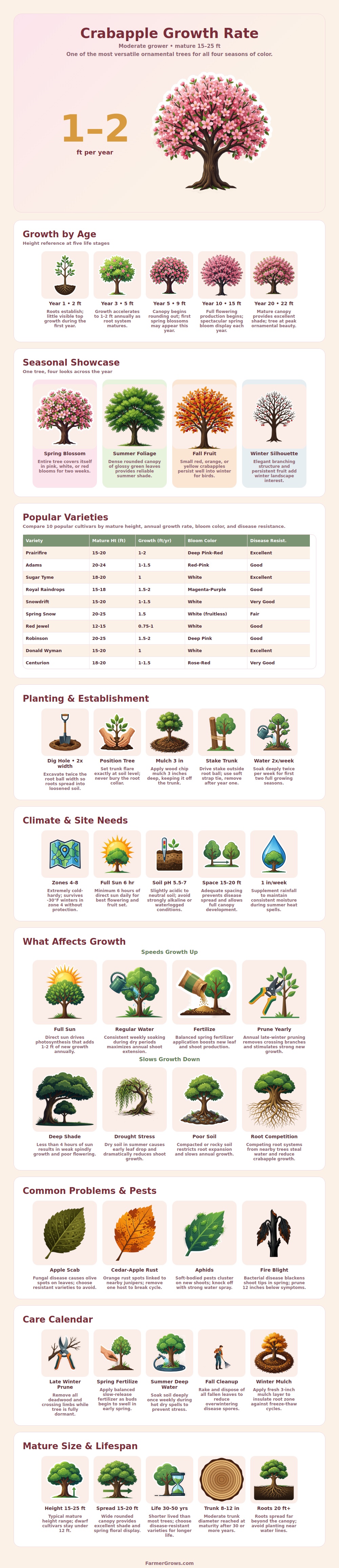
The chart above shows how it grow over time: it stays quiet at first, but then picks up speed around Year 2 once the root system has matured. And then by year three, the payback begins. Slowly but surely, tree starts adding a foot or two of height per year, which feels like an even keel and something you can handle. It is not a shoot-up-and-there-it-is kind of thing, but an ever-so-slowly going up.
Many fast-growing things is weak-growing; their wood won’t hold together well in big windstorms. Because crabapples don’t rush so much, they’re solid and tight. So many years later, you’ve built yourself a structure that holds up over decades, not some flashy momentary showpiece that blows apart at the first gust of a thunderstorm. When you’re investing this much time into framing a view, or making shade for your patio, that solidity count.
But this is where most of us hang up: There are hundreds of varieties and how do you choose the correct one? To help cut through the noise, they created this visual guide. It ranks varieties based off how well they resist disease compared to other varieties and their ultimate height when full grown.
You don’t have to commit all cultivar to memory, just know your space! If you have limited space like in a small yard, opt for one of the dwarves that will top out at less than a dozen feet high. And if you have room to spare, go big and have a large tree that really provides some shade.
The fun part is the bloom color; the work that pays off is knowing which ones resist disease. Less disease means less clean up, less spraying. It is a small thing to consider at purchase…but speaks volumes in the work that you’ll be doing the next three decades.
It’s also critical where these things go. Full sun is a must (six or more hours of direct sunlight each day). Planting them in the shade? Sure, they’ll grow, but weakly and spindly. The flowers will be reduced, as will the fruit. Photosynthesis, the process where sunlight builds a tree, will not happen on a spindly little thing like this; it require full sun to fill out the flower and build its wood.
Soil matters as well: They likes slightly acid soil, and don’t do so well if kept constantly soggy. Wet feet are their undoing. Good drainage is necessary. Digging a wide hole for your tree helps here too. It should be wide enough to allow its roots to explore the natural soil, since you want them to have room to stretch out.
It’s also low maintenance after the initial establishment of the tree. A couple of notes from the care calendar (shown in the infographic) shows the points. But really, it is simple: Cut back in late-winter to open up the canopy, remove dead wood, etc.
If they get dry in their early years, be sure to water well so that roots establishes themselves deeply, but after year three or four most crabapples would of been okay with just average rainfall.
It is fall. Because leaving the leaves on the ground allows diseases to overwinter in the leaf litter, we rake them up then. It is an additional job for us, but cleaner trees comes in springtime.
Crabapples are beautiful because they are versatile trees, with something of interest every month of the year. Spring brings bright flowers. Clouds of pink, white, or even red cover the branches. Then comes steady summer shade from the leaves, followed by fall fruit that feeds the birds well past harvest time. Even in winter, when the rest of the land is bare, the remaining fruit and the silhouettes of its branches contribute character to an otherwise empty landscape.
One tree does four jobs. If you think about it, from that silent first-year growth through the mature canopy in year twenty, you didn’t just plant a tree. You planted a background for your life, changing season by season as you do.