
It’s spring. You buy a tree, dig the hole, insert the seedling with great expectation of grand shade provider, or an impenetrable privacy screen any day now. Summer arrives, and what do you know? That poor little thing look no bigger than the day you planted it. Was the soil poisoned? Is this a dead stick after all?
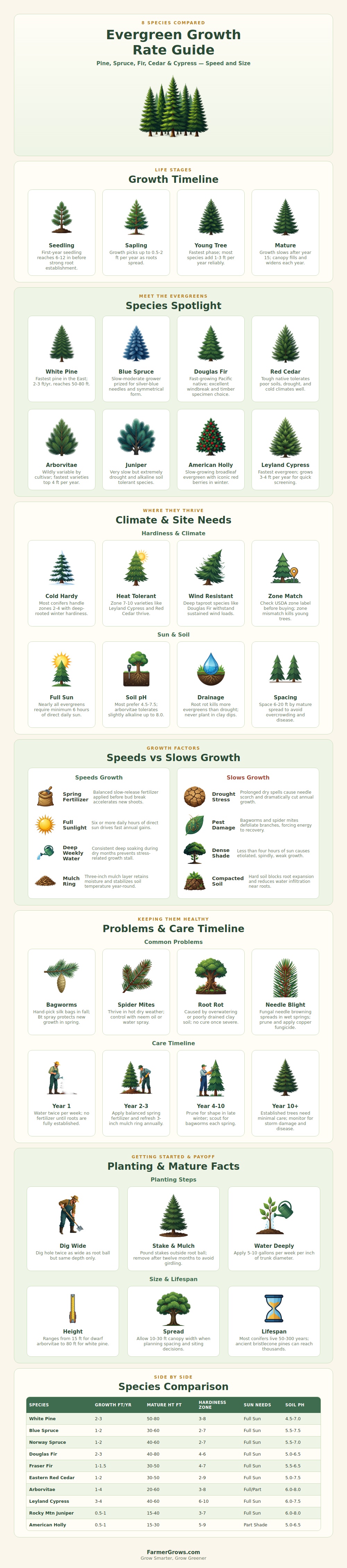
Most likely not; it’s just about evergreen time, and evergreens follows their own calendar, often one that doesn’t coincide with yours at all. Knowing that rhythm is the key to raising trees (or bashing them out in exasperation). Here’s how it plays out over time, broken down in the chart above into four stages:
How Evergreen Trees Grow Over Time
In the seedling stage, the plant go down instead of upward for its energy. This is what discourages most beginning gardener. The first year, you’re lucky if you get six to a dozen inches showing, and that’s all about building root systems deep in the soil (though it can feel as though nothing at all are happening above). That’s the foundation.
Then during sapling, things start to move faster again; half a foot or two feet a year. As that root system fan out and gets bigger. It doesn’t happen fast, think of it as climbing steadily, not sprints, and then finally, in the young tree phase, BOOM! You have an actual explosion, and many species will go another foot a year or even three a year after that. It’s a fast lane, but only for so long.
About 15 years in and the tree move into its mature phase. Energy shifts from growing up to growing out. The tree slows down its height and begins filling out it’s canopy.
Speed isn’t one size fits all among evergreens. Leyland Cypress is the one everyone uses for quick screening because it can reach four feet in a year (in ideal conditions). That’s an engine of a plant; fast, effective and widely available. At the opposite end is the Juniper. It is oh-so-slow (often adding less than a foot a year) but pays you back in spades with extreme durability. It takes alkaline soil, drought, even neglect that kills off the faster growing plants in a heartbeat.
And then there are the classics (White Pine, Douglas Fir). They offer a solid two to three feet of growth per year. This is a middle ground that is neither too fast nor too slow. You get reasonable speed without losing structural integrity.
It has a moderate growth rate, though not as fast as those first two, but needle color is oh so beautiful: Blue Spruce with its dramatic silvery needles. It’s about form, not really a lot of rush for height gain. So it’s about what you value most: speed or something else?
Genetics are important, but so is the environment. This chart points out that almost all evergreens requires full sun (six or more hours of direct sunlight per day). In shade they stretch and become thin and weak, like a noodle instead of a proper tree. Even worse: poor drainage of the soil is far more lethal to an evergreen than drought will ever be. Regardless of how much water you apply, planting in clay soil that doesn’t drain is a prescription for root rot, which will kill more evergreens then drought will. The soil must let water flow right through.
Most conifers wants slightly acid soil; yes, pH makes a difference. A few, such as Red Cedar, can take harsher conditions.
Change how you care for the tree based off its age. In the early years, there’s just one task: water it. Soak deeply once a week to encourage roots to grow deep. No fertilizer at this point. Let the tree establish its own foundation. Later, when the tree is up and running (with shoots to feed), apply a balanced slow release fertilizer in springtime to feed those new shoots.
Another easy task is mulching. And that’s a biggie. Use a three-inch ring of mulch to keep the soil temperature stable and retain moisture without suffocating the trunk. It stabilizes the soil temperature and holds moisture. It also doesn’t smother the trunk.
Look out for pests such as spider mites and bagworms, which can really do some damage and cause fast defoliation, particularly during hot, dry summers. That means the tree has to use precious energy recovering, rather than growing.
Then comes planting properly: Dig a hole twice as wide, no wider than deep, so that roots have room to spread out (above). Don’t dig it any deeper; that promotes flow problems in the tree later on when roots circle around the trunk. Unless needed (which is rare), don’t stake the tree; if you do, remove the staking within a year. Staking an evergreen means over-staking, which keeps the trunk soft against the wind and doesn’t allow it to harden off.
Give your evergreen what it needs, good drainage, good sun and patience… And it will repay you with happiness. The first year may not seem much like a forest, but that’s because it is creating something for long term. That slow beginning isn’t failure. It’s starting a relationship that lasts a hundred years.