Dahlia Bloom Time Calculator
Estimate first bloom, peak bloom, and frost-window risk from planting date, tuber or transplant start, named variety, form, height, pinching, soil temperature, sun hours, zone, and local frost dates.
📋Dahlia bloom presets
Start with real named dahlia cultivars and common planting situations, then adjust the exact dates and site conditions for your garden.
🌼Planting date and dahlia type
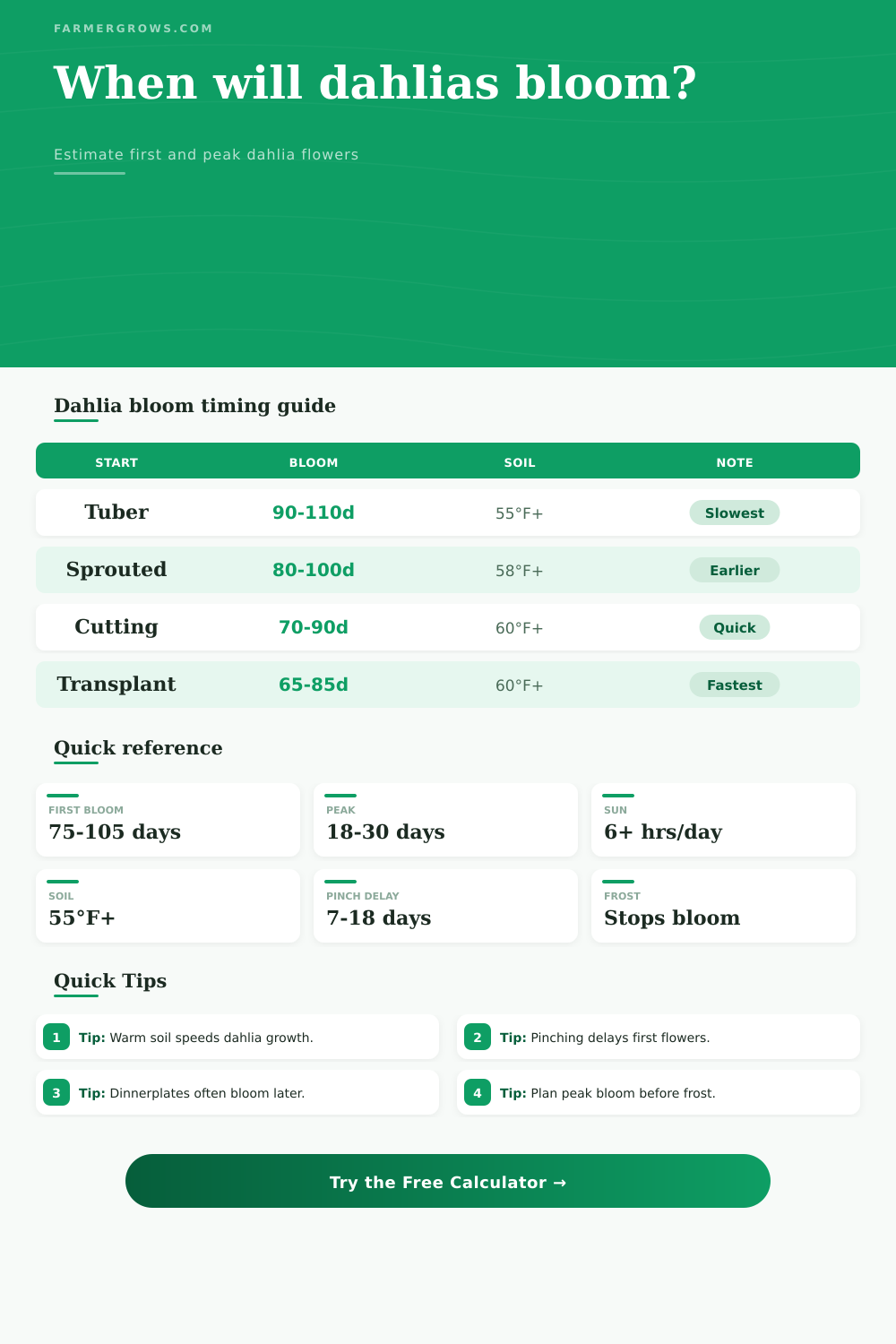
The calculator treats a planted tuber, pre-sprouted tuber, rooted cutting, and hardened transplant differently because each begins the season with a different amount of active growth.
🌡Garden warmth, sun, and frost window
Dahlias grow fastest in warm soil and full sun. Frost dates help show whether peak bloom has room to develop before the first hard cold spell.
Dahlia bloom estimate
Calculated dates appear here after you choose a planting date and dahlia variety.
Timing breakdown
📊Dahlia timing signals
⚖Bloom path comparison
Use these side-by-side paths to see the tradeoff between earliest color, more stems, larger blooms, and frost pressure.
Fastest color
More cut stems
Big bloom route
Frost-tight crop
📚Dahlia reference tables
| Variety | Form | Height | Base days |
|---|---|---|---|
| Cafe au Lait | Dinnerplate | 4 to 5 ft | 100 |
| Cornel Bronze | Ball | 3.5 to 4.5 ft | 86 |
| Thomas Edison | Decorative | 4 to 5 ft | 92 |
| Bishop of Llandaff | Single | 3 to 4 ft | 76 |
| Totally Tangerine | Anemone | 3 to 4 ft | 82 |
| Kelvin Floodlight | Dinnerplate | 4 to 5 ft | 104 |
| Wizard of Oz | Pompon | 2.5 to 3.5 ft | 84 |
| Penhill Watermelon | Decorative | 5 ft plus | 96 |
| Labyrinth | Informal decorative | 4 to 5 ft | 94 |
| Arabian Night | Decorative | 3.5 to 4.5 ft | 88 |
| Factor | Choice | Days | Bloom effect |
|---|---|---|---|
| Start | Dormant tuber | 0 | Standard timing |
| Start | Pre-sprouted tuber | -8 | Earlier growth |
| Start | Rooted cutting | -12 | Quick establishment |
| Start | Greenhouse transplant | -16 | Fastest first bloom |
| Pinch | No pinch | 0 | Fastest color |
| Pinch | Early pinch | +7 | More branching |
| Pinch | Standard pinch | +12 | Balanced stems |
| Pinch | Late pinch | +18 | Latest first bloom |
| Condition | Range | Days | Timing note |
|---|---|---|---|
| Soil temp | Below 50°F | +18 | Tubers sit slowly |
| Soil temp | 50 to 54°F | +12 | Slow emergence |
| Soil temp | 55 to 59°F | +6 | Workable but cool |
| Soil temp | 60 to 68°F | 0 | Good start |
| Soil temp | 69 to 75°F | -3 | Fast root growth |
| Sun | Under 5 hours | +14 | Delayed buds |
| Sun | 5 to 6 hours | +8 | Marginal bloom |
| Sun | 8 hours plus | 0 | Best production |
| Zone | Typical setout | Frost watch | Planning move |
|---|---|---|---|
| 3 to 4 | Late May to Jun | Sep to Oct | Start indoors |
| 5 to 6 | Mid to late May | Oct | Use sprouted tubers |
| 7 to 8 | Apr to May | Oct to Nov | Pinch for stems |
| 9 to 10 | Mar to Apr | Late or rare | Watch heat stress |
For dormant tubers, warm soil matters more than the calendar. A tuber planted early in chilly soil may bloom later than a sprouted tuber planted after the bed warms.
Skipping the pinch can bring the first flower sooner, but a standard pinch usually builds a better cutting plant with more later stems and a longer useful peak.
Early summer’s silent dahlia bed seems falsely peaceful. All that waiting, the digging and setting of tubers, and now you’re wondering if that lump of earth is rotting or just sleeping. Days tick by like money; count them. Why isn’t it doing anything? Don’t other people gardens over the fence have color already? How long can this wait?
It’s tempting to think all dahlias want grow up and bloom on the same universal clock, so there is anxiousness: some varieties rush to their initial blooms, while others stroll along, developing a skyscraper of stems first. How does it work? You plug in what type of thing you’re growing (above) and how you’ll be planting it, and the calculator do the rest, so you know if a week later is okay…or not.
How Long Do Dahlias Take to Bloom?
It begins with the question: How will you get the plant into the ground? A bare root, like a tuber, has to first break dormancy, then grow roots, then push up shoots, and finally focus on producing flowers. All that effort before showing off? And then a greenhouse-started transplant with some green growth means you’ve paid early season price ahead of time. Depending on where it came from, when it left its former home, the biological clock tick away at different pace, and the tool takes all that into account.
Another thing that surprises people: Soil temperature matter. I see people planting May first “because it’s time,” according to the calendar. But then they get a late spring, and their soil remains chilly for weeks more, and the tuber sit in the soil doing nothing. Dahlias don’t like cold feet. They’re tropical things at heart. Warm soil help roots grow quickly; once established, they’ll feed onward. In fact, planting when the soil warms may lead to earlier blooms. This is often faster then planting too early in cool, wet soil. It is counterintuitive but true. The calculator takes that into account, too, allowing you to enter what your soil temperature realy was, versus just assuming it’s May.
Read more about dahlias.
But then there’s the pinch. Every grower must decide carefully whether or not to cut off top of the young plant, which will cause the dahlia to branch out, delaying its first bloom by about two weeks, but forcing more blooms overall. Tradeoff: early spectacle vs. Later abundance. Want a single pretty flower in July? Don’t pinch. Want a bucket full of cut stems for your kitchen table in September? Pinch and wait. How much does this cost you in days, actualy? The tool shows you, right there, just how many. A vague garden tip becomes a concrete date on the calendar.
I am always telling people that dinnerplate dahlias take forever. To develop those big flowers, they has to grow something to hold them up. If you expect a compact pompon to flower as fast as a giant bloom, think again. A marathon runner doesn’t sprint out of the blocks. That’s why the calculator use specific base days for each variety to figure out how many days are left. It sets expectations realisticly: When will your particular cultivar begin showing off?
How to use: You know when the first flower opens, and that lets you predict into the future, calculating your peak bloom window. Typically, this happens a few weeks after that initial flower buds break open, this is prime time for enjoying garden in all its glory (or for harvesting for arrangements). The calculator also calculates how much of a “frost buffer” there is on your timeline. This means seeing if you have a little wiggle room. If your peak is too near your typical frost date, you might not need to change varieties; you could simply start earlyish next year. It’s all dead once frost comes.
And finally, knowing about peak bloom means you’ll know when to expect the rest of the season to wind down. The end of the season is just as vital as the beginning. There’s a lot of planning in gardening, and there’s also a lot of waiting. Knowing what factors determines how fast something grows helps take the mystery out off the delay. Instead of asking why my plant isn’t up yet, I know when it should of, right down to the day. The math takes the worry out of the wait. It lets me relax, watch the slow buildup of green leading up to the moment when color happens at last.