Mint Plant Lifespan Calculator
Estimate how long a mint planting will stay productive from variety, pot or bed system, runner renewal, winter zone, rootbound stress, harvest frequency, division schedule, and current vigor.
📋Mint lifespan presets
Start with a common mint growing situation, then adjust the runner renewal, pot size, winter exposure, harvest load, and division rhythm to match your planting.
Mint lifespan estimate
Adjust the inputs and calculate to estimate useful life, productive years left, renewal timing, and stress risk.
Calculation breakdown
🌿Plant type and planting system
Mint is a short-lived top growth on a persistent crown and runner network. A bed may live for years because the stand renews itself, while an individual potted crown often declines sooner.
🔁Runner renewal and division schedule
🌡Climate, winter, harvest, and health
📊Mint lifespan comparison
Longest useful stand life when young runners replace old crowns and spread is contained.
Good root room, but crowding and dry edges can require division sooner.
Usually limited by rootbinding, winter exposure, and exhausted potting mix.
Lower light and dry air often make cuttings or repotting the best renewal plan.
📈Stand health indicators
📘Mint lifespan reference tables
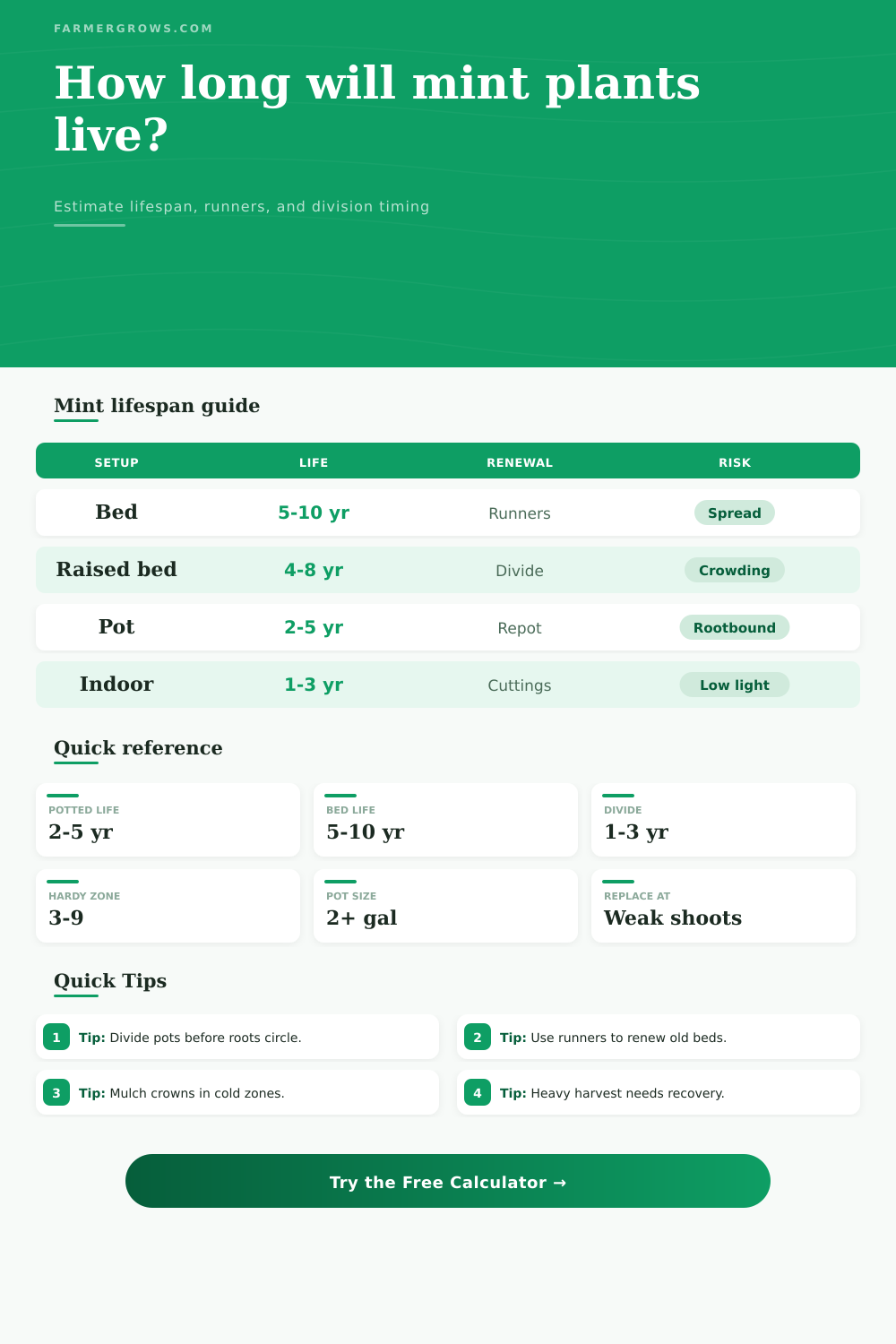
| System | Typical life | Division rhythm | Main limit |
|---|---|---|---|
| Contained bed | 5 to 10 years | Every 2 to 4 years | Spread and crowding |
| Raised bed | 4 to 8 years | Every 2 to 3 years | Dry edges, crowding |
| Large pot | 3 to 5 years | Every 1 to 2 years | Rootbound stress |
| Small pot | 1.5 to 3 years | Yearly | Root volume and drying |
| Indoor pot | 1 to 3 years | Yearly or cuttings | Light and dry air |
| Mint type | Vigor | Renewal | Notes |
|---|---|---|---|
| Spearmint | High | Strong runners | Reliable long-lived patch |
| Peppermint | High | Strong runners | Productive but can thin when crowded |
| Apple mint | High | Fast spread | Needs containment and thinning |
| Chocolate mint | Medium | Moderate | Often best refreshed in pots |
| Variegated mint | Lower | Moderate | Replace earlier if green reversions dominate |
| Container | Best use | Refresh timing | Watch for |
|---|---|---|---|
| Under 1 gal | Temporary plant | 6 to 12 months | Daily drying |
| 1 to 2 gal | Kitchen patio pot | Every year | Circling roots |
| 3 to 5 gal | Outdoor herb pot | 1 to 2 years | Dense crown mat |
| 7+ gal | Longer container stand | 2 to 3 years | Old center decline |
| Bed or box | Runner renewal | 2 to 4 years | Overcrowded runners |
| Signal | Likely cause | Action | Timing |
|---|---|---|---|
| Small leaves | Rootbound or hungry | Divide and feed | Spring |
| Woody center | Old crown mass | Keep young edge runners | Spring or fall |
| Rusty leaves | Disease pressure | Restart clean stock | Immediately |
| Thin regrowth | Overharvest or crowding | Cut less, thin runners | 4 to 6 weeks |
| Winter dieback | Cold or dry roots | Mulch or move pot | Before freeze |
A mint bed can look like one old plant, but the productive part is often a rolling population of younger runner crowns. Keep the youngest, healthiest sections when renovating.
If a pot dries within a day, lifts as one root mass, or produces only small leaves after feeding, divide it instead of waiting for the top growth to fail.
Heavy tea, garnish, or market harvest should leave enough leaf area for regrowth. Mint handles cutting well, but repeated scalping shortens the productive window.
Recurring rust, crown rot, or severe mite pressure can make a fresh plant safer than keeping infected runners in the same crowded soil.
These estimates describe productive garden life, not the absolute biological limit of mint. A protected mint clone can persist much longer through runners, cuttings, and divisions.
Though mint is A hardy plant in the garden bed, it is aggressive, quickly covering earth like a green carpet. It may seem indestructible to you, but there’s all the difference in the world between surviving and thriving, particularly when it comes to quality for eating. The plants’ essential oils decreases; their stems grow woody, and eventually even leaves shrinks. Knowing that mint is naturaly hardy is not necessarily relevant to your set-up. How you grow it makes a big difference.
In a terracotta pot sitting in sunlit window, the mint will suffocate as its roots clog up container. But in ground, the mint crowns renew themselves by sending out runners.
Why Mint Needs Care to Taste Good
To start: Define your situation, and the tool does the rest. It considers factors like division frequency, your winter hardiness zone, and size of container to predict a realistic timeline of when productivity will drop. You don’t have to memorize any complicated gardening math. It just considers whether your mint is in an in-ground bed or a three-gallon pot.
A big difference… Rootbound stress will kill potted herbs. Whatever their fertilizer status, those roots circling tightly don’t take up water well; the leaves gets small and flavorless. If you see that coming, you have time to reset things by repotting or dividing. The calculator alerts you to do this when it is time.
Getting a new crop of mint each year (or any perennial) means getting runners renewed. The young shoots will come up on the runners in open beds, and old crowns will fade away in the middle. Left to its own devices, it creates a solid mass of old wood with little production. Division thins out that woody heart, creating space for new growth. This is also true for raised beds, but the productive growth season is even shorter different than if soil stays moist. Tables of comparisons make all this easy to understand.
What is the difference between a contained patch lasting five or ten years and a little pot on patio needing refreshment once or twice a year? Getting the runners renewed Most of the care, though many people don’t know it, is in winter. Technically mint is a perennial (zones three through nine), provided its roots remains insulated from freezing and thawing cycles. In a pot, soil temperature mirrors what air temperature does, wildly. The top growth may appear okay until spring but there will still be some damage to the root system without insulation and mulch.
Your climate zone gets figured into calculator, which then adjusts estimated lifespan accordingly. If you live in colder area, it probably means dividing plants more often or using better winter protection, such as insulation and mulch, to get that survival score up higher. It’s not about spending less money on plants. It’s about preserving quality. Stressed-out old mint doesn’t taste good; it’s harsh and lacks the bright scents required in tea and mojito drinks. You should of known this.
Then there’s what we do with our harvests. Mint will grow back from a severe haircut, so long as some leaf area remains to make food while it recovers. However, repeated scalping and no time for recovery shorten its lifetime considerably. Since the tool factors in how often plant is harvested, it works for regular heavy use like kitchen work vs. Just picking the odd garnish here and there. With mint, which grows quickly, one can be tempted to over-harvest, but restraint pays in longevity.
No matter what form it takes (root system or crown), there’s no such thing as “forever” with mint. Left on its own, whether in the woody garden or a potted plant, mint declines. Whether shriveled or flavorless… Whether rootbound or otherwise (it’s time to do something about it).
Plan ahead, don’t react: With the help of calculator, you’ll never have tired-looking herbs again; you’ll always know when to start more cuttings, when to divide things up, and when to repot them all. That way your stock remains always flavorful; not shriveled and bland. It is not merely kept alive, but kept useful.
Treated as a renewable resource (not a permanent fixture) mint rewards us with improved results using less effort. The best results comes from planning the dividing schedule. Not waiting until there’s inevitible decline.