Basil Plant Lifespan Calculator
Estimate how long a basil plant may stay alive and productive from basil type, indoor or outdoor setting, flowering pressure, harvest frequency, temperature, light, pruning, and current plant age.
Pick a realistic basil setup, then adjust age, basil type, indoor or outdoor conditions, flowering pressure, pruning quality, harvest style, warm nights, light, and expected frost or cleanup date.
Fast, tender, and productive, but leaf quality drops quickly once flower spikes are allowed to build.
Often tolerates heat and flowering pressure better than sweet basil when tips are cut regularly.
Can stay useful longer in warm protected conditions, especially when harvested as flowering tips.
Light intensity and pruning decide whether an indoor plant regrows or becomes woody and sparse.
Often best replaced in successions instead of forced through a long stressed late-season life.
Basil Plant Lifespan Results
Choose a basil profile and calculate to estimate lifespan, flowering pressure, and productive weeks.
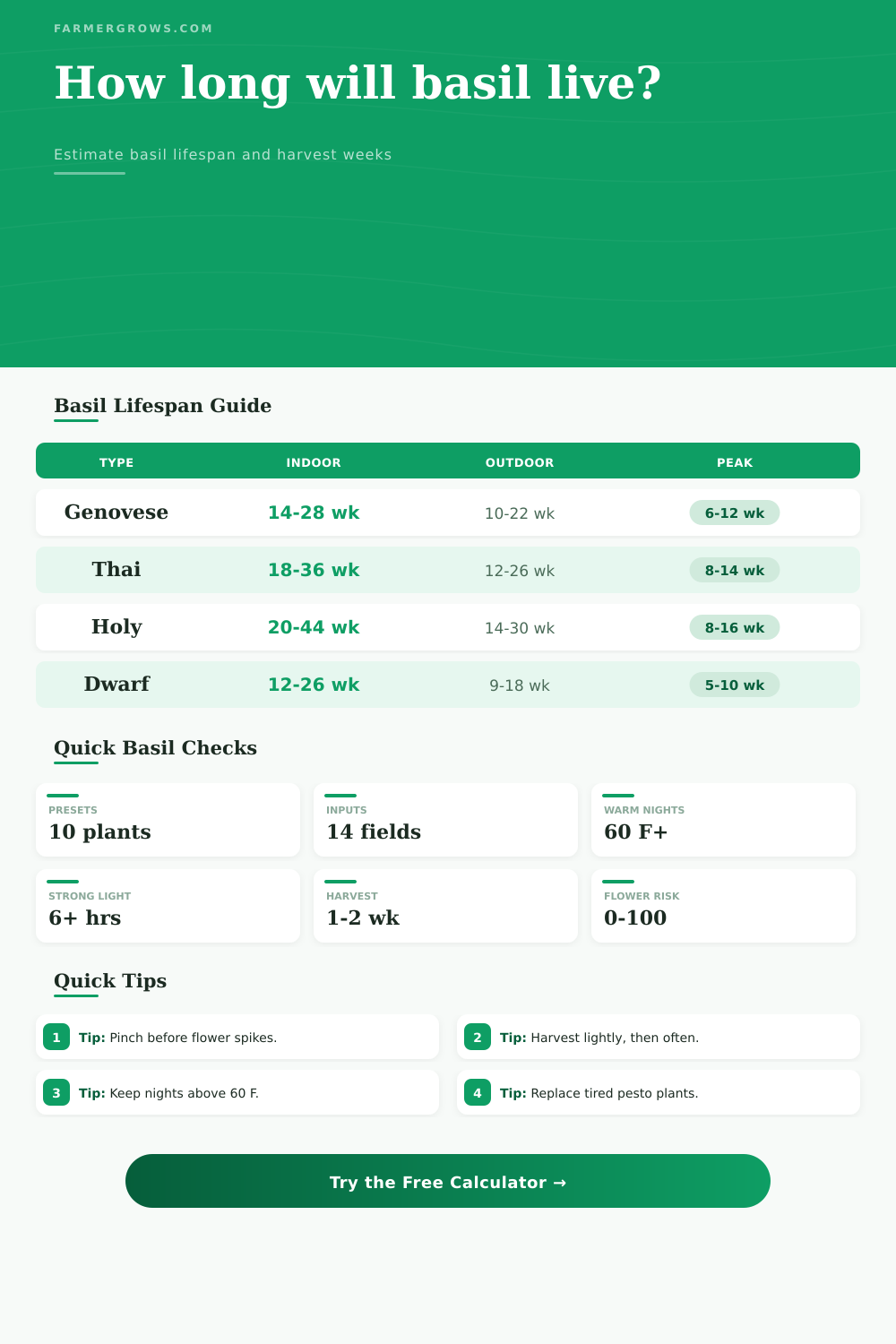
| Basil type | Typical useful life | Productive peak | Lifespan note |
|---|---|---|---|
| Genovese or sweet basil | 10 to 28 weeks | 6 to 12 weeks after strong branching | Best leaf quality before heavy flower spikes; succession planting works very well. |
| Thai basil | 12 to 36 weeks | 8 to 14 weeks in warm weather | Handles heat and flower-tip cutting better than many sweet basil types. |
| Holy basil or tulsi | 14 to 44 weeks | 8 to 16 weeks, often with flowering tips | Can be longer-lived in protected warm conditions if harvested as an herbal flowering plant. |
| Lemon basil | 8 to 24 weeks | 5 to 10 weeks | Often grown as a quick aromatic crop and replaced before stems become tough. |
| Greek dwarf basil | 9 to 26 weeks | 5 to 10 weeks | Compact plants stay tidy in pots but have less cutting reserve than tall basil. |
| Condition | Best range | Lifespan effect | What it changes |
|---|---|---|---|
| Night temperature | 60 to 75°F | Strong positive | Warm nights keep new shoots moving after each cut. |
| Cool nights | Below 55°F | Shortens outdoor life | Cold stress stalls regrowth and may blacken leaves. |
| Day temperature | 72 to 90°F | Best leaf expansion | Moderate heat supports fast regrowth without cooking container roots. |
| Outdoor light | 6 or more sun hours | Longer productive window | Dense branching needs light after each harvest. |
| Indoor LED | 12 to 16 hours | Extends life if warm | Good light can replace seasonal sun better than a window alone. |
| Management style | Productive weeks | Flowering pressure | Best use |
|---|---|---|---|
| Weekly tip harvest | Longest | Low to moderate | Kitchen basil and compact, branchy plants. |
| Heavy cut-and-come-again | Moderate | Moderate | Pesto batches when plants are watered and fed well. |
| Leaf stripping | Short | High | Emergency harvest only; it removes the plant's energy panels. |
| Rare pruning | Short to moderate | High | Ornamental basil or flowering herb tips, not tender leaf production. |
| Flower-tip cutting | Longer for Thai or holy basil | Managed | Use when flowers are part of the harvest instead of a defect. |
| Growing goal | Sow again every | Replace when | Planner note |
|---|---|---|---|
| Kitchen leaf supply | 21 to 35 days | Stems turn woody or flowering dominates | Keep one young pot behind the main plant. |
| Pesto batches | 14 to 21 days | After 2 to 4 heavy cuts | Bulk cutting is productive but ages plants faster. |
| Thai basil sprigs | 21 to 30 days | Flower tips become tough | Cut flowering stems before they harden. |
| Holy basil tea harvest | 28 to 42 days | Plant declines or pests build | Flowering can still be useful if leaves remain healthy. |
| Indoor winter basil | 28 to 45 days | Lower stems bare out | New seedlings beat trying to rescue weak old stems. |
Once basil is covered with open flower spikes, leaf texture and flavor often decline faster than the plant actually dies. The calculator separates lifespan from useful harvest weeks.
Cut above paired leaves, not down to bare stems. Basil needs living nodes and leaf area to push strong replacement shoots.
A window can keep basil alive, but long productive life usually needs strong light for 12 to 16 hours and warm roots.
For sweet Genovese basil, a younger replacement plant often gives better leaves than an old woody plant kept alive past its prime.
MAY: You bought a seedling of basil, planning on turning it into pesto through October. JULY: It’s a lovely green thing, all lush. But somewhere along the way it change into something else. The leaves go pale, get papery-thin and bitter-tasting, and little flower buds forms on each end (you can’t see them, they’re white). And that’s that for most people’s home herb garden.
What everyone thinks is happening: The poor old basil has just grown up and tired out. Fact: Basil doesn’t typically expire from old age; rather, it gets pushed by some stress or other, light, lack of care, whatever, to seed. Know what causes it, and know how to handle it different.
How to Keep Your Basil Alive Longer
Before you drop the harvest on the table, use this page’s calculator to plot out that timeline. Many factor matter, such as how much direct sun the leaves get daily. Consider whether they are indoors under LEDs or outdoors in a patio pot. The variety of basil you grow also matters. Plus, there are some other factors that most people don’t pay attention to: how aggressively you prune and how stable the night temperature are.
Sure, you may think all you need do is keep basil warm by day, but no. Basil is happiest when nights is over sixty degrees F; cool nights slow its post-harvest recovery from any loss of leaf mass. And if it can’t catch up quickly enough, what happens? It bolts. That’s why this tool balance out those environmental pressures with the seedling’s own internal timing.
Not all basil grows at the same rate. Holy and Thai basil is tougher; they tolerate some flowering and also like a little bit of warmth. Their leaves don’t become inedible like Genovese (the classical pesto type) do. Genovese is also famously short-lived once it start to flower. The calculator knows what kind of basil you’re growing, don’t treat a tropical strain like sweet basil if it won’t act the same way!
If you grow dwarf basil on your kitchen window sill, chances are, light is the limiting factor, the issue is weak illumination indoors, forcing the plant into extension mode, elongating its stems but producing fewer leaves. Tell the calculator how many hours a day you’ve got, since the key to a compact, productive plant is less soil quality and more light.
The one area that you can have the most influence over is pruning. Most people make this fundamental error: they take all of the big top leaves (energy factory) right away as-is for consumption now, leaving behind an empty naked stem. You want to cut just above the point at which two leaves meet the stem (called a node). By doing so, you force it to grow more branches, twice as many places for future harvests! Frequent tip harvesting keep it in veggie-growing mode longer, delaying bloom.
How frequently are you planning to cut? Will you be good about pruning? The calculator updates your expected life expectancy with each of these factor. If you pick a “heavy” cutting frequency along with poor pruning, the model will tell you it’ll be shorter-lived. Realistically, it probably would, since few plants ever bounce back from being stripped of their leaves. But there’s strategy involved in timing as well.
If you’re fighting all the stressors, you could get several more months from any individual plant, but at some point the lower stems goes woody and your yield will drop. In the case of some plants, it’s wiser to replace them than save them. That’s where using the succession sowing setting in the tool helps you time your crop rotation. Staggering new seedlings every couple of weeks mean that you always have fresh leaves coming along, which is superior to trying to nurse one old plant along beyond prime.
It is a living timer that responds to you. Basil will reward your attention with plenty of growth, provided it gets light, warmth, and you sharpen your pruning knife. However, it will punish laziness, cold weather, or other neglect by flowering and turning bitter. These are guidelines to help you know when to sow more seed in the pages ahead; treat them as predictions, not a hard-and-fast rule.
And knowing what makes basil decline will slow it way down, so much so that it’s not just surviving but being useful. That’s the point of any gardening effort, not just keeping something alive: making it do something. That shifts all kinds of things in your garden (from spring into frost).