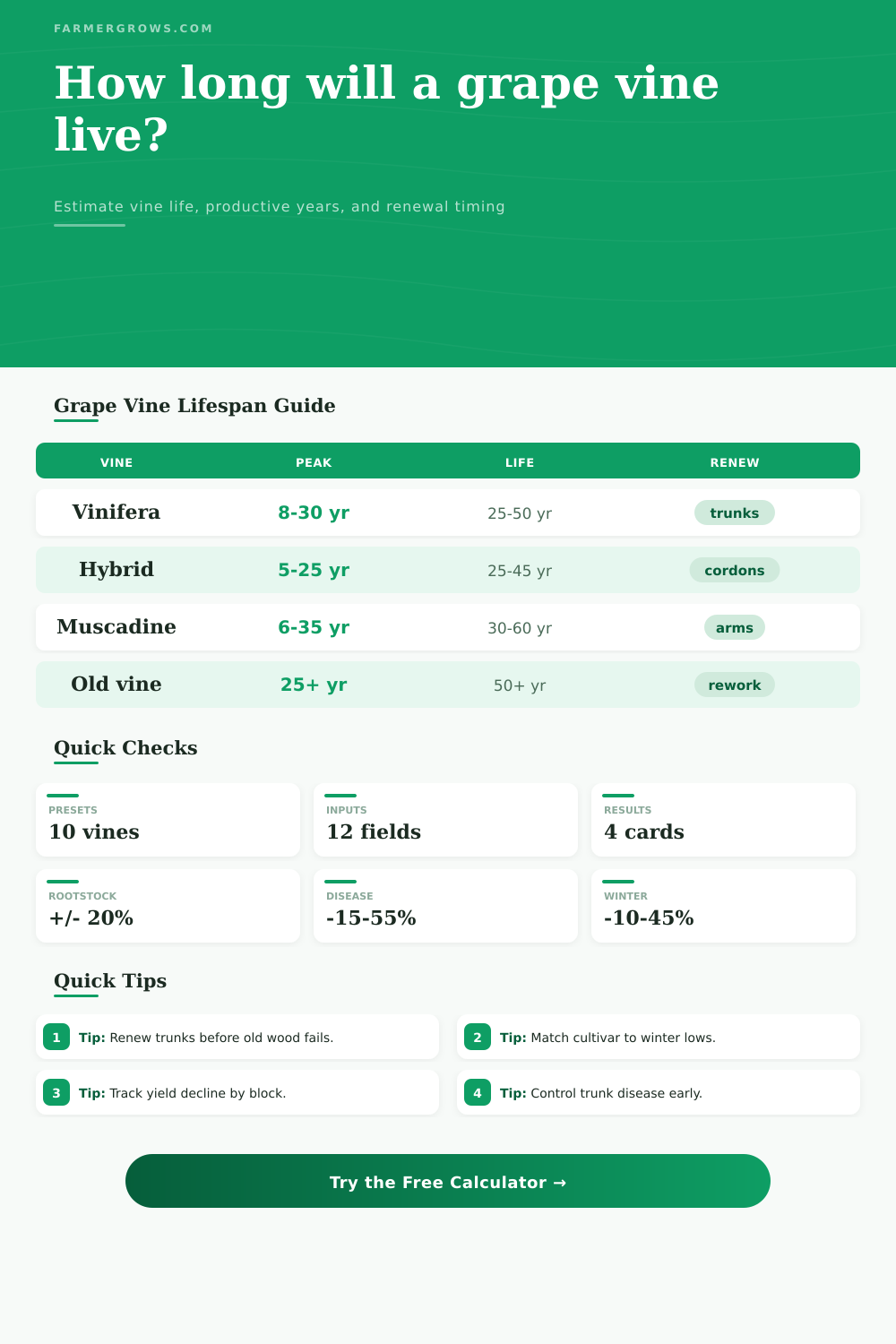
Grape Vine Lifespan Calculator
Estimate how long a grape vine or vineyard block may stay productive using vine age, cultivar group, rootstock, disease pressure, trunk renewal, pruning system, winter injury, and productivity decline.
Load a realistic vineyard profile, then tune cultivar, current vine age, rootstock, trunk renewal, pruning system, winter injury, disease pressure, soil vigor, and productivity trend.
Many managed vines produce for 25 to 50 years, but trunk disease, winter injury, and virus status often decide the real block life.
Cold-hardy and juice types can stay productive for decades when cordons are renewed and canopy density is kept open.
Well-sited muscadines can remain useful a long time, but freeze exposure, crowded arms, and neglected renewal shorten service life.
Age alone is not failure. An old block can be worth keeping if trunks are sound, yield is purposeful, and replacement gaps are planned.
Grape Vine Lifespan Results
Results update as you change the vine profile.
| Vine profile | Typical useful life | Peak productive window | Longevity note |
|---|---|---|---|
| Vinifera wine grapes | 25 to 50 years | About years 8 to 30 | Can last longer, but trunk disease, virus status, and winter injury often define block life. |
| Cold-hardy hybrids | 25 to 45 years | About years 5 to 25 | Good winter fit helps, though crown gall and cordon injury still require renewal wood. |
| Concord and labrusca | 30 to 55 years | About years 6 to 35 | Vigorous vines can be long-lived when high cordons are renewed and canopy density is managed. |
| Muscadine | 30 to 60 years | About years 6 to 35 | Warm-climate durability is strong, but freeze-prone edges and neglected arms reduce useful life. |
| Table grapes | 20 to 40 years | About years 5 to 25 | Cluster quality, vine gaps, pergola access, and renewal pruning often set replacement timing. |
| Old vine blocks | 50 years or more | Site dependent | Low yield can still be valuable if trunk structure, vine spacing, and fruit goals justify retention. |
| System | Renewal strength | Risk if neglected | Best use |
|---|---|---|---|
| Spur-pruned cordon | Renew spurs and cordon sections gradually | Old blind wood, weak positions, and trunk disease spread | VSP wine grapes and high-cordon juice grapes |
| Cane-pruned system | Annual fruiting cane choice can bypass weak wood | Poor cane choice lowers crop and exhausts renewal spurs | Cold-prone vinifera, hybrids, and quality-focused blocks |
| Multiple trunk training | Spare trunks protect against freeze and trunk disease | No replacement trunk when the main trunk fails | Winter-injury sites and crown gall risk blocks |
| Retraining after injury | Can recover a block without full replanting | Yield dip during rebuild and uneven canopy age | Freeze events, graft damage, cordon collapse, or storm injury |
| Signal | Early warning | Serious decline | Replacement cue |
|---|---|---|---|
| Yield pattern | Variable clusters or small berries | Repeated low crop despite good weather | Useful yield no longer meets target block purpose |
| Trunk structure | Small cankers, dead spur positions | Large dead arms, splitting trunks, weak renewal | Renew trunks or replant before gaps dominate |
| Winter injury | Bud kill or cane dieback | Cordon death, crown gall, repeated retraining | Choose hardier cultivar or protected site |
| Missing vines | 5% to 10% gaps | 15% to 25% weak or missing vines | Replant block when gaps make management inefficient |
Trunk renewal: Keep spare trunks or renewal shoots before the original trunk fails. This matters most in cold regions and trunk disease blocks.
Rootstock reality: Grafted vines can manage root pests and soil limits, but scion disease, graft union damage, and canopy imbalance still shorten the useful window.
Winter injury: Repeated bud kill is a production issue, but repeated trunk or cordon injury is a lifespan issue. Treat those separately when planning replacement.
Decline tracking: Record weak vines, missing vines, crop weight, pruning weight, and trunk symptoms each year so replacement timing is based on trend, not memory.
Use local viticulture guidance for cultivar hardiness, rootstock choice, trunk disease diagnosis, virus testing, pest control, and pruning details. This calculator estimates planning timing; it does not replace field inspection.
Treat your vineyards like a ledger, like a living one. Each year you reap its fruit, but so do you when you reap time from it’s roots. It will eventualy die, but what matters more is when it stop producing enough quality juice or wine to pay for its own care.
Most people only begin considering replacing vines once they’ve begun to drop (too late). From a mile away, however, you should of be able to spot the downward trend.
How to Keep Your Vines Healthy and Productive
Once you plug in your variables (the calculator do all the hard work), you no longer need to estimate any coefficients; there are no more guesses at winter-damage or soil-type coefficients. Instead, it makes us see system as a whole, not just the leaves. Often people assess health of the vine based off how green the canopy appears in July, without considering what’s happening beneath the surface… What might be rotting out the trunk (the part they commonly misjudge).
The tool wants to know not only the cultivar group and plant’s current age, but whether there was winter injury or disease pressure. And that matters: Those are the silent killers of longevity. The first thing that sounds boring about rootstock: It’s a boring word. The second thing that make you say “oh” is that rootstocks determine how long your investment lasts.
So if you’re planting in an area free from phylloxera where you can grow on own-root vines, you might get decades of life. But if you have other issues… Drought or nematodes, you’ll rely on a rootstock as your lifeline. The page explains it well, in both words and the accompanying reference table. In short: Rootstocks form a system within the soil that will match the way the soil drains and the strength of the vine.
Vigorous rootstocks on poor-draining soils won’t last; they’ll exhaust themselves quick. And when the roots aren’t finding water? The vine doesn’t invest in fruit; it invests in surviving. That change occur gradually, even unnoticeably, year after year, until it all falls apart.
Woody plants like grapevines scar and accumulate damage (such as freeze splits, crown gall, and trunk disease) that don’t heal up very well. No; they simply grows larger. That’s why it is so important to renew the trunk. Your pruning habits play a heavy role in what the calculator assesses. By keeping spares or old cordons going, you dramatically prolong life of the block.
What happens if you let the wood age beyond its prime? You’re banking on a miracle; and it ain’t worth it. A few hours of careful wintertime pruning buys you a decade or more of production; renewal costs far less then replanting.
Adding a bit more complexity: In colder zones, difference between a good year and a bad one often comes down to whether the buds survives the freeze. But trunk injury caused by repeated weathering is not the same as the kind of damage caused by bud kill. Bud kill means a loss of yield for a season, and trunk dieback means the loss of the vine. Since each requires a different approach in how to manage it, having a way to distinguish is important, and this is what the tool do.
Multiple trunk systems or even high cordons provides options if winter hits hard. However, you will want an easy-to-rebuild training system anyway if winters are tough.
It’s easy to think that a couple of missing vines won’t affect harvest significantly, or that small gaps in a row aren’t a big deal. But missing vine create microclimates that promote the spread of disease. They also make harvesting more difficult which makes the work less efficient. And beyond some critical threshold number of missing vines, the entire block become unmanageable.
The calculator estimates when that tipping point is, based on how quickly the vines are declining according to the percentage of missing vines you see. So it provides a time frame for planning ahead and replanting, but without panic. “Turning a crisis into a schedule,” as they say, “means planning ahead,” which also means that your income doesn’t go down a cliff when you have old blocks and new ones overlapping.
You have to be disciplined about this, walking the rows with a notebook and making notes of where things are weak before it’s obvious. It is tedious, yes. But you get rewards by keeping things stable.
You don’t just want to keep the vines alive; you want to make them pay. Growing vines forever isn’t magic; it’s tending to them. You must make sure they get the right root stock for the ground, keep an eye out for dead wood and replace it, and know when to pull the plug on a block. Begin monitoring the digits while there are still grapes swinging from branches, fat with sweetness.