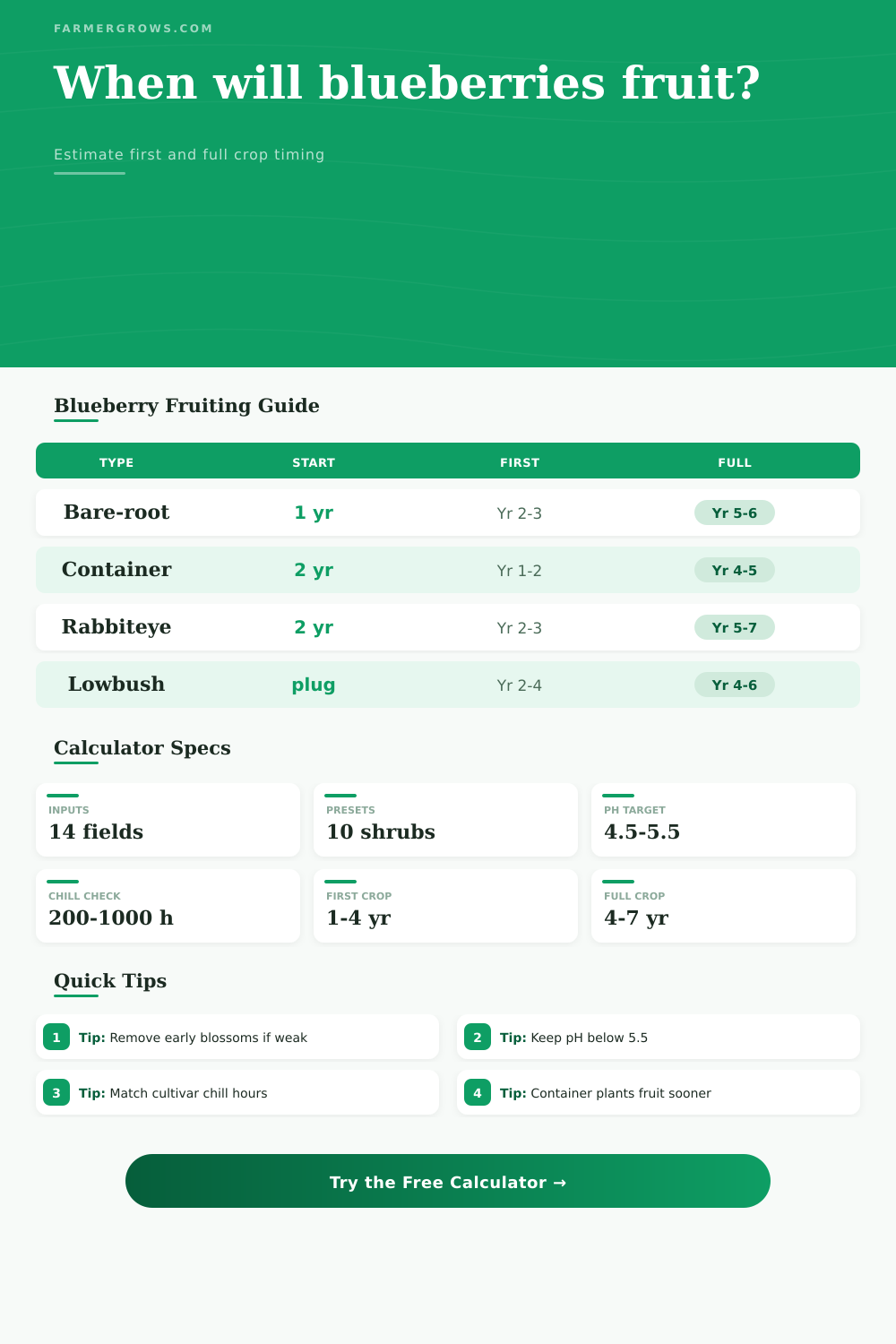
Blueberry Time to Fruit Calculator
Estimate when a blueberry plant may flower, produce its first worthwhile berries, and reach full crop age from plant age, bare-root versus container stock, chill hours, soil pH, cultivar group, blossom pruning, sunlight, and plant vigor.
Load a common planting profile, then tune the exact plant age, container or bare-root start, cultivar group, chill hours, soil pH, blossom pruning plan, and site condition.
A 2-year nursery container plant can be close to a sample crop, while a 1-year bare-root whip usually needs more root and cane growth first.
Container plants keep more roots and often fruit sooner. Bare-root plants are economical, but they commonly spend the first season rebuilding roots.
Highbush, southern highbush, rabbiteye, half-high, and lowbush blueberries need different winter chill ranges to bloom evenly.
Blueberries need acidic soil. A pH near 4.5 to 5.5 supports iron uptake, cane growth, flower buds, and fruit size.
Estimated Blueberry Fruiting Window
Adjust the inputs and calculate to estimate first bloom, first berries, first useful crop, and full crop year.
| Blueberry group | Typical first berries | Full crop age | Chill and climate note |
|---|---|---|---|
| Northern highbush | Often year 2 to 3 from young plants | Usually year 5 to 6 | Commonly needs moderate to high chill and acidic, well-drained soil |
| Southern highbush | Often year 1 to 3 depending on plant size | Usually year 4 to 6 | Lower chill selections suit mild winters but still need acid soil |
| Rabbiteye | Often year 2 to 4 with a compatible partner | Usually year 5 to 7 | Vigorous shrubs need cross-pollination for best set and berry size |
| Half-high | Often year 2 to 3 | Usually year 4 to 6 | Cold hardy, compact, and commonly used in northern home gardens |
| Lowbush | Often year 2 to 4 from plugs or divisions | Patch fills over year 4 to 6 | Patch density matters as much as individual plant age |
| Dwarf patio cultivar | Often year 1 to 2 from container plants | Usually year 3 to 5 in a large pot | Water and pH swings can delay fruit more than genetics |
| Chill fit | Local hours vs need | Likely bloom effect | Calculator effect |
|---|---|---|---|
| Excellent | Meets or exceeds need by 100+ hours | Compact bloom and stronger budbreak | Higher confidence and normal timing |
| Close | Within about 0 to 100 hours short | Usually workable, but bloom may stretch | Small delay and mild confidence loss |
| Marginal | 100 to 250 hours short | Uneven bloom, fewer flowers, weaker set | Adds a season risk and lowers confidence |
| Poor | More than 250 hours short | Repeated poor bloom is possible | Major delay and low confidence warning |
| Soil pH | Blueberry response | Fruiting impact | Planning note |
|---|---|---|---|
| 4.5 to 5.2 | Ideal to very good | Supports normal cane growth and flower bud formation | Keep mulch acidic and avoid alkaline irrigation buildup |
| 5.3 to 5.5 | Usually acceptable | Minor delay risk if nutrition and moisture are good | Monitor new leaves for yellowing between veins |
| 5.6 to 6.2 | Marginal | May delay fruiting through weak growth and iron lockup | Correct before expecting full crop potential |
| Above 6.2 | High risk | Can stop useful crop development even on older plants | Use acid mix, sulfur planning, or containers where practical |
| Scenario | First crop expectation | Full crop expectation | Watch point |
|---|---|---|---|
| 1-year bare-root highbush | Light berries in year 2 or 3 if blossoms are kept later | Year 5 or 6 after planting | Remove first-year flowers and build roots first |
| 2-year container highbush | Sample berries in year 1 or 2 | Year 4 or 5 after planting | Do not var a small pot dry during fruit fill |
| Rabbiteye pair | Usually year 2 or 3 from strong plants | Year 5 to 7 | Use overlapping cultivars for better fruit set |
| High pH soil correction | Delay until pH and vigor improve | Full crop moves later if chlorosis persists | pH can be more limiting than plant age |
| Renovated old bush | Reduced crop during renewal year | Usually rebuilds over 2 to 3 seasons | Keep enough young canes for next year's flower buds |
Blossom pruning matters: Removing flowers the first year can feel slow, but it usually shifts energy into roots and new canes that carry later crops.
Container plants are not magic: A large container plant may fruit quickly, but tight roots, dry pots, and high-pH water can still delay full production.
Chill mismatch shows in bloom: If buds open unevenly after mild winters, a lower-chill cultivar may be more useful than waiting for plant age alone.
pH drives the clock: Blueberries with yellow new leaves and weak cane growth often need root-zone correction before any fruiting estimate becomes realistic.
This calculator gives planning estimates from common blueberry bearing ranges. Local cultivar genetics, pruning, late frost, pollination, soil moisture, root disease, salinity, pH testing accuracy, and winter weather can move real harvest dates.
Plenty of hope, but zero patience. That’s what fruit gardening is all about. It involve planting a blueberry or any other kind of fruit shrub or tree, and it’s a universal experience. You are thinking about berries right now! What the plant has in mind: Wait till I get some roots down first. And so the whole growing season becomes a tug-of-war between your hunger and plant’s biology.
Yes, part of it is waiting X number of years before the thing bears. No, part of it is understanding a complicated series of environmental conditions necessary to turn those earliest buds into flowers and then into fruit. This online calculator take you beyond just counting years to figure out that timing.
How to Know When Blueberries Will Grow
When people buy blueberry shrubs, most are thinking only about age: The one-year-old bare-root whip seems too weak to produce now; the two-year-old in a container will be ready right away. True enough, though we’re overlooking what happens behind-the-scenes as roots gets established. Because those container trees come with all their roots intact, they can starts producing flowers (and shoots) earlier. That’s not true of the bare-root, which spends its initial year re-creating belowground infrastructure. It is a sacrifice for the greater good! Long-term strength depends on it. To adjust accordingly, the tool takes into account not just the tree’s age, but nature of the stock itself (container or bare root).
But then there’s winter chill. Blueberries are temperamental shrubs; they needs to get a certain number of cold hours in order to reset their hormonal clocks and wake up in time. No, they’re not tropical plants who just want sunshine all day long. Without enough chilling hours in your area, the bloom will be weak and erratic. Yes, maybe you’ll even have some flowers, but then what? They falls off before the process of fruiting starts. The calculator compares the chilling hours you’d expect with actual requirement of your cultivar group. This way, you won’t waste time thinking it’s just bad luck, when it is actualy a genetic mismatch between your plant and your weather patterns.
Growth depends heavily on soil pH. Because blueberries are acid-loving plants (they love acid soil, with soluble iron as one example of why), if the pH creeps up past five-five, it basically locks out those nutrients from the soil. And then the plant yellows, and stops producing new canes which bear the flower buds for the coming year. This means there is no new wood, which mean there is no fruit. A physiological trap, and it takes a while to untangle. The tool will assess your soil acidity plus your plan for fertilizing, and alert you when there’s a risk of that happening. It give you a realistic confidence score instead of generic timeline.
Timing also gets pushed by pruning choices. If you’re hungry for a snack you might be tempted to leave on the first-year blossoms… But it’s an emotional cost of what comes later. You’ll get less fruit next year (and a weaker root system) from keeping initial flowers. Whether you intend to leave a modest number of bloomers or lop off every one, enter that choice into the calculator and it will recalculate the expected date of full maturity and when to expect some first fruit.
And then there’s the whole pollination thing. Most blueberries aren’t self-fertile, not really. They require a matching neighbor for proper fruit set; they must be cross-pollinated. You may have noticed a lot of open flowers but few berries developing without such cross-pollination, and the tool accounts for that in its confidence rating. It reminds you: Biology is a team sport.
With those two factors combined you get a better idea than if you just guessed: “I’m 20 years old.” It’s a profile you create for your particular situation. For example, it considers the soil chemistry. It looks at what kind of winters it gets. It also considers whether you are willing to plan to prune for long-term benefit. The range of tables in the references indicates typical ranges for various types of blueberries. They reflect differences in rate of maturity between highbush or rabbiteye varieties, for instance.
With those factors understood, you no longer wonder “why isn’t this plant moving?” You know how to fix what’s slowing it down. In turn, you begin managing your waits as a tactic rather than a passive state. When the chemistry and the roots are ready (the berries will be ready). Be patient, but understand why you are waiting.